


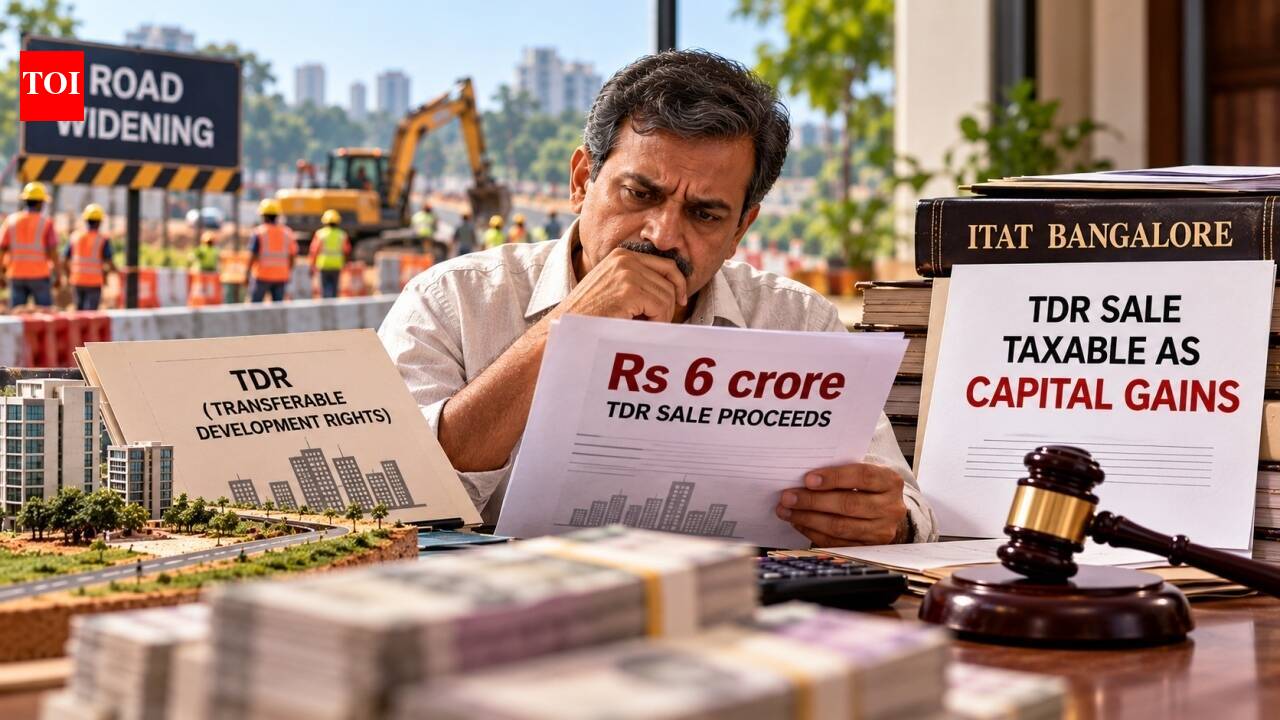
You get Transferable Development Rights from the government by giving up a part of your land and sell them to a builder. Are you liable to pay capital gains tax?In one such case a landowner received Transferable Development Rights (TDRs) but assumed them to be capital receipts. The Income Tax Department sent him a notice.
What the case is about
When the Bruhat Bengaluru Mahanagara Palike (BBMP) approached the landowner to acquire a portion of his property for road widening, he agreed to surrender the land. In return, he received TDRs, which are certificates that are issued to landowners when the government takes over privately owned land for public purposes.Also Read | Rs 5.2 crore cash deposit, but Rs 7.65 lakh shown in ITR: Grain trader wins tax case after ITAT quashes notice, finds bank account was disclosed in Form 3CDThese rights can be used to construct additional floors on another property or sold to builders who want to undertake development projects, according to an ET report.The landowner chose to sell the TDRs he had received for surrendering 2,839 square metres of land. He sold them to a builder for Rs 6 crore but did not pay income tax on the proceeds. His understanding was that the amount received from the sale was a capital receipt and was therefore not taxable.The Income Tax Department, however, took a different view. The Deputy Commissioner of Income Tax in Koramangala, Bengaluru, sought to bring the entire Rs 6 crore within the tax net and levy capital gains tax on the amount.Disputing the department’s position, the landowner challenged the decision before the National Faceless Appeal Centre (NFAC) in Delhi. The NFAC dismissed his appeal on July 8, 2025, prompting him to approach the Income Tax Appellate Tribunal (ITAT), Bangalore.Also Read | Builder promised to pay stamp duty on Rs 1.6 crore plot, later called it a typo; MahaRERA orders him to pay charges plus interest for delayed possession to buyer
Why did the landowner lose the case?
The tribunal delivered its ruling on August 14, 2026. While the landowner secured some relief, he largely lost the case, with the ITAT Bangalore holding that the sale of TDRs was taxable as capital gains.It directed the Assessing Officer (AO) to allow him credit for the cost attributable to the land surrendered in exchange for the development rights.Chartered Accountant Suresh Surana told ET: “The ITAT Bangalore rejected the landowner’s assumption that he doesn’t need to pay tax on TDRs, as they have no ascertainable cost of acquisition and thus are essentially a capital receipt not liable for tax.”The tribunal did not accept this argument. It held that TDRs qualified as capital assets and that the proceeds from their sale were subject to capital gains tax.To support his contention that TDRs should not be taxed, the landowner had cited the Supreme Court’s judgment in B.C. Srinivasa Setty and the Bombay High Court’s ruling in Sambhaji Nagar Co-operative Housing Society Ltd.However, the ITAT Bangalore distinguished these judgments on the basis of the facts involved. It explained that cases such as Sambhaji Nagar concerned self-generated development rights.Also Read | Delhi couple repaid Rs 1.41 crore home loan, but the bank lost their original sale deed property papers; consumer commission orders Rs 15 lakh compensation plus Rs 50,000 costsIn those cases, taxpayers gained additional development potential because of changes in development regulations, without surrendering a separately identifiable asset in return.The tribunal found that the landowner’s case was different in a material respect. He had given up an identifiable and valuable asset, namely his land and building, to obtain the TDRs.On this basis, the ITAT Bangalore treated the transaction as having two distinct stages. In the first, the landowner surrendered his land to BBMP and received TDRs in exchange. In the second, he sold those development rights for cash.The ITAT Bangalore held that Section 2(47), which includes an exchange within the definition of a transfer, applied to the transaction.The TDRs received by the landowner were therefore capital assets acquired in exchange for the land he surrendered. The tribunal concluded that he had paid for the TDRs through the surrender of his property.Surana said: “Consequently, the capital gains computation mechanism did not fail, and the Rs. 6.02 crore received on their subsequent sale could not be treated as an exempt capital receipt.”The landowner also pointed out that his brother had received consideration for similar TDRs and that the Income Tax Department had accepted the amount as exempt while assessing his brother’s income.Also Read | He moved to Canada and rented his Punjab house for Rs 20,000 a month, then sought eviction to use it during India visits; Punjab & Haryana HC rules against landlord, allows tenant to stayHowever, the ITAT Bangalore did not consider the treatment given to his brother’s case sufficient grounds to grant the landowner the same tax exemption. As Surana explained, the tribunal observed that an assessment order concerning another taxpayer does not permanently bind the Income Tax Department. This is particularly relevant where a claim may have been accepted without adequately examining the applicable facts and legal provisions.While the ITAT Bangalore rejected the landowner’s argument that the TDR sale was not taxable, it did not accept the Income Tax Department’s position on the cost of acquisition without further consideration.Since the landowner had received the TDRs in return for surrendering 2,839 square metres of land, the cost attributable to that land had to be taken into account while calculating his capital gains.The tribunal found that the AO had failed to provide for the cost associated with the 2,839 square metres surrendered to BBMP.The ruling means Talera is liable to pay tax on the capital gains arising from the transaction, but this does not automatically make the entire Rs 6.02 crore sale proceeds taxable. The AO must first calculate the appropriate cost attributable to the surrendered land and account for that amount, along with any other deductions permitted under Section 48, before determining the taxable capital gain.Also Read | Man had Rs 2 crore bank deposit and didn’t file ITR, faced Rs 2.51 crore tax addition; ITAT Chennai quashes reassessment after Income Tax Department missed 6-year deadline by 5 days

