


Warns India against weaponising water, says any attempt to stop Pakistan’s water will be treated as ‘act of war’
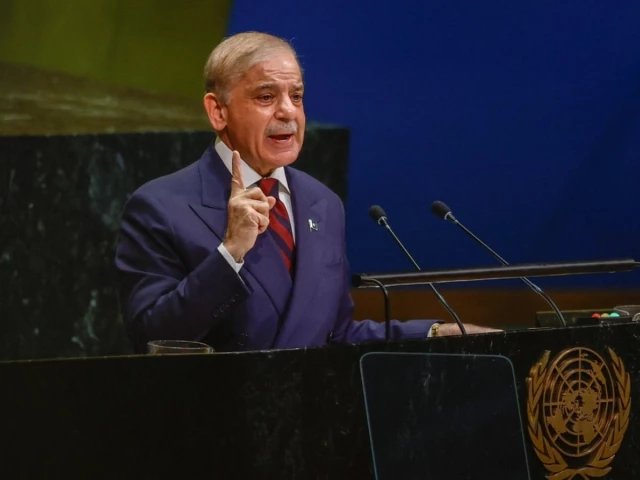
Prime Minister Shehbaz Sharif addresses the 81st United Nations General Assembly (UNGA) at UN headquarters in New York City, US, September 25, 2026. Photo: Reuters
Prime Minister Shehbaz Sharif on Friday denounced Israeli aggression against Lebanon and Syria while also condemning attacks on Saudi Arabia, warning the safety and sanctity of the Haramain Sharifain was a “red line that must never be crossed”.
Addressing the 81st session of the United Nations General Assembly in New York, the prime minister highlighted the US-Israel attack on Iran, which he said led to the resumption of the war earlier this year, calling it an “unfortunate incident”.
“Unfortunately, conflict engulfed the Gulf along with the wider Middle East. Precious lives were lost, economies suffered, critical maritime routes, particularly the Strait of Hormuz, came under severe pressure,” he said, highlighting Pakistan’s efforts to resolve the conflict.
Pakistan brought US, Iran ‘under one roof’: Shehbaz
He said that at the critical juncture, Pakistan had chosen to act swiftly and successfully brought Washington and Tehran “under one roof”.
“From the Islamabad talks to the Islamabad memorandum of understanding, many historic steps were taken to bring an end to this serious conflict,” he said.
The prime minister, who was speaking at the session for the fourth consecutive year, also appreciated the efforts of Chief of Defence Forces and Chief of Army Staff Field Marshal Asim Munir, saying his “relentless efforts” had helped create space for diplomacy while also hailing the efforts of the Deputy Prime Minister and Foreign Minister Ishaq Dar.
Regretting the dangerous surge in hostilities and drone strikes, he said the voice for diplomacy must “echo even louder and stronger”, stressing that the Strait of Hormuz and Bab-el-Mandeb were arteries of the global economy and must remain open.
“The Strait of Hormuz and Bab-al-Mandeb are arteries of the global economy; they must remain open,” he said, adding that nations connected through these routes must not allow them to become “choke points of confrontation”.
Makkah pact not against any country: PM Shehbaz
The prime minister categorically condemned the recent Houthi strikes against Saudi Arabia, saying the attempted drone attack on the holy city of Makkah had outraged Muslims across the globe.
“Any threat to the safety and sanctity of the Harmain Sharifain is a red line that must never be crossed. No Muslim can even dare to think of committing such a heinous crime,” he said.
He said Pakistan stood in “complete solidarity” with the brotherly people of Saudi Arabia, “as we always have throughout our history”.
Discussing the Makkah Joint Defence Agreement between Pakistan, Saudi Arabia and Türkiye, the prime minister said the alliance was not directed against any country.
“It is a collective commitment for defence, stability and peace in the region and nothing more,” he added.
Talking about the skirmish with New Delhi in May last year, Prime Minister Shehbaz Sharif said Pakistan had faced external aggression from India under a “false pretext” and had exercised its inherent right to self-defence under Article 51 of the United Nations Charter.
“Our brave and valiant armed forces, under the courageous leadership of Field Marshal Asim Munir, responded with precision and professionalism. They silenced the enemy, repulsed its attack and taught it a lesson it shall never forget,” he said.
He once again thanked US President Donald Trump for “saving millions of lives in South Asia” through his timely intervention in the conflict, which, he said, had brought the two nuclear-armed nations to the brink of an all-out war.
“And who knows the extent of devastation that could have taken place had President Trump not stepped in at this critical moment with clarity of thought and action,” he said.
Kashmir remains Pakistan’s ‘jugular vein’: Shehbaz
The prime minister said South Asia must not reach that “precipice” again, but added that this required a “just and fair solution” to the Jammu and Kashmir dispute.
“For eight decades, the people of Kashmir have waited for the United Nations to fulfil its solemn commitment of a free and impartial plebiscite under its auspices,” he said.
He also highlighted what he described as illegal occupation, arbitrary detentions, extrajudicial killings, enforced disappearances, sexual violence and collective punishment endured by the Kashmiri people in the occupied territory.
“Helpless Kashmiri mothers and fathers yearn for their sons and daughters who never return,” he said.
“Their homes lie silent — under curfew and in grief. For many, there is no closure — only a lifetime spent searching for graves that bear no names,” the premier added.
PM Shehbaz also highlighted the attempts to alter the legal status of Jammu and Kashmir through “demographic re-engineering” and other illegal measures.
He assured the Kashmiri people that Pakistan would continue to extend its “full diplomatic, political and moral support” until they were granted their right to self-determination.
“Kashmir has, and always will be, Pakistan’s jugular vein,” he said.
Any attempt to stop water ‘act of war’: PM Shehbaz
Turning to the Indus waters, which India suspended following the Pahalgam attack in Indian Illegally Occupied Jammu and Kashmir, the prime minister said water should never be weaponised.
“The shared waters of the Indus River system are the lifeblood, not only for the people of Pakistan, but for the entire region,” he said.
He said India’s unilateral decision to hold the existing treaty in abeyance had “no legal basis whatsoever”, adding that the treaty remained “valid, binding and fully operative”.
The prime minister warned that any attempt to stop, impede or divert Pakistan’s share of water under the Indus Waters Treaty would be treated as an “act of war”.
“India must make no mistake about it,” he said.
He also expressed concern over what he called an alarming rise in Islamophobia, saying Muslims faced hate speech, discrimination, attacks on mosques and desecration of the Holy Quran.
He alleged that the RSS-driven Hindutva ideology in India was fuelling religious hatred and leading to lynching, communal violence, attacks on places of worship and restrictions on religious freedom.
He also referred to the demolition of a 150-year-old mosque in Saharanpur earlier this month as a “case in point”.
“Religious hatred must have no place in this world,” he said.
Demands justice for Palestinians
The prime minister was particularly grieved over the situation in Palestine where he said generations of Palestinians, particularly women, children and the elderly, had suffered occupation, eviction and violence.
Recalling his address to the General Assembly the previous year, he referred to Hind Rajab, whom he described as an innocent Palestinian girl who was killed by Israeli soldiers.
“This year, another tragedy weighs heavy on the heart,” he said, referring to eight-year-old Wafaa Akila.
“Does not a child born in Gaza deserve the same life, and the same future, as a child anywhere else in the world?” the prime minister asked.
While expressing concern over the spread of violence to the West Bank, he said the forcible eviction of Palestinians reflected what he described as Israel’s “genocidal agenda”.
Pakistan, he said, believed the only “just and lasting solution” was the creation of an independent, sovereign, viable and contiguous Palestinian state based on the pre-1967 borders, with Al-Quds Al-Sharif as its capital.
He also condemned continued Israeli aggression against Lebanon and Syria, calling for an immediate end to it.
Shehbaz calls for ‘verifiable, decisive action’ against terrorists
Describing terrorism as one of the gravest threats to international peace and security, the prime minister said Pakistan had stood on the frontline of the fight against militants, confronting them in its cities, mountains and along its frontiers.
“Pakistan has sacrificed almost 100,000 precious lives and suffered economic losses exceeding 150 billion dollars,” he said.
He said the world was safer today because of the sacrifices of Pakistan’s armed forces and civilians who had fought terrorism.
“The peace-loving world must never forget this reality,” he said.
The premier said that Afghan territory continued to be used by the TTP, Fitna-al-Khawarij and the BLA, Fitna-al-Hindustan and described them as foreign-funded groups operating from sanctuaries inside Afghanistan to destabilise Pakistan.
“All such attacks, including incursions from the territory of Afghanistan, must come to a grinding halt,” he said.
Shehbaz urged Afghanistan’s Taliban government to fulfil their international commitments and take “verifiable, decisive action” to ensure that Afghan soil was never again used against Pakistan or any other country.
On the economy, the premier described economic revival as a “defining responsibility” of his government, saying Pakistan had embarked on difficult but necessary reforms to restore macroeconomic stability and lay the foundations for sustainable, inclusive growth.
He said the government was modernising agriculture and industry, developing mineral resources, digitalising the economy and equipping young people with skills in artificial intelligence and information technology.
Pakistan was also opening new avenues of cooperation with China through the China-Pakistan Economic Corridor, as well as with the Gulf and Central Asia, he said.
Shehbaz also praised Chinese President Xi Jinping for spearheading the Global Development Initiative, Global Security Initiative, Global Civilisation Initiative and Global Governance Initiative.
“On these pillars, we can surely build a shared future for mankind,” he said.
Urges world to choose peace over war
Turning to climate change, Shehbaz highlighted the disproportionate burden faced by developing countries, particularly Pakistan.
“Is it not an irony of fate that Pakistan contributes less than one per cent of global emissions, yet repeatedly bears the horrific consequences of climate change?” he asked.
He urged developed countries to honour their climate-finance commitments, provide funding for loss and damage and support adaptation and resilience efforts.
Concluding his address, Shehbaz said the world was passing through a “dangerous moment”, but its future remained a matter of choice.
“War is a choice. Peace is also a choice,” he said, adding that the greater courage lies not in starting a war — but in preventing one.
“Pakistan has made its choice. We have chosen dialogue over confrontation. We have chosen cooperation over coercion. We have chosen peace over war,” he said and urged the General Assembly to make the same choice “for ourselves, for our children, and for generations yet unborn”.

