


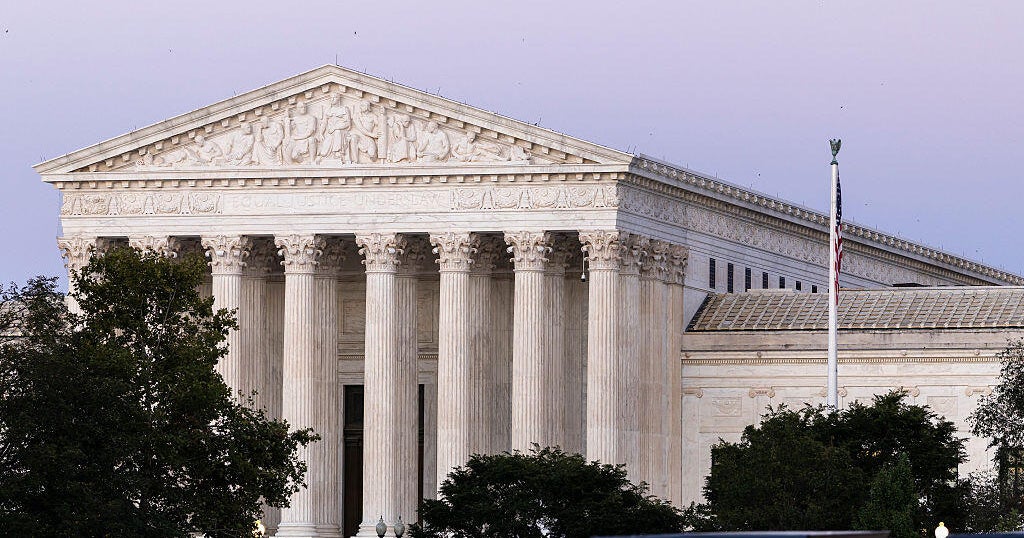
Washington — The Supreme Court on Friday sided with the Trump administration in its push to use a controversial database to review state voter rolls for potential noncitizens, pausing for now a lower court order that found that expanded system violated federal privacy laws.
In a 6-3 decision, the justices granted a request for emergency relief from the Justice Department to stay a June ruling from a judge in Washington, D.C. The judge had blocked the Department of Homeland Security’s overhauled database — called the Systematic Alien Verification for Entitlements, or SAVE, system — which the administration allows states and localities to use to verify citizenship and immigration status of registered voters.
U.S. District Judge Sparkle Sooknanan found that the Trump administration “knowingly trampled on the privacy rights of American citizens in a manner that threatens the sacred right to vote” through the overhauled SAVE system.
The potential impact of the Supreme Court’s decision for the upcoming midterm elections is likely to be limited, as federal law bars states from systematically removing ineligible voters from their voter registration lists within 90 days of an election. The Nov. 3 general election is less than 40 days away.
The Supreme Court said in its unsigned decision that claims from voting rights groups about the legality of the modified database “likely lack merit,” and said it is likely to reverse the district court’s finding that the Trump administration violated federal law with the revamped system.
Under immigration law, “the Federal Government has an obligation to respond to requests from state and local election officials seeking to verify the citizenship of voters,” the court said in its unsigned decision. “The order below prevents the Federal Government from using the program it believes is best suited to the task.”
The high court said that the district court’s decision blocking use of the expanded database, including for individualized inquiries, “inhibits the Federal Government’s efforts to assist state and local agencies in the proper administration of the midterm elections.”
Justices Sonia Sotomayor, Elena Kagan and Ketanji Brown Jackson dissented. Jackson wrote in a dissenting opinion that states could still use the revamped system to conduct individualized voter-roll maintenance.
“[T]he harm caused by burdening or disenfranchising even a few lawful voters outweighs the nonexistent harm that the Government experiences when it is prevented from taking an action that it likely lacks the authority to take,” Jackson, who was joined by her fellow liberal colleagues, wrote.
The system is part of President Trump’s government-wide push to find evidence of widespread voting by noncitizens in federal elections, which has largely been debunked and shown to be very rare.
Voting rights groups challenging the overhauled database have warned that the modified database provides inaccurate citizenship data to states. As a result, some of their members have had their voter registrations wrongfully canceled, they said.
“Today’s decision is profoundly disappointing, as it puts millions of Americans at risk of being unlawfully targeted by the administration’s unreliable voter purge database weeks before the midterm elections,” the coalition of plaintiffs said in a statement. “However, this case is not over. The D.C. district court ruled that the expanded SAVE program violated multiple laws. We will be doing everything in our power to protect Americans’ voting and privacy rights by ensuring that the district court decision stands.”
The Department of Homeland Security cheered the decision as a “victory for election integrity.”
“It’s remarkable that we had to file an emergency petition in the Supreme Court just so we can use government data to stop noncitizens from voting illegally,” James Percival, Department of Homeland Security general counsel, said in a statement. “American elections are for Americans. The Trump Administration and the Department of Homeland Security will use every tool at our disposal to secure our elections.”
The SAVE database
The SAVE database was modified in response to an executive order signed by Mr. Trump in March of last year that sought to impose a new proof-of-citizenship requirement for those registering to vote. Federal judges have since blocked the citizenship-related rules.
The order directed DHS and the Social Security Administration to create a database that would allow state and local officials to verify the citizenship or immigration status of individuals trying to register to vote or who are already on state voter rolls.
The directive triggered the overhaul of the existing SAVE system, which is used by states to check eligibility for certain public benefits and licenses. It was expanded to include the records of natural-born citizens; to access records from the SSA, including Social Security numbers; and to permit bulk searches of records by entities that use the database.
In response, the League of Women Voters, the Electronic Privacy Information Center and five individuals sued DHS, the SSA and the Department of Justice, arguing that the consolidation of Americans’ sensitive records from multiple agencies was unlawful. They argued that some states had partnered with the federal government to run their voter databases through the SAVE system, and U.S. citizens falsely identified as noncitizens were incorrectly removed from voter rolls.
In court filings, the Trump administration argued that the SAVE system, which has been in place in some form since 1986, was being used with “clear congressional directive to break down information silos between government agencies.” It also said that instances of improper removal of voters were rare.
Sooknanan, however, rejected the Trump administration’s arguments in a June ruling, saying they “border on the absurd.” The administration, she said, “haphazardly combined and repurposed the private information of millions of Americans, including citizenship data that they knew to be unreliable,” leading some states to remove U.S. citizens from their voter rolls “based on inaccurate information.”
The judge said the overhauled system and related notices from DHS and the SSA were “contrary to law, arbitrary and capricious, in excess of statutory authority, and without observance of procedure required by law.”
Early this month, the U.S. Court of Appeals for the D.C. Circuit denied the Trump administration’s request to pause Sooknanan’s order, after which the Trump administration went to the Supreme Court for relief.
In filings with the court, Solicitor General D. John Sauer called Sooknanan’s ruling “indefensible” and said it “threatens the integrity of upcoming elections.” He also said the judge exceeded her authority and that the voting rights groups that brought the initial lawsuit did not have the legal right to sue.
“SAVE does not disqualify any voter; instead, it merely notifies the States whether the federal government can confirm citizenship,” Sauer wrote. “Thus, any voter injury is caused by the States, not by the federal government, and would not be redressed by the relief the court entered against the federal government.”
In response to the government’s request, lawyers for the plaintiff groups argued in court filings that “Congress has not authorized the federal government to create a master database of U.S. citizens,” and said the government “has recklessly created an error-laden master citizenship database that endangers millions of Americans’ privacy and voting rights.”

