


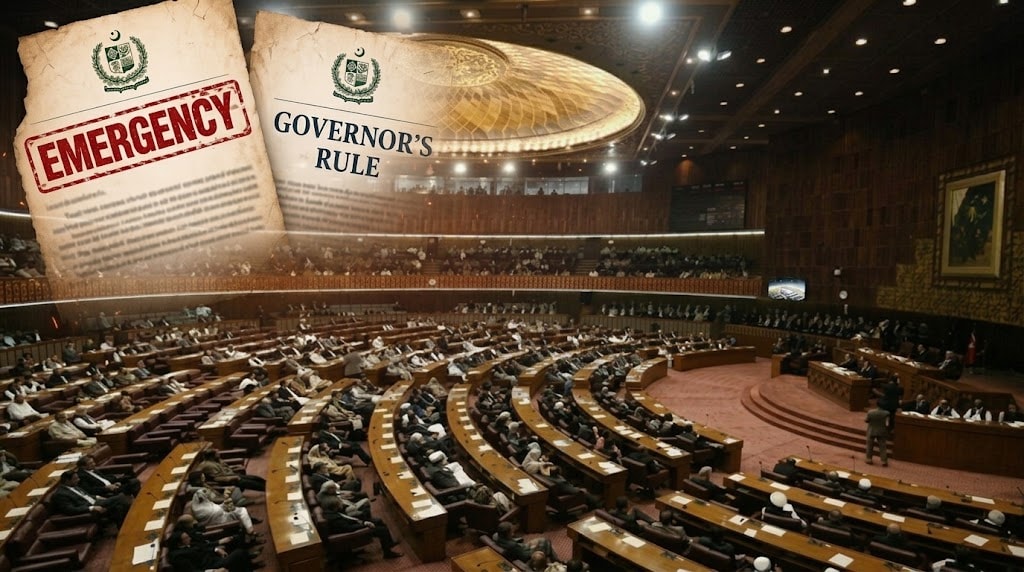
ISLAMABAD – The federal government moved to secure parliamentary approval for emergency and Governor’s Rule in Khyber Pakhtunkhwa, as tensions escalate between Centre and the Pakistan Tehreek-e-Insaf (PTI)-led provincial leadership.
The matter was brought before National Assembly on October 14, after the reported imposition of emergency measures and Governor’s Rule by President Asif Ali Zardari on October 11, on the advice of Prime Minister Shehbaz Sharif.
The move, taken under Articles 232 and 234 of the Constitution, curtailed PTI provincial government’s power, transferring authority to Governor Faisal Karim Kundi. The federal government also invoked Article 245 to direct the armed forces to assist the governor.
The decision triggered fierce political opposition, with PTI and other critics describing the action as an attempt to remove an elected government and a violation of constitutional principles.
Federal Minister for Parliamentary Affairs Tariq Fazal Chaudhry moved resolution seeking parliamentary approval for the emergency during a National Assembly session chaired by Speaker Ayaz Sadiq on Wednesday. The question hour was suspended to take up the matter, underlining the urgency attached to the government’s attempt to obtain legislative endorsement.
Similar proceedings were expected in the Senate on the same day. Under the constitutional framework outlined in the reported proceedings, Parliament must approve the emergency within the prescribed 10-day period if the provincial assembly has not passed a supporting resolution.
The deadline has been cited as October 21, making the coming days crucial for the federal government as it seeks to establish parliamentary backing for its decision.
Defending the move in Parliament, Law Minister Azam Nazeer Tarar said the provincial administrative system had not been dismantled but the provincial government had been rendered inactive. He argued that rising terrorism, internal disturbances and cross-border infiltration had created a situation that threatened national security and required extraordinary measures.
Tarar also accused Chief Minister Sohail Afridi of prioritising political activities, including visits and the planned Islamabad march, instead of standing with families affected by terrorism and the relatives of security personnel killed in attacks.
The law minister maintained that the federal government had explored political and constitutional solutions through negotiations but failed to achieve the desired outcome.
According to the account presented in Parliament, the federal cabinet debated the proposal for approximately two and a half hours before recommending the measures.
The government placed the deteriorating security situation at the heart of its justification for imposing emergency measures. Figures cited during the proceedings put the number of terrorism-related incidents at approximately 2,911 between 2021 and 2024. The figure reportedly climbed to around 8,600 during 2024–2026, representing an increase of approximately 195 to 196 per cent.
The government has also pointed to alleged provincial-level non-cooperation on counterterrorism measures and what it describes as a breakdown of constitutional machinery. Negotiations reportedly failed despite mediation efforts by Jamiat Ulema-e-Islam-Fazl chief Maulana Fazlur Rehman.
Some government statements have also levelled allegations of links between PTI and militants. Such claims remain allegations and should not be treated as established facts without independent verification.
‘KP Emergency Could Last Until 2029 Elections’, Rana Sanaullah hints at Govt’s Strategy

