


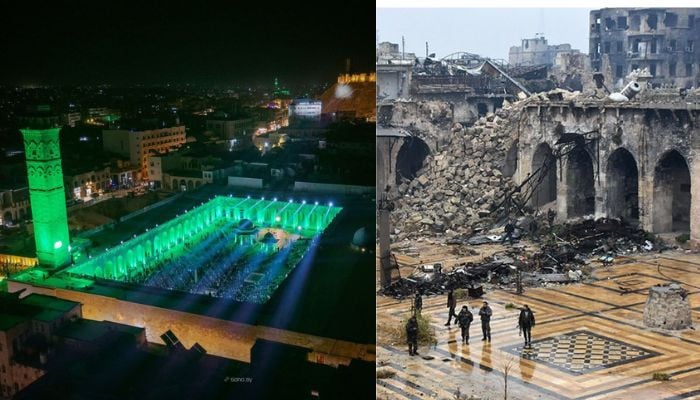
Great Umayyad Mosque in the historic city of Aleppo, Syria, has reopened after years of restoration. Worshippers appeared back to one of most important religious landmarks in the country more than a decade after it was badly damaged during the civil war.
The mosque formally reopened on Thursday, around 13 years after it had gone out of service due to fierce fighting in Aleppo’s Old City.
The ceremony was attended by senior Syrian officials, religious scholars and local figures.
The pictures and videos of the restored mosque and the reopening ceremony has been widely shared on social media with muslims around the world celebrating the reopening the landmark mosque.
The mosque has witnesses some of the fiercest fighting as its famous minaret collapsed in 2013, while other parts of the complex also suffered damage as the Old City became a frontline between government forces and opposition fighters.
That minaret has now been rebuilt reusing a number of original stones after recovering them from the rubble. The historic rocks were sorted and documented before being placed back into the reconstructed structure. Work also covered the mosque’s arcades, courtyard paving, ablution area, public drinking fountain and Hijaziyah hall.
Aleppo Governor Azzam al-Gharib said the reopening returned one of the city’s most important landmarks to its people after years of destruction.
The mosque dates back to the Umayyad period and has been rebuilt and altered several times over its long history.
For centuries, it served not only as a place of prayer but also as a centre for religious teaching and scholarship in Aleppo.
Its location makes the restoration particularly significant.
The Great Mosque sits inside Aleppo’s historic centre, an area that suffered enormous destruction during the Syrian conflict and has since become one of the symbols of the city’s slow recovery.
Some worshippers had already returned to parts of the mosque during Ramadan in 2025 after limited rehabilitation work allowed prayers to resume. The latest reopening, however, follows a much broader restoration of the complex.
Officials now say the mosque will again host Quran study circles, religious lessons and other activities alongside daily prayers.
The restoration also carries an unusual physical reminder of the war.
Rather than replacing everything that was destroyed, workers incorporated surviving pieces of the old mosque back into the building.
So when worshippers walk beneath the reconstructed minaret today, part of what they are seeing is not new at all.
It is stone recovered from the ruins of the war and returned to the place where it had stood for centuries.

