


NEWYou can now listen to Fox News articles!
NEW YORK — Nearly three decades after the Good Friday Agreement transformed Northern Ireland, Irish Prime Minister Micheál Martin said the United States could potentially play a role in a future push for a united Ireland following President Donald Trump’s backing for reunification.
Martin, whose Fianna Fáil party supports Irish unity, said the landmark 1998 agreement – which largely ended 30 years of sectarian violence in Northern Ireland known as “the Troubles” – created a peaceful mechanism for deciding Northern Ireland’s constitutional future, but cautioned that the deep divide between Northern Ireland’s nationalist and unionist communities must first be bridged.
“I believe in unity and my party believes in unity, but we have to work on it,” Martin told Fox News Digital in an exclusive interview. “We have to build reconciliation among the different traditions on the island of Ireland.”
“The U.S. were critical to the success of peace and conflict resolution in Ireland,” Martin added.
IRISH PM REJECTS ANTISEMITISM CONCERNS IN IRELAND AMID DRAMATIC VOTE OVER BOYCOTTING ISRAEL GAME
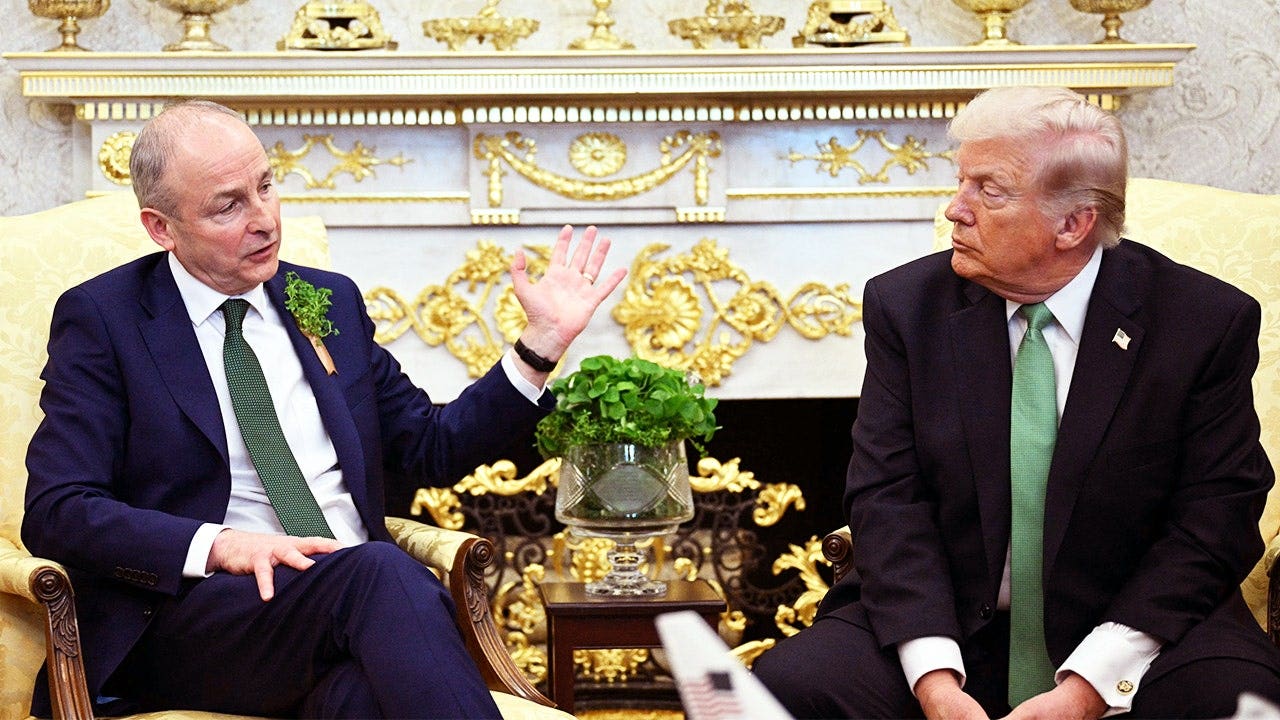
President Donald Trump listens to Irish Prime Minister Micheál Martin during their meeting in the Oval Office on March 17, 2026. Martin told Fox News Digital last month that the United States could potentially play a role in a future push for a united Ireland. (Jim Watson/AFP via Getty Images)
Martin spoke to Fox News Digital during the U.N. General Assembly in New York at what he described as a global “crossroad,” with war raging in Ukraine, conflict across the Middle East and negotiations underway over Iran and the Strait of Hormuz.
Throughout the interview, he repeatedly returned to Ireland’s own experience of conflict and peace as a guide to how the country approaches crises abroad, while defending the country’s long-standing policy of military neutrality despite its growing support for Ukraine.
The constitutional question of Irish unity gained renewed attention during Trump’s recent visit to Ireland last month, when the president said he would “love” to see Ireland unified and predicted it would eventually happen.
Asked during the Fox News Digital whether Washington could play a role again if Ireland eventually moves toward reunification, Martin replied: “To a degree maybe, potentially, yeah.”
Martin spoke before the latest confrontation over Garvaghy Road erupted in Portadown, reviving one of Northern Ireland’s most bitter marching disputes and underscoring how potent nationalist-unionist divisions remain.
The Parades Commission last month approved a limited Orange Order march along the mainly nationalist Garvaghy Road for the first time in 28 years. Residents and supporters blocked the route, while police declined to force the parade through amid fears of serious disorder.
The Orange Order is a Protestant organization whose members generally support Northern Ireland remaining part of the United Kingdom, while many residents of the mainly nationalist Garvaghy Road community, who are predominantly Catholic, favor a united Ireland.
The standoff has since spilled into the courts and Stormont, where parliament meets, as efforts to broker a compromise continue.
Under the Good Friday Agreement, a referendum can be called if it appears a majority in Northern Ireland would support reunification. But Martin said more work is needed to define what a united Ireland would look like and deepen engagement on both sides of the border.
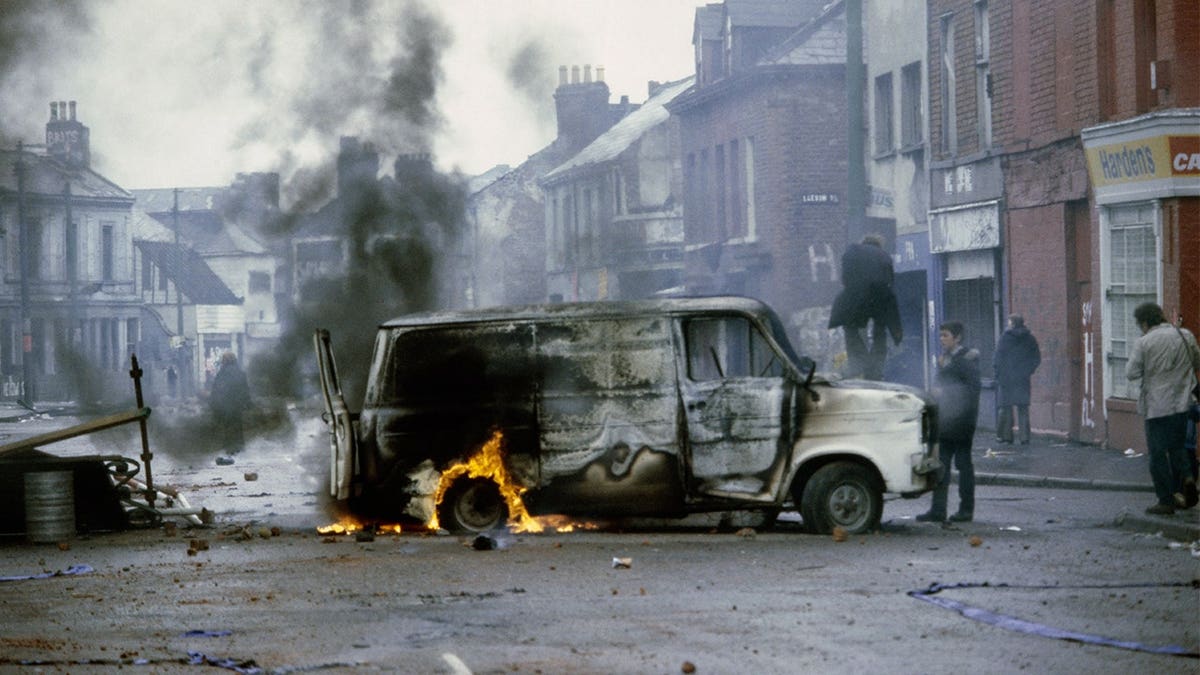
A van burns following the death of IRA hunger striker Bobby Sands in Belfast, Northern Ireland, on May 6, 1981. The image captures unrest during the Troubles, the decades-long conflict that preceded the Good Friday Agreement. (UPI/Bettmann Archive/Getty Images)
IRISH PM SAYS IRELAND ‘NOT OVERRUN’ BY IMMIGRANTS, LEGAL MIGRATION TIED TO ECONOMIC SUCCESS
UKRAINE AND THE SEARCH FOR PEACE
For Martin, however, the lessons of Northern Ireland’s peace process extend far beyond the island.
“Because of our conflict in Northern Ireland, we feel we can make a contribution to that conflict resolution pathway,” Martin said.
He said Ireland’s experience ending decades of violence now shapes how it approaches Russia’s war in Ukraine, the conflict in the Middle East and Europe’s increasingly uncertain security environment.
“We don’t get a sense that Russia is really interested at this particular stage,” Martin said of efforts to end the war in Ukraine.
Martin, who had met Ukrainian President Volodymyr Zelenskyy the previous evening, nevertheless argued that continued channels between Washington and Moscow were important.
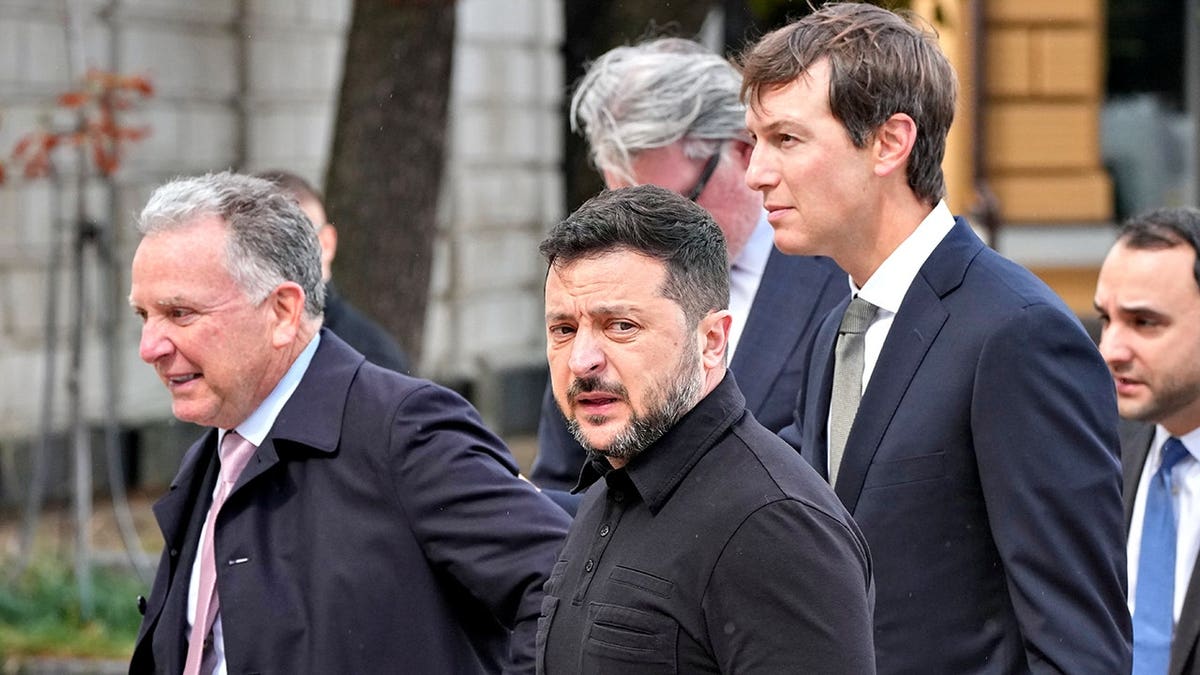
Ukraine’s President Volodymyr Zelenskyy, center, and President Donald Trump’s envoys Jared Kushner, right, and Steve Witkoff, left, meet in Kyiv, Ukraine, Sept. 6, 2026. (AP Photo/Efrem Lukatsky)
Asked whether a realistic peace settlement would ultimately require Ukraine to surrender territory to Russia, Martin rejected the premise.
“Ukraine can’t cede territory that Russia hasn’t even conquered, despite four years of war,” Martin said.
But he said a ceasefire along existing battle lines could provide a starting point for negotiations.
“If we even could get a ceasefire on existing lines, and then negotiations to start,” Martin said, adding that Kyiv would need protections against renewed Russian aggression. “Ukraine needs security guarantees.”
Martin also pointed to Ukraine’s path toward European Union membership as potentially providing an additional layer of security and said the broader security architecture between Europe and Russia would ultimately have to be addressed in negotiations.
“From our perspective, no one has the right to go into another country and take its territory,” Martin said.
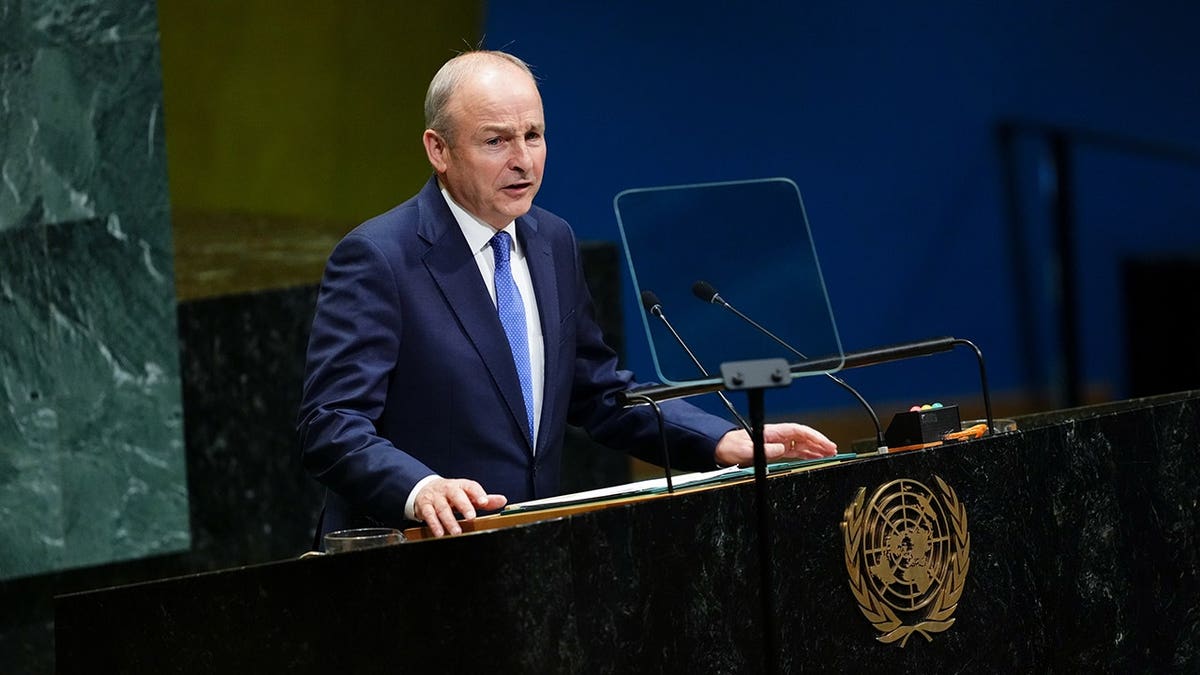
Irish Prime Minister Micheál Martin addresses the 81st United Nations General Assembly in New York on Sept. 24, 2026. Martin used his address to criticize Israel’s conduct in Gaza and Israeli settlement activity in the West Bank. (Angela Weiss/Bloomberg via Getty Images)
HOW NEUTRAL IS IRELAND?
Ireland’s extensive support for Kyiv, however, raises a more contentious question at home: how far can a militarily neutral country support one side in a war while maintaining that neutrality?
Ireland has committed more than $754 million in humanitarian assistance, military training and other non-lethal support to Ukraine since Russia’s full-scale invasion in 2022 while stopping short of providing lethal weapons.
Fox News Digital asked Martin whether that level of support undermined Ireland’s neutrality.
“No, because we don’t give lethal aid, we haven’t given military weaponry, but we have given non-lethal assistance in terms of training and so on like that, and also humanitarian aid to Ukraine,” Martin said.
Ireland has also taken in large numbers of Ukrainians fleeing the war. Martin said more than 120,000 had arrived at one point, with roughly 80,000 remaining in the country at the time of the interview.
“That’s not taking sides, that’s taking a humanitarian response to a war,” Martin said. “And many are contributing, many are working in the economy.”
Ireland’s neutrality has also faced scrutiny over the long-standing use of Shannon Airport by the U.S. military.
NATO’s top military commander, Gen. Alexus Grynkewich, described Shannon in August as a “very important logistics hub” for the United States and said withdrawing American military access would probably damage U.S.-Irish relations.
The airport’s role has long drawn protests from Irish neutrality campaigners, who argue that allowing U.S. military personnel and aircraft to transit through a civilian airport undermines the country’s neutral status.
Despite differing approaches to conflicts in Ukraine and the Middle East, Martin described the U.S.-Ireland relationship in almost familial terms.
“There’s a very strong bond between Ireland and the United States,” Martin said.
He pointed to the long-standing tradition of Irish leaders visiting the White House on St. Patrick’s Day and the enormous Irish American diaspora, which he estimated at roughly 30 million people.
“It’s just family, there’s kinship ties,” Martin said.
MIDDLE EAST
Martin said Ireland’s peace-process experience also informs its approach to the Middle East, where Dublin has emerged as one of Israel’s strongest European critics.
He condemned Hamas’ Oct. 7 terrorist attack and defended Israel’s right to security while arguing that the subsequent Israeli military campaign in Gaza had been “absolutely disproportionate.”
“We believe in a two-state solution,” Martin said. “We believe that Israel, of course, has a right to exist in security and its people need to be guaranteed of security. But likewise, Palestinians should have a right to live in their homeland in a peaceful way.”
Martin said Ireland’s strongly anti-Israel position was shaped partly by its own history and what he described as a “sense of right and justice and fairness.”
WATCH: Irish PM explains Ireland’s position on Israel, rejects antisemitism concerns amid controversial soccer match
TRUMP’S INVESTMENT PUSH HITS EUROPE AS IRISH PM EYES NEXT TARIFF BREAK
EUROPE’S SECURITY
Ireland currently holds the rotating presidency of the Council of the European Union, placing Martin at the center of negotiations as Europe confronts its biggest security challenges in decades.
“There’s a big realization in Europe that we have to do more to provide greater security to Europe, particularly because of the Russian-Ukrainian war,” Martin said.
He pointed particularly to Baltic and Nordic countries, whose governments have increased defense spending amid fears about Russia.
“Many have an existential fear of Russia,” Martin said.
Martin said Europe was also tightening its approach to immigration, echoing comments he made elsewhere in the interview that asylum applications had fallen across Ireland and that governments across the continent were responding to mounting political pressure.
CLICK HERE TO DOWNLOAD THE FOX NEWS APP
For Martin, those challenges — from Ukraine and the Middle East to Ireland’s own unfinished constitutional future —ultimately return to the lessons he believes his country learned through decades of conflict and the peace process that followed.
“The world needs to try and turn a page toward a more peaceful sort of coexistence,” Martin said.
WATCH: Irish PM explains how Ireland is responding to Trump’s ‘America First’ agenda

