


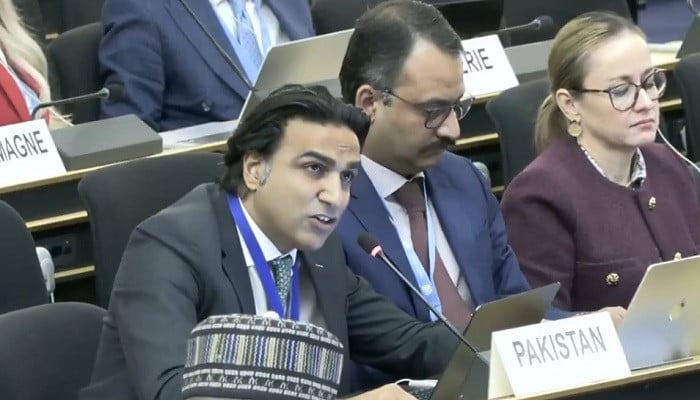
- Pakistan says shared water resources entail shared responsibilities.
- First secretary raises India’s ‘weaponisation of water’ at rights council.
- India eyes transboundary water cooperation reference out of resolution.
GENEVA: Pakistan has warned at the United Nations against the use of water as a tool of political pressure, describing India’s actions concerning the Indus Waters Treaty as a “weaponisation of water” and stressing that water must not become an instrument of coercion, political leverage or war.
Pakistan’s First Secretary Adeel Mumtaz Khokhar made the remarks during the 63rd session of the UN Human Rights Council as the body considered a resolution on the human right to safe drinking water and sanitation.
The resolution, presented by Germany and Spain, was adopted without a vote. Pakistan had played an active role in retaining an explicit reference to transboundary water cooperation in the final text.
According to Pakistan, India had sought to remove the reference, arguing that transboundary water cooperation fell outside the scope of a resolution dealing with human rights.
Pakistan maintained that cooperation over shared waters was directly linked to the human rights to safe drinking water and sanitation.
Speaking during consideration of the resolution, Khokhar set out Islamabad’s position on shared water resources and the Indus River system.
“Where water is shared, responsibilities are also shared,” Khokhar said.
He said cooperation over shared waters between neighbouring countries was not a matter of favour or concession but a shared responsibility.
“No upstream country can use water as a tool of political pressure or influence,” Khokhar said.
He stressed that water should be managed according to the principles of cooperation and mutual responsibility rather than being used as an instrument of political pressure.
In his intervention, Khokhar also described India’s unilateral action concerning the Indus Waters Treaty as a “weaponisation of water” and said water must never become an instrument of coercion, political leverage or war.
Pakistan also thanked states for retaining the reference to transboundary water cooperation in the final resolution.
The official UN record identifies the measure as draft resolution A/HRC/63/L.34, titled “The human rights to safe drinking water and sanitation”. It records Germany and Spain as the countries that submitted the draft and lists Khokhar among those who spoke during its consideration.
Two proposed amendments to the resolution, L.39 and L.40, were rejected before the main text was adopted without a vote. Both amendments received 10 votes in favour, 17 against and nine abstentions.
The resolution was considered during the 63rd session of the Human Rights Council, held from September 7 to October 7, 2026.

