


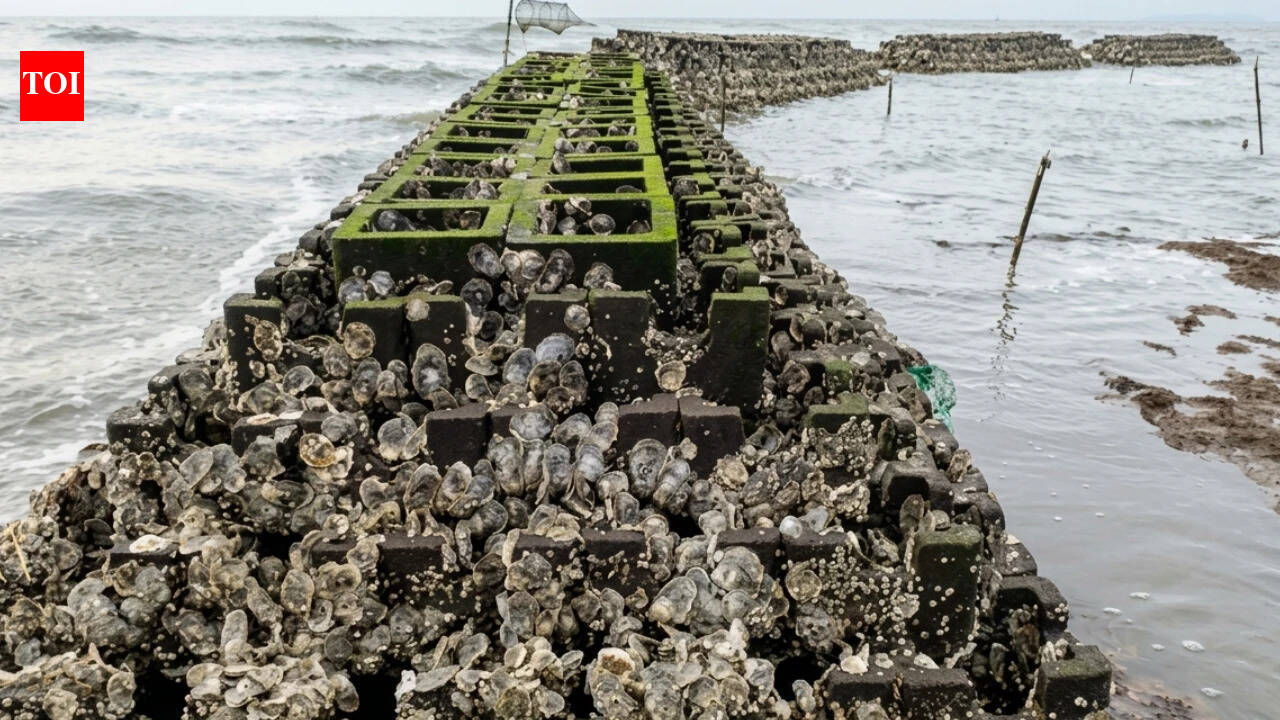
In an unusual effort to protect an eroding stretch of New Jersey’s Delaware Bay shoreline, 40 constructed oyster reefs were installed at Gandy’s Beach Preserve between 2015 and 2016.A new study published in Frontiers in Marine Science examined the project along with other nature-based coastal protection measures used in New Jersey. Researchers found that while such projects can help restore habitats, their ability to protect coastlines often requires continued maintenance.The manmade reefs at Gandy’s Beach quickly attracted oysters. In 2016 and 2017, researchers recorded average densities of more than 800 live oysters per square metre.The reefs also reduced waves during storms when they were above water or only slightly submerged. During four nor’easters in 2018, wave height fell by 41% across the reefs and by as much as 51% between the seaward and most landward monitoring points.However, the protection weakened when the reefs were fully underwater. Over seven years, the reef groups also lost about 20 centimetres of elevation on average, while the site recorded a net loss of 558 square metres of vegetation.
Protecting Gandy’s Beach
Gandy’s Beach Preserve in Cumberland County had been losing shoreline for decades. Around 152 metres of shoreline disappeared between 1930 and 2007, an average retreat of about 0.61 metres a year. In some areas, erosion reached about 3.6 metres a year.Hurricane Sandy in 2012 worsened the erosion. The oyster reef project was later developed to test whether a living shoreline could protect the coast under the relatively strong wave conditions of Delaware Bay.The project included 27 “oyster castle” breakwaters made from interlocking concrete blocks and 13 reefs made from bags filled with oyster, clam and whelk shells. Together, the reefs covered about 25% of the targeted 800-metre shoreline. Gaps were left between them to allow horseshoe crabs to reach spawning areas.
Reefs cut storm waves
Researchers monitored the reefs for seven years, studying waves, erosion, vegetation, oysters, fish habitat and the condition of the structures.During four nor’easters in winter 2018, the reefs worked best when their crests were exposed or only slightly underwater. Significant wave height fell by 41% across the reefs and by up to 51% between the seaward and landward monitoring points.Erosion was also lower behind the reefs during short-term monitoring. Average vertical erosion in the protected area was 0.25 centimetres, compared with 1.52 centimetres at a control site.But the reefs were submerged for more than 85% of the tidal cycle. When fully underwater, their ability to reduce waves dropped sharply. Monitoring in 2019 even recorded some cases in which waves became larger behind the submerged reefs.
Oysters quickly colonised reefs
The reefs performed better as habitats. Oysters rapidly colonised the structures, with average densities exceeding 800 live oysters per square metre in 2016 and 2017.A major oyster mortality event occurred in the winter of 2018-2019, likely because of extreme changes in water temperature. The population later recovered. By 2021-2022, researchers recorded 84 to 157 oysters per square metre on oyster castles and 189 to 462 per square metre on shell bags.Ribbed mussels also colonised the reefs. Surveys between 2015 and 2021 recorded 45 fish and invertebrate taxa and more than 12,000 individuals.However, these ecological gains did not stop the broader physical changes at the site. By 2022, all reef groups had lost about 20 centimetres of elevation on average. Some shell bags had also been moved or scattered by strong waves, while vegetation declined by a net 558 square metres between 2016 and 2022.
Why protection remained limited
The study found that the reefs were not large enough to deal with the conditions at Gandy’s Beach. Early planning had underestimated shoreline erosion and incoming waves, while Hurricane Sandy had also changed the nearshore area.Regulations required the reef crests to remain below the mean high-water level. As a result, they spent most of the tidal cycle submerged, when their ability to reduce waves was weakest.Rising sea levels add to the problem. Relative sea level at Gandy’s Beach is increasing by about five to six millimetres a year, meaning fixed-height reefs are likely to spend more time underwater.The researchers concluded that the reefs provided valuable habitat and reduced storm waves under certain conditions, but they did not stop the long-term loss of elevation and vegetation. The findings show that nature-based coastal projects need careful design, long-term monitoring and continued management to maintain their protective benefits.

