


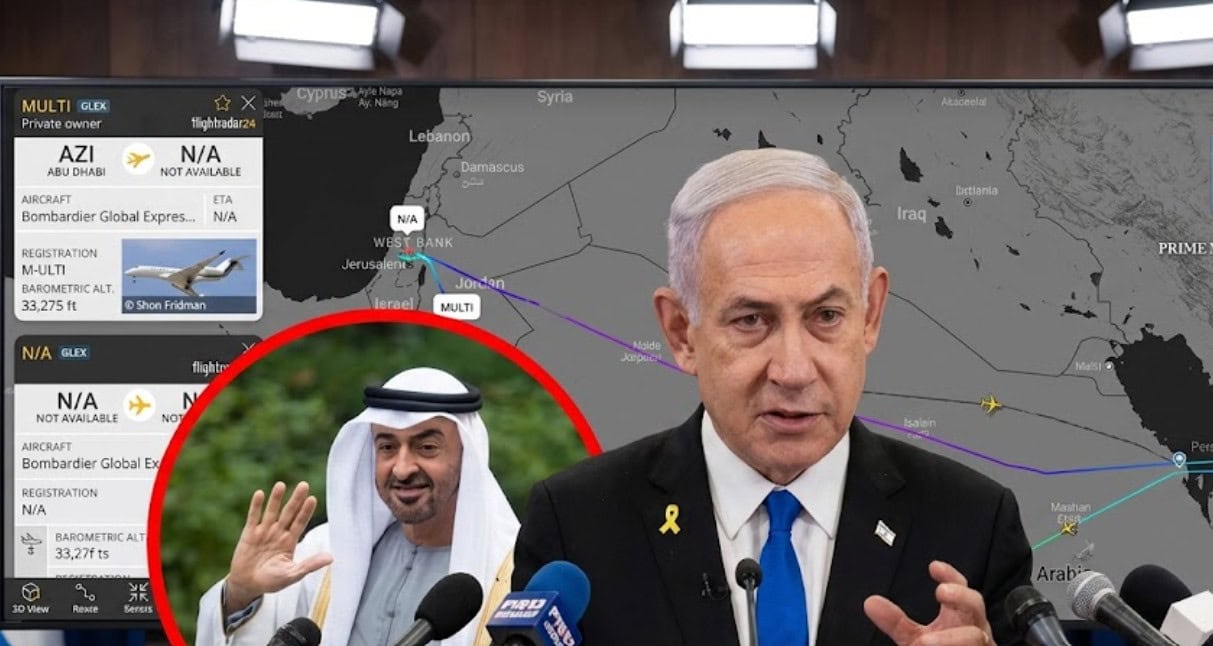
ABU DHABI/TEL AVIV – Israeli Prime Minister Benjamin Netanyahu was in Abu Dhabi over weekend, where he held private meeting with UAE President Sheikh Mohammed bin Zayed Al Nahyan and returned to Israel within hours, in a secretive trip that has placed the deepening Israel-UAE security relationship under fresh scrutiny.
Netanyahu reportedly left Ben-Gurion Airport shortly after noon on September 27, aboard private executive jet previously linked with another reported covert UAE trip. Two jets reportedly involved in the trip, Bombardier Global Express XRS jets registered T7-MCB and M-ULTI. The aircraft movements alone do not establish which jet carried Netanyahu or who travelled aboard either plane.
The aircraft landed in Abu Dhabi, with Netanyahu spending nearly four hours in the UAE capital before departing at approximately 7:10pm. A senior Israeli official confirmed the visit while neither Netanyahu’s office nor the UAE Foreign Ministry immediately shared official statement on the secret visit.
As per reports, Israeli premier spent much of the visit in a one-on-one meeting with MBZ, with only a small group of people reportedly aware of the trip. Claims that Netanyahu received a high-level ceremonial welcome have also emerged, although those details remain officially unconfirmed.
The biggest question surrounding the surprise visit is what Netanyahu and MBZ discussed behind closed doors. Israeli public broadcaster Kan reported that Tehran was major focus of the talks, adding rumours to meeting that comes after months of intense regional confrontation.
Israel and the UAE have dramatically expanded security coordination since the 2026 Iran war, as both countries face concerns over Iranian missiles, drones and regional armed groups. UAE has simultaneously sought to maintain its diplomatic relationship with Tehran, making its increasingly close security coordination with Israel a particularly sensitive regional issue.
Netanyahu’s Abu Dhabi trip also comes just weeks after controversial report claimed that MBZ warned the Israeli premier about a major Hamas operation before the October 7, 2023 attack.
A September investigation by Israeli newspaper, drawing partly on a book by journalists Shlomi Eldar and Ruth Yuval, alleged that MBZ contacted Netanyahu around 10 days before the attack. The report claimed UAE leader passed on information that Hamas chief Yahya Sinwar was preparing a large-scale operation that could result in widespread bloodshed and destabilise the region.
According to the investigation, the conversation lasted for nearly an hour. Netanyahu responded calmly and indicated that Israel was prepared, but alleged that the warning was not subsequently passed to Israeli intelligence or military authorities. Netanyahu has fiercely rejected the allegation, calling it an “absolute lie” and threatening legal action against the publication.
UAE has not directly confirmed the alleged warning. Instead, Abu Dhabi pointed to direct communication channels established with Israel after 2020 Abraham Accords and said sensitive security issues are handled through the relevant institutions. The controversy has nevertheless intensified scrutiny of Netanyahu’s actions before the October 7 attack.
The latest reported encounter is not the first time Netanyahu and MBZ have been linked to a secret meeting. In May, Netanyahu’s office claimed that the Israeli prime minister had secretly met MBZ on March 26 during the Iran war. The alleged meeting was said to have taken place in Al Ain, close to the UAE-Oman border, and Netanyahu’s office described it as a “historic breakthrough”.
Abu Dhabi rejected the account as “entirely unfounded”. A former Netanyahu aide later claimed he had accompanied the Israeli leader and alleged that MBZ personally drove Netanyahu during the visit. Separate reports also said the heads of Mossad and Shin Bet travelled to the UAE for security coordination.
Behind the political secrecy lies a rapidly expanding military relationship. During the 2026 Iran conflict, UAE faced waves of Iranian missiles and drones. Reports estimated that hundreds of ballistic and cruise missiles were launched, along with more than 2,000 drones and other projectiles. The escalation prompted unprecedented security cooperation.
Israel reportedly deployed an Iron Dome battery and personnel to the UAE after a request from MBZ conveyed through Netanyahu. US Ambassador Mike Huckabee publicly confirmed the deployment, while Emirati officials later described the episode as an unforgettable moment in bilateral security cooperation.
Other Israeli systems associated with UAE defence cooperation include Iron Beam, Spectro drone-detection technology, Barak air-defence systems and SPYDER platforms. The countries have also strengthened intelligence sharing and coordination over Iranian military activity and threats from regional proxy groups.
The relationship also expanded into the defence industry. UAE’s EDGE Group continues cooperation with Israeli defence companies, including Elbit Systems, with projects involving Hermes 900 drones, technology transfer and potential local manufacturing. One reported contract has been valued at around $2.3 billion.
Other projects include Controp’s roughly $30 million Abu Dhabi subsidiary for electro-optical technology, unmanned maritime systems and an EDGE investment in an Israeli drone-detection company. Israeli defence companies also maintained a prominent presence at Abu Dhabi’s IDEX defence exhibition.
Cooperation now stretches across counter-drone systems, artificial intelligence, surveillance, early-warning technology and cybersecurity. The two sides have also discussed security interests around the Red Sea and Horn of Africa, particularly threats linked to Iran-backed groups and the Houthis.
Military cooperation is only one side of the rapidly expanding relationship. Israel-UAE merchandise trade reached an estimated $3.209 billion in 2025, compared with around $3.254 billion the previous year. Cumulative trade from September 2020 through May 2026 stood at approximately $14.53 billion, while trade during the first five months of 2026 reached around $1.243 billion.
UAE exports make up roughly 80% of bilateral trade. Israeli exports include precious stones and metals, electrical machinery, optical and medical equipment and precision instruments. Comprehensive Economic Partnership Agreement has further supported commercial ties.
The relationship has also transformed travel between the two countries. Passenger traffic surged to approximately 1.53 million in 2025, around 71% higher than in 2024. At peak periods, direct flights reportedly reached between 120 and 136 per week. Meanwhile, cooperation has expanded into AI, semiconductors, cloud computing, healthcare, logistics, energy, food security and tourism.
More than 1,000 Israeli companies are reportedly active in the UAE, while Emirati sovereign funds have invested in Israeli ventures. The two countries have also explored joint defence research, supply-chain resilience and projects connected to the India-Middle East-Europe Economic Corridor.
Abraham Accords initially opened the door to formal diplomatic relations between Israel and the UAE. The years since have produced a much broader partnership, from trade and tourism to intelligence and advanced weapons systems.

