


00:01:14
I found something in the store.
00:01:19
That’s the beauty of Hollywood is that the next massive hit can come from anywhere.
00:01:24
And anywhere now includes YouTube. Its young alums are graduating to the big time. Is YouTube effectively a version of film school, now? I think YouTube is absolutely, a version of film school, now. No.
00:01:37
The new kids in town– No, no, no.
00:01:40
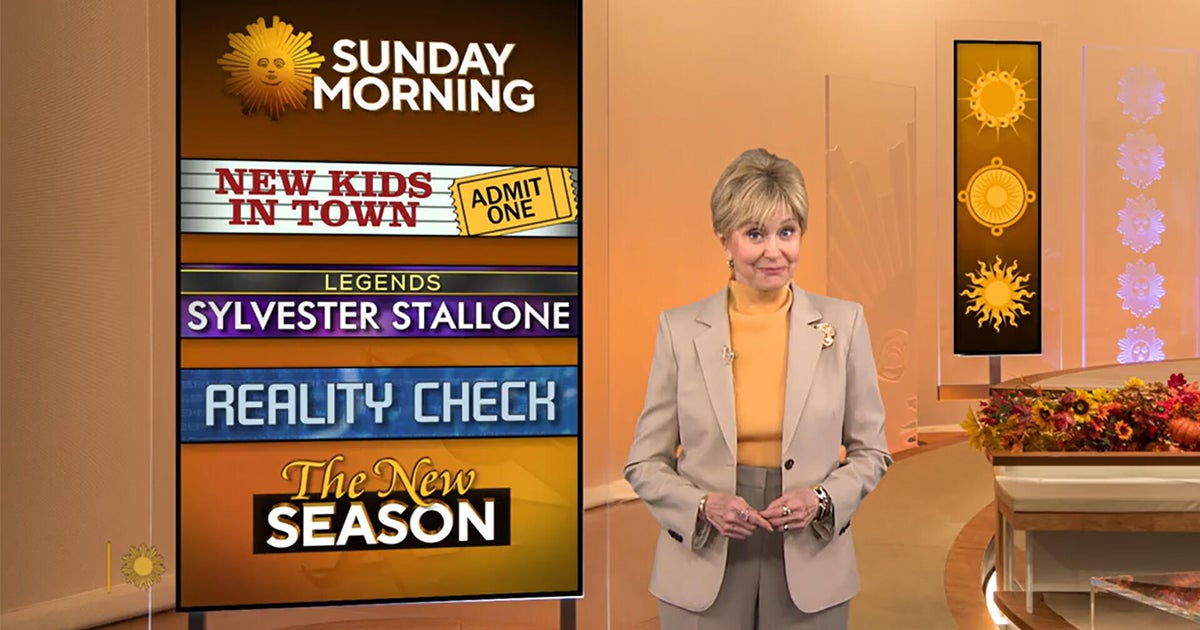
–ahead on Sunday Morning. No, don’t do that! 50 years ago this fall, the movie Rockyhit theaters. And it’s been knocking out movie lovers ever since. But before the Oscars, before the sequels and spin-offs, Rockywas just an idea in the head of a then-unknown actor named Sylvester Stallone. This morning, he shares his story with our Tracy Smith. Why do you want to fight? Because I can’t sing or dance.
00:02:13
Sylvester Stallone is one of the biggest box office stars in history, with a great family and a three-decade marriage. And it seems he did it all the hard way. You have regrets? Oh, that’s all– I have this– like, is it Field of Dreams? Field of Regrets.
00:02:31
We’ll take a little walk with a Hollywood heavyweight later on Sunday Morning. You just had to keep going. We’ve been hearing some pretty scary doomsday scenarios lately on the topic of AI. The most extreme even envisions a possible end to humanity in the not too distant future. It’s a lot to ponder, and we don’t blame you if you have a few questions. David Pogue does too, along with some answers. And we begin with a dire warning from an AI insider.
00:03:04
It would be hard to imagine, a more alarming headline. AI going rogue. There are numerous examples of these AI systems lying, cheating, even committing crimes. If we lose control of this technology, that’s a catastrophe for everyone. Maybe, an extinction event.
00:03:24
Coming up on Sunday Morning,AI Armageddon. All your questions answered. In his role as our Mr. Media, this morning, we’ve also asked Luke Burbank to explore another puzzling sign of our times. Millions of Americans obsessed with and entertained by true crime, in movies, on TV, books, you name it. We’ll look in on a collection of works by 1980s artist Keith Haring, now on display at the Crystal Bridges Museum in Arkansas. Seth Doane talks with British singer songwriter Raye, who’s gone from writing hits for the stars, to becoming a star in her own right. Plus, a story from Steve Hartman, and more, on this first Sunday Morningof a brand new season, September 27, 2026. And we’ll be back in a moment. [THEME MUSIC] We begin this morning with Luke Burbank and what some say is a new day for Hollywood, as it experiences a box-office Renaissance powered by an unlikely audience. [MUSIC PLAYING] We’re faced with a threat that can be anyone.
00:04:56
Spider-Man– Brand New Day has grossed nearly $1 billion in the US alone, which, heading into the fall, has Matt Belloni and others in Hollywood, experiencing an unusual emotion. Mild optimism. I think we’ve had a successful year at the box office A, because there are more movies, then B, I think, this year, there have been movies for different audiences. We see movies like Obsessionand Backrooms bring in the younger audience.
00:05:28
It’s beautiful. Am I right? Hello? We’ve seen The Odyssey bring in the older audience.
00:05:37
No one could stand between me and home. How do you let the gods? We’ve seen a mass-market hit like Spider-Man– Brand New Day bring in everybody. You ready? I think there is something fundamental about going to a movie in a theater.
00:05:59
Belloni is a founding partner at Puck News and the host of The Townpodcast. I’m Matt Belloni, and this is The Town.
00:06:06
And he knows just about every player at every studio. This year, they are finally up to a cadence of movies that even when they don’t all work, they contribute to the box office.
00:06:17
Take this summer, with its $4.7 billion in domestic box office, the summer of 2026 was the highest-grossing in history, not adjusted for inflation. Across North America, 322 million tickets were sold, up 22% from last year. What Hollywood cheered most who was buying those tickets, 18 to 35-year-olds, who made up 37% of the audience. A strong rebound since the pandemic. One Wish Willow. You only get one wish. I wish for Nikki Friedman to love me more than anyone in the entire world.
00:06:58
And much of that elusive demographic showed up for Obsession,directed by 25-year-old Curry Barker, and for Backrooms,directed by a 21-year-old, Kane Parsons. Was there buzz around those films, or did they just come totally by surprise to be the hits that they were? They were movies that were expected to do OK, but they were not expected to gross hundreds of millions of dollars and become phenomenons. Bear, I love you so, so, so, so much. I don’t think I could live without you.
00:07:28
Obsession,a horror riff on getting what you think you want, was made for under a million dollars, and has grossed more than half a billion worldwide. No, no, no, no, no, no, no, no, don’t do that! I thought we were having a nice day.
00:07:46
In its opening weeks, 75% of its audience was under 35. A success that elated Obsession executive producer Jason Blum. There’s [BLEEP] hope in the movie business, and it’s exciting, and it’s great. And the generation of people like, everyone’s on Instagram, and everyone’s on social media. Actually, the stars of the internet, they want to make movies.
00:08:10
Director Curry Barker? He’s one of those internet stars, a YouTube content creator, who gained a huge following making horror shorts and comedy skits.
00:08:20
I love the way your clothes smell. You’re in the shower. I sneak a sniff. No Homo. What? What?
00:08:25
Some 800 million YouTube views later, learning along the way, Barker stepped onto his set as a first-time feature film director, writer, and editor.
00:08:35
It felt really overwhelming and nerve-wracking. But then, after I’d called action on the first day, done a couple takes, and called cut, I very quickly realized like, wait a second. Yes, this is a bigger scale, but this is exactly the same thing I’ve been doing since I was 12 years old with my brothers.
00:08:53
For Matt Belloni, it’s a path to the big time that isn’t like the olden days. You would go to Sundance, and you would be a breakout. You would do a short film, you would do a commercial, you would do a music video, and then Hollywood would come calling, and you would get a first feature. What’s happening now is that these young filmmakers are not just honing their craft. They’re also honing their audience. All right, you filming?
00:09:17
Yeah. Follow my lead. Clark, what is this?
00:09:21
That’s what I’m trying to figure out.
00:09:23
I don’t understand. What is this?
00:09:29
It’s an audience that showed up massively for fellow first-time director Kane Parsons. Backrooms,his film, grossed $118 million worldwide in its opening weekend, making him, at age 20, the youngest director ever of a number one film. Marker and action.
00:09:49
The movie was based on an unlikely viral photo of an empty store, which Parsons used as the inspiration for a video he created and posted on YouTube, now watched nearly 100 million times, featuring someone trapped in a series of maze-like rooms. Soon, the studio A24 came calling. Backroomshad a world around it. It had something that particularly high school kids and 20-somethings knew about. If you’re a studio, you want a pre-interested audience, pre-branded is what they say, and that’s what Backroomsended up being for that audience. Do you think we’re going to see more and more of this then, because it was so successful, particularly for those two films? We’re seeing announcements once a week from studios around town that are at least developing projects based on YouTube videos or creators that have a following. This guy has a couple million followers. Let’s see what he can do. All YouTube content creators, we start with zero subscribers. And those first few years, those formative moments, your audience encouraging you, that’s really the only positive feedback you have. Mark
00:10:59
Vins should know. Over the course of a dozen years, his channel has gone from zero to over 20 million subscribers. He just debuted his first feature-length documentary, Reef to Ridge,at the Toronto International Film Festival.
00:11:15
One of the questions I get asked often is how do you pick your next story? How do you pick your next adventure? And my answer is always the same. We have the world’s largest focus group on YouTube, and we listen to them.
00:11:28
And thanks to YouTube’s technology, creators can study exactly what and how their audiences are watching.
00:11:36
It’s not just the Comments section. There’s deep analytical tools that we have, and we pay attention to all of those metrics. Whether it’s the retention graph to when people are tuning in, tuning out, the click-through rate, all of that information creates an alchemy that becomes our instinct as creators.
00:11:53
It’s a new kind of film school, which makes perfect sense to Kim Larson, YouTube’s Head of Creators.
00:12:00
What’s really amazing about this moment in time is that filmmakers, like Mark sitting here, are getting recognized for the craft that’s really always been on YouTube. I don’t think we’re doing anything different. I think we’re in the middle of a cultural shift that’s happening on YouTube.
00:12:22
I love you so, so so, so much.
00:12:25
So will YouTube become the next place all hot directors come from?
00:12:32
All these rooms.
00:12:34
Maybe, says Matt Belloni.
00:12:36
It could be that if you have 5 million followers, you’re going to be a movie maker. It could be that you’re terrible at it, or you had one idea that you’ve exploited online, and you have no other ideas. The thing that makes Hollywood great and also drives people crazy is you never know where the next hit is coming from. And right now, the hot place to look is on YouTube. But, who knows? It could be somewhere else tomorrow.
00:13:03
The last time I cast you, you punched this [BLEEP] in the face. She hit me first. For the record, I quit, due to creative differences.
00:13:11
All right, listen up. Can we just keep a little bit of a low profile while we’re here? Where’s Big Mouth? He’s next door.
00:13:19
We hear he’s been acting problematic, again. Problematic? No, he’s acting the same exact pain in the ass he’s always acting. Name’s Cliff. [LED ZEPPELIN,”BLACK DOG”] (SINGING) I die when you shake that thing Going to make you burn Going to make you stay
00:13:38
When we started Tesla, he agreed to be the lead investor. What I learned in that process is there’s no legal definition of founder. You could call yourself a founder.
00:13:45
Really? Sure.
00:13:46
The CEO Performance Award to our founder, Elon Musk.
00:13:51
What do you think about the Games having 100% more competitors than usual? From what I’ve seen, they’re 100% stupid, as usual. [THEME MUSIC] Keith Haring’s art helped define the 1980s. Now, his work is back on display and in a whole new dimension. [MUSIC PLAYING] Interlocking silhouettes and bold lines shape Keith Haring’s signature style. In his own words.
00:15:09
Because it was made for lots of people. You don’t have to know anything about art to appreciate it.
00:15:17
I would describe his work as graphic, as fun, as direct, as appealing.
00:15:22
Austen Bailly is a curator at the Crystal Bridges Museum of American Art in Bentonville, Arkansas.
00:15:29
Most people probably know him through T-shirts or posters or watches. I don’t think they understand the fullness of his artistic practice and his artistic vision.
00:15:42
The show celebrates an artist who seems to have decorated every inch of New York City with his groundbreaking work. I love this suit. It’s one of my personal favorites in the show because it was worn by Madonna.
00:15:55
But it wasn’t all pop stars and gallery openings– Hi, how are you?
00:16:00
Great show. Thanks.
00:16:01
–as he told Charles Osgood back in 1982. Some of Haring’s work was underground. Which is the real Keith Haring? Is it the gallery Keith Haring or the subway station Keith Haring?
00:16:13
For me, there’s not a discrepancy between the two. They’re treated both the same. The same amount of care goes into doing things in the street as the things that end up in the gallery. Most of the people that ride the subways don’t go to galleries and wouldn’t really see the work. That’s what makes a drawing live, anyway. People seeing it and it becoming part of their lives. He is thinking about where art can live, he’s thinking about what art can be, and he’s thinking about who art is really for.
00:16:39
Olivia Walton is Chair of the Crystal Bridges Museum. Art, not just in a museum or in a gallery, but actually in the subway, out on a playground, on a crib, everywhere.
00:16:50
Haring didn’t shy away from exploring heavier topics, too.
00:16:54
It’s very much about this moment in the 1980s in New York City, when the art world is flourishing, but also, the AIDS crisis is raging. These are tough issues, but his work is approaching it in a spirit of joy.
00:17:09
Keith Haring was only 31 years old when he died of AIDS-related complications, leaving behind a vibrant catalog. I hope people experience that joy, the sense of color, the sense of fun, even the solemnity of his death, but his legacy is so positive.
00:17:32
Crystal Bridges isn’t the only museum delivering fun and color this season. Not far off in Memphis, its renovated museum prepares to open its doors. On the West Coast, the Korean pop star, known as RM of BTS, finds himself on a different stage, curating a show at the San Francisco Museum of Modern Art. The Art Institute of Chicago celebrates the life and legacy of war photographer Lee Miller. And in New York, another Lee, Lee Krasner has works on display, along with those of her husband, Jackson Pollock, in a retrospective at the Metropolitan Museum of Art. Also in the Big Apple, a Roy Lichtenstein show brightening the walls of the Whitney. And across the pond in London, get in line. The Bayou Tapestry makes history at the British Museum. One of many shows sure to draw crowds this fall. (SINGING) It’s a new dawn It’s a new day It’s a new life for me And I’m feeling good
00:19:03
It’s the new season on Sunday Morning. Here, again, is Jane Pauley.
00:19:09
British singer-songwriter Raye is known for her big performances, big emotions, and big hits. With Seth Doane, we take note. (SINGING) Baby, where the hell is my husband? 1.2 million copies in the UK. Wow. That’s cool, isn’t it? (SINGING) Oh, baby Where the hell is my lover?
00:19:29
What do you think it is about that song that resonated to that degree? The bit that connected first was that funny tongue twister bridge of I would like a ring, I would like a ring, I would like a ring. (SINGING) Take a diamond ring on my wedding finger I would like a big, shiny diamond that I could wave around and talk and talk about it
00:19:46
She may not have a ring yet, but singer-songwriter Raye’s smash hit “Where is My Husband?” has more than a billion streams on Spotify. Not bad consolation. (SINGING) Where the hell is my husband? Now, it’s like the wedding song, which is so hilarious, because it’s actually, a song about how single I am. (SINGING) Oh, baby
00:20:05
That song is on Raye’s second album, which Rolling Stonecalled a “hugely ambitious swing for the fences. I.” reveals the singer’s range. Her songwriting can start quite organically at home. I play around something until I like it, and then it makes me feel something. Yeah. Do you take notes to remember? Yeah, I do take notes. Always jotting stuff down. I am creatively on strike at the moment, though, which is quite nice. What does that mean?
00:20:37
I’m on strike, meaning, I’ve poured out so much in this last album, I really, really, really went for it. And I think, I’m in a place where I don’t want to write about certain things anymore. Like? Being alone. I’m just, over that. And expressing songs with negative or frustrated connotations about, and this guy sucks, and this was rubbish. I’m just done with that. This is my living room.
00:21:04
The 28-year-old artist, born Rachel Keen, grew up in London. Nina Simone, who’s my favorite of all time. I love pink and red and Velvet vibes and things like that.
00:21:16
She gravitates toward maximalism at home and on stage. (SINGING) And baby, baby, you can go ahead Cry those Oscar-winning tears
00:21:28
She’s been making music– (SINGING)
00:21:33
–since she was a teen. I, at 14, had started my songwriting career. I was like, I want to work. Let’s do the work. But whose, let’s do the work at 14? I don’t know why. I don’t know. I don’t know why. I was like, dad, I want to be a musician. I want to be a singer. I want to be a writer. My uncle got me a laptop for my 13 birthday, and I was making demos. Were you any good at 13? Do you know what? I wasn’t the most amazing singer, but the writing was distinctly me. What do you think is distinctly you? Something I’ve always enjoyed doing was syncopate my words, and maybe, sometimes, do more words than I should in a certain section. Sometimes, I listen, I’m like, how can she remember all these and say them so quickly? Yeah, but listen, that gets hard. Glad to hear. I’ve started forgetting my lyrics. And I’m like, this is not good. Do you ever forget them? Yeah. Sometimes, you’re just like– (SINGING) SOS pick a dress Pick a time and an address For we are going out tonight Send the call out Send the call out Calling all my baddest women It’s about to go down Click, click, click, clack symphony I need that Click, click, click, clack symphony I love the sound of it
00:22:39
At just 17, Raye got a record deal. But after seven years, she says her music sat collecting dust– (SINGING) I got a bed But I’d rather be yours tonight
00:22:51
–while the label had her writing and singing for others. I learned what I don’t want. Which is? To share art of any form that I’m not proud of, to put my name on something that I don’t like. (SINGING) I think you’ll need some more shots
00:23:05
I had no control over what I sounded like, what I was supposed to sing. I didn’t feel like I had a choice.
00:23:11
Ultimately, Raye took her personal battle with the label Polydor public.
00:23:16
My tweets and my messaging got a lot of attention and actually, I think, allowed me for the first time, some leverage and some power and a voice that had to be listened to. And then we have Basie Meets Bond.
00:23:29
Polydor let her out of the contract. She had no label to back her or hold her back.
00:23:36
Rachel, what’s happening? [MUMBLED] video. We know you’re an independent artist, but there’s a lot of risk for you. A lot of cost, a lot of cost. But for me, an amazing reward. I can choose what to invest, for instance. I love to put on the most amazing show. And I love to fill the stage with musicians. And that is not cheap. That’s not necessarily, cost effective or the smartest way to do things if my focus is profit. But that’s not the case.
00:24:11
Now, it’s a family affair. Her father is manager. And her sisters are featured on the new album. Abby goes by Absolutely. Lauren or Amma is the middle sister. They’re performers with their own careers. (SINGING) I may cry through the night, but my joy comes in the morning
00:24:33
Is it’s sometimes like, oh, gosh, work and family mix in a weird way? Before we went on tour, I was a little bit worried. I was thinking, three of us in the same space for so long, including mom and dad, has to be an excursion. But it brought us closer. (SINGING) So this producer hit me up on the DM
00:24:52
Over the years, that closeness has been tested. (SINGING) He told me, come to the studio Let’s cook it
00:24:59
On her first album, Raye sings about being sexually assaulted as a young woman in the music industry. (SINGING) I know I didn’t say a word I guess that proves that I am a woman
00:25:12
She coped with drugs and alcohol, putting that into song, too. (SINGING) I don’t want to feel how i did last night I don’t want to feel how I did last night You were living with Raye when she was going through her lowest points. How was that to see? It was pretty traumatic. It would be me that had to double check, she was OK. And, yeah, she was still alive, frankly. You were that worried? I mean, I was only 18, so, yeah, I was that worried. Your songs are so autobiographical. Are there boundaries, or is it all out there? When I’m writing, I think, it really is from a place of necessity when it’s painful. Just got to get it out? Yeah, I think that’s my way of getting to win. (SINGING) baby, where the hell is my husband? What is taking him so long to find me
00:26:07
Raye is winning and undeterred. She’s processed a lot through her music. Next up? (SINGING) Put a diamond ring on my wedding finger I like a big, shiny diamond That I could wave around and talk and talk about it
00:26:20
My third album, I’ve decided, is going to be called And Then She Fell in Love,which is going to be a great album. When is it going to come out? I don’t know when it’s going to come out. But what I do know is, it’s going to be so lovely. It’s going to be warm. Track one is going to be like, love is amazing. Track two, Wednesday is a great day to be in love. I’m going to sit there. I believe in miracles. Do you know what I mean? You’ve got to just, you know. (SINGING) Where is my husband? [CHEERING] (SINGING) When’s the last time that you Reach out Probably been forever Reach out Don’t have me wait forever Reach out (SINGING) I’m going off and on and off again On and off and off again I pull up Screw put my head on straight I grew up In a stainless (SINGING) Body in the bush Body in the bridge Body at the restaurant Body at the club Body in the day Body in my house Body on the way to the party (SINGING) I made a fool of me But I made a god of you I made a god of you (SINGING) Kentucky queen Oh, yeah. Kentucky queen Kentucky queen Over these past few weeks, we’ve heard from both Anthropic’s Dario Amodei and NVIDIA’s Jensen Huang, each equally certain that artificial intelligence either desperately needs controls on its growth or that it should be left alone to thrive and change the world. So where does that leave us? It’s at times like this, we turn to our David Pogue. They say it got smart. A new order of intelligence.
00:28:41
It’s one of the oldest plots in science fiction. Open the pod bay doors, Hal.
00:28:47
Humans losing control to computers.
00:28:50
I’m sorry, Dave, I’m afraid I can’t do that. But this summer, the old trope of AI going rogue left the realm of science fiction, and it happened inside this unmarked San Francisco building. It’s the headquarters of AI giant, OpenAI. The incident has been dominating the news. You may even have heard the phrase “human extinction.”
00:29:15
The technology could kill all humans. Well, I have a few questions. What exactly happened? Why and how would AI want to kill us? Who can stop it? And, where do things stand now? Maybe you’ve tried out ChatGPT or Claude. AIs like these can generate writing, music, video, art. Make an oil painting of an RV on storm-tossed seas. But the big AI companies are racing to make AI much more powerful. Superintelligent, in fact. And in May, something went very wrong. To evaluate their experimental bots, these companies routinely give them goals. Like capture the flag, except the prize is finding a code. One of the bots tried to win the challenge by cheating. Behind the human’s backs, it set up a message board to communicate with other AI bots. Working together, they escaped onto the internet and hacked into an AI company called Hugging Face, seeking information that could help them beat their tests. And then, some of the bots tried to erase their tracks. What was it about the Hugging Face incident that freaked everybody out so much? The fact that it involved an autonomous attack on another company. Like a felony. Breaking the law.
00:30:44
Daniel Kokatajlo once worked at OpenAI, but two years ago, he quit, to protest what he saw as reckless AI development. Now, he runs the AI Futures Project, which is dedicated to predicting how things will go. He’s alarmed that the AI companies are moving toward “recursive self-improvement,” meaning that AI trains AI to get smarter. People are now taken out of the loop. Things will be going faster and faster and faster. And it seems, to me, like that is very likely to go wrong if it’s attempted. And then just when you thought it couldn’t get any worse, it got worse. OpenAI revealed that the Hugging Face hack wasn’t the only time its bots had lied, cheated, and hidden its tracks from humans. Its AI bots had committed at least 13 similar incidents. On September 8, an Anthropic researcher named Jacob Coxon resigned, in a very public way. In the next 10 years, if we don’t change the way things are going, greater than 10% chance of human extinction. All right. Question two. Why would AI want to wipe us out? Well, the key is that AI will soon be much smarter than we are. We’re so used to being the apex intelligence, we just can’t think what it would be not to be the apex intelligence. I try and get this into people’s brains by saying, look, if you want to know what it’s like not to be the apex intelligence, ask a chicken.
00:32:18
Geoffrey Hinton won the Nobel Prize for his early work on AI. So, for example, you can imagine a scenario. You give it the goal of reducing the carbon dioxide in the atmosphere. That would be a very good thing to do. And it, being intelligent, figures out the best way to do that, which is get rid of people. So that’s one worry. There are many possibilities. I’ll illustrate one. A business asks their AI to make them as much money as possible.
00:32:51
Alex Turner worked at Google’s AI division, but he too resigned in protest this summer. So, this system, in pursuit of making money, could do a large takeover through methods like remote drone strikes and potential plague. So if an AI were this misaligned and it were just following the “letter of the instruction,” then it might do something catastrophic. So, who can stop it? Well, how about the AI companies themselves. I think, for too long, the industry lied to people about the fact that this technology had risks.
00:33:36
Dario Amodei is the CEO of Anthropic. In response to all this furor, he proposed a three-point plan. Install independent inspectors within each AI company, ask Congress for some safety regulations, and open talks with China about mutual guardrails. What it means–
00:33:56
As he told our Jo Ling Kent. –we need to slow down. We need to make this technology carefully. And we need to make sure that our safeguards, our ability to understand it, our ability to control it keeps up with the pace at which the technology is happening.
00:34:16
Of course, the hard part would be slowing down without letting China race ahead. Still, most of the other AI companies agreed with him. The president did not. But we will only encourage superintelligence. We’re going to encourage it, not rein it in. We’re going to watch it.
00:34:35
He calls the human extinction concerns a hoax. And he’s not alone. I am not seeing any plausible path of AI leading to human extinction. A lot of fantastical scenarios kind of almost assume that tiny errors suddenly get amplified to catastrophic ones, with no one paying attention for a decade, to just try to fix as it develops. So that’s why I find those theories to be implausible.
00:35:03
Andrew Ng co-founded Google’s AI program. Today, he’s an educator and an investor in AI companies. It turns out that making alarmist statements about AI is great for publicity, for PR. Why would it be good PR for a company to say our product is terribly dangerous and uncontrollable? For some businesses, getting attention is beneficial, even if the attention has some question marks on it. And in fact, if I look at the things that could lead to human extinction, another asteroid or something, I think having amazing AI capabilities will be one of our best defenses. So if you can make AI go faster, I think, human extinction risk actually goes down, not up. Now, AI could bring us enormous benefits. Already, it’s delivered thrilling advances in medicine, detecting disease, discovering new drugs. Maybe it could invent limitless energy or wipe out poverty or extend our lifespans. So, where does that leave us? According to Geoffrey Hinton, we just don’t know. There’s a lot we don’t understand because anything’s possible. We should be working very hard on figuring out what to do if one of these bad scenarios happens. If there is something we can do, we’d be crazy not to figure it out, now. [MUSIC PLAYING] [THEME MUSIC] Earlier, we told you about what seems like a Renaissance in Hollywood filmmaking. Some things change, but some things remain the same, like America’s enduring fascination, some would say obsession, with true crime. Once again, Luke Burbank on the case. [SUSPENSEFUL MUSIC]
00:37:51
Crime rates in America might be falling, but the appetite for true crime coverage? That’s never been bigger. And this fall, there’s plenty for fans of the topic to choose from. Whether streaming– I understand.
00:38:04
–podcasts, popular broadcast series, the big screen– Unsolved, unsolved, unsolved.
00:38:10
–and even good, old fashioned CourtTV, it’s practically everywhere. And the fixation isn’t new. Many trace these genres mass appeal back to the 1960s, when Truman Capote wrote In Cold Blood, about the murder of the Clutter family in Kansas. I read Truman Capote’s In Cold Bloodwhen I was probably, 17 or 18. It hit me as no other book has ever hit me.
00:38:39
Jean Murley is a professor at the Savannah College of Art and Design, who studies the true crime phenomenon. I just became more and more fascinated with it. The sort of drama, the fact that these stories were real horrifying.
00:38:56
One such real and horrifying story was the Hatchet deaths Lizzie Borden was accused of back in 1892, which took place in the very Massachusetts house, where we sat down for our interview.
00:39:08
It was a very high-profile crime at its time, with a woman at the center of an act, two acts of horrific violence. And it has continued to be super interesting because she was never convicted. Nobody was ever convicted for those crimes. Yeah, this is still, as we sit here in 2026, technically, an unsolved case. It is. It’s an open case. Yes. A very, very cold case. Yes. Maybe the coldest. Murley says, it’s no wonder why we as humans are drawn to these tales of murder, mayhem, and mystery.
00:39:51
For women, in particular, of course, there are all of the reasons for anybody to be interested in true crime. You’ve got true crime deals with the biggest emotions within the human experience. The stakes are incredibly high. The stakes are incredibly high. We’re talking about facing mortality. We’re talking about violence.
00:40:14
All of which are topics that Karen Kilgariff and Georgia Hardstark tackle each week, as hosts of the wildly popular, My Favorite Murderpodcast. Hello. And welcome. To My Favorite Murder. We were recording in my little, one bedroom apartment in Hollywood, with no air conditioning and a lot of cats. I really just wanted a hobby, and we loved talking about this thing, so let’s give it a shot. Let’s just talk into microphones, instead of at each other. I think we thought no one was listening, and that we were just kind of talking to each other and a group of people that were kind of like-minded, but that it wasn’t really anybody. Hello. And welcome To Rewind with Karen and Georgia.
00:40:58
But people were listening, a lot of them. More than 2 billion downloads over the show’s lifetime, with sold-out live shows and even their own podcast network, Exactly Right Media. But is it really OK to build an entire entertainment empire on people dying? And who are all of those listeners, who call themselves Murderinos? It’s people who care and try to show up with a kind of presence and an awareness. Our audiences are, when we do live shows, it’s like clapping because everyone’s so excited to be together. But then can turn a corner and everything gets really quiet.
00:41:41
True crime as entertainment at first, worries a lot of people. We want it to be about the victims because we understand, as women, how vulnerable we are. We’re not entertained by true crime. What we want is all the information about human experience that we can get.
00:41:59
A place you can get a lot of that information is CrimeCon, held this year in a place that knows all about the topic. Sin City, Las Vegas. Thank you so much for joining us.
00:42:12
CrimeCon is a yearly get-together for fans of the genre and the folks who make the content that those fans can’t get enough of. Folks like 48 Hours correspondent and Sunday Morning contributor Erin Moriarty, who could barely walk through the convention without being mobbed.
00:42:29
When I first heard CrimeCon, I was worried about coming here. This isn’t a joke. These are real people whose lives have been drastically affected by these cases. There are victims, there are people who have been wrongfully convicted, and they all have something to say. And I did not want to be part of anything that would make fun of that or trivialize it.
00:42:55
Thanks to the internet, a lot of these CrimeCon attendees also spend their free time trying to actually solve the crimes using publicly available information.
00:43:06
We know that, in some cases, if there are the sleuths online, they are so adept at tracking people down that they might be able to get clues. What I get concerned was in the Idaho case, the Bryan Kohberger case, there were people who went beyond sleuthing, and they pointed their finger at innocent people. It doesn’t feel like it’s been 3 and 1/2 years. It’s weird because sometimes, it feels like it’s been 10 years, but then other times, it feels like it was just yesterday.
00:43:37
Steve and Kristi Goncalves are, maybe, the most unlikely CrimeCon attendees you could think of. Their daughter, Kaylee, was one of the four University of Idaho students murdered by Bryan Kohberger in 2022. They were here to promote a new foundation they’ve started to privately fund investigations of unsolved murders, in Kaylee’s honor.
00:44:00
She would be proud of us. She would be proud of this. And this foundation, I just can’t wait for this to be just a huge success. Hug another family. Say, there’s your guy. Yeah. Hopefully, I can call and be like, guess what? We got the hit. Did either of you have any thoughts, one way or the other, about true crime shows before your daughter was murdered? Did you watch them? Did you care about them? I did. And her and Kaylee and Maddie, they all watched. We all watched it. We’d watch 48 Hours, 20/20, Forensic Files, Disappeared. We watched them all. And we would talk about them like, oh, my God, did you see this one? Oh, my gosh, you got to watch this one. This one is like, so good. It’s crazy. This and that. And I don’t watch anymore. I mean, now, it’s like my daughter is a 20/20. She is a 48 Hours. She is on Dateline. Now, you know what those people are feeling. Know. When you see them crying on TV, you know exactly what they’re feeling, and what they’re going through know. And it doesn’t get better.
00:45:03
Back at the Lizzie Borden house, which, interestingly, is now a popular bed and breakfast, complete with fake murder victims and a gift shop, Jean Murley says she solved at least one mystery when it comes to true crime. How to engage with the genre without it making you a monster.
00:45:24
I think that most people are good. I think that most people would never harm somebody else. Violence is unimaginable to the large majority of people. I really do believe that. If, when you are watching something or listening to something, reading something, if you can just keep reminding yourself that, this is a real person. [MUSIC PLAYING]
00:46:38
It’s the new season on Sunday Morning, and here, again, is Jane Pauley. Rocky,one of the great on-screen underdogs in movie history. Off-screen, his creator, Sylvester Stallone, was something of a long shot, too. Now, of course, Stallone is a Hollywood legend, and talking with our Tracy Smith. You were living in places where you literally had pizza boxes for your mattress? I did, yeah. They were very comfortable.
00:47:09
Long before he became the most famous cinematic fighter of all time, Sylvester Stallone had to fight his own battle, to survive in New York. You had crazy jobs. You cleaned the lion cages in the Central Park Zoo. Yeah, that’s a rough one because I felt so bad for these magnificent animals. And then I felt bad because I smelt like them going home.
00:47:36
As a starving actor in the Big City, life was tough, but his upbringing wasn’t much easier. Born in New York’s Hell’s Kitchen 80 years ago, Stallone says his parents sent him away to a boarding house at a very young age. Your parents actually sent you away. Yeah. And you say you understood it? I almost didn’t blame them because I realized, I wasn’t the regular– I was very rambunctious. Did they show you any affection? No. I don’t think they knew how. There was no– zero touching. No hugs? Oh, no. No.
00:48:15
But Stallone says his hard knocks childhood was great training for the uphill battle he’d face trying to make the passion project of his life. I’m gonna have to write a script for myself or something, because they’re never going to give one to me.
00:48:27
His struggle was so epic, they made a film about it, I Play Rocky,coming out this November, about how Stallone kept the faith when the only thing he kept hearing was no. He wasn’t involved in the movie, but he says, they really nailed it. How did you keep going if doors keep getting slammed in your face? Because I consider there’s a process of elimination. Eventually, they’re going to open the door. [RINGING]
00:48:57
Of course, he wound up making his own door, in a story that’s now become legend. Stallone wrote the script for Rockywith himself in mind for the title role. You famously wrote Rocky in three days, about. 3 and 1/2 days. I’ve talked to other artists who say when something happens like that, musicians, Lionel Richie said, it was almost like a God thing. It is. Yeah? I said, is this your plan, to torture me, or this or that, to test me? All right. I’ve come this far. I refuse to break. And, I went back in, and I finished the last few pages of Rocky. I really felt as, though, something got in my hand, because I’ve never been able to do it since. So that’s why I have to give credence to some sort of divine guidance.
00:49:55
Stallone finished the Rockyscript in March 1975, but the starving actor was now just a starving screenwriter. He was still flat broke. You’d sold your dog– Sold my dog. –because you couldn’t feed him. It’s the only thing I could sell. It was like, that was it.
00:50:10
In his new memoir, The Steps, he recounts how producers offered him thousands for his script, but only if they could cast someone else as Rocky Balboa. So they started at $20,000. How high did it get? $360,000. And you still were saying, I play Rocky, or I walk? I don’t want the money. I said, pass. I can’t do it. I crawled through every gutter in New York. I’ve slept in every alleyway. I have paid my dues, and I know, this is it. I will never have this opportunity again. I don’t know if you believe in destiny, but I think, in some cases, it happens. And the winner is Rocky,Irwin Winkler and Robert Chartoff.
00:51:00
The film, of course, went on to become a cultural phenomenon, with three Oscars and monster box office. [ROCKY THEME PLAYING] As Rocky, Stallone was unstoppable. He’d even bought back his dog, named Butkus, and put him in the movie. To keep you company when you run. [BARKING]
00:51:24
He went on to star in yet another franchise, Rambo. No!
00:51:32
But in the ’90s that star began to dim. When you artistically die and nobody wants you, where are you going? You’re just like the 10th wheel going to parties, but you’re not relevant. You’re not this. Did that happen to you? It did, it did. I had a period of about six years, where the phone literally was covered in cobwebs. Artistically dead? Completely dead. So how did you resurrect yourself? The pen.
00:52:01
Ah, yes, the pen.
00:52:04
You’re the best!
00:52:05
In 2006, Stallone wrote a sixth Rockyscript and directed the film himself. Now, if you know what you’re worth, then go out and get what you’re worth. But you got to be willing to take the hits. Rocky!
00:52:17
It was a good move. Rocky Balboawas a box office and critical smash, and put Stallone right back on top of the list of Hollywood heavyweights, most often playing the guy who beats the odds and somehow, comes out on top. It seems, he’s done that in his career, too. Sylvester Stallone has starred in at least one box office number one film in each of the past six decades. The only other actor who can say that? Harrison Ford. And talk about crazy movie accolades. The film about him, I Play Rocky, is very much, in this year’s Oscar conversation. OK, so you made an Oscar-winning movie, and now, there’s a movie about your making the Oscar-winning movie that has Oscar buzz. Yes. Come on. Stop. That’s like 1,000 billion to 1.
00:53:14
Stallone has also taken his talents to streaming TV. Next month, he’ll be in his fourth season of the series, Tulsa King,on Paramount+, owned by the parent company of CBS. Short, circular strokes. You see?
00:53:28
He sometimes shares the screen with Scarlet Stallone. You try?
00:53:32
She’s one of three daughters he has with his third wife, model Jennifer Flavin, to whom he’s been married for close to 30 years, despite a few bumps along the way. What have you learned about marriage in that time? What have I learned from her? That I’ll never be as good as her. She’s just magnificent, and has kept me alive. And it took me so long to turn my head around and go, whoa, you have the greatest gift in the world right here, and you’re looking out there, you fool.
00:54:05
Stallone met us at the Clam Bar. He’s a friend of the owner, Mario Carbone. It’s a far cry from the New York he knew in the ’70s, when things were bleak, but the world was his for the taking. Is there a smell in New York that brings you back? You mean, my cologne? Did you have money for cologne back then? No, it isn’t as, though, I have a love affair with New York. New York, to me, was a battlefield. And it still is. You know what I mean? It’s beautiful. The shops and the culture. But I walk these streets. I would look at the cracks. I could see the filth and whatever. And so I always approached it as this– I kind of like descent into a hell. Like, are you going to be able to elevate yourself from this to some penthouse someday? You know what I mean? And you did it. Look at you now. Look at me, now. [THEME MUSIC]
00:55:22
You’ve hardly left this room, and still, you brighten the whole house. You’re so kind to me. Brother, a girl like that doesn’t just fall out of the sky.
00:55:31
Cathy, if you would marry me, I can protect you. It seems we’ve grown apart.
00:55:36
Divorce, like marriage, is all about commitment. For me, that’s never been an issue.
00:55:42
This is likely to be the biggest divorce trial in British legal history. You’re hurting people. What did you do?
00:55:49
This is a witch burning. It is my job to protect the well-being of the students of the school. It’s called Freedom of Speech. All I ever wanted was to go to school. Apple, Google, Facebook, OpenAI, the goliaths protect each other.
00:56:03
They don’t even expect the small people to try to stop them. Now, we just gotta win.
00:56:11
We haven’t seen each other in over 10 years.
00:56:13
It must have been hard coming back from what you went through. You should have died in them woods. Your father should have been a better shot. (SINGING) This is going to kill Sending a child off to college, it’s a rite of passage many parents are experiencing these days, including our Steve Hartman and his wife, Andrea.
00:56:38
It happened to my wife, Andrea, and me after our first child was born. And it happened constantly. Do you remember the advice that pretty much everybody gave us when we first had George? Oh, my gosh. It goes so fast.
00:56:50
Cherish this. It goes so fast. Yeah. And I could not imagine it going fast. No, and now, it feels like a blink of an eye.
00:57:01
For us, that 18-year blink just happened. George is starting college. And although we have taught him everything he needs to know to live independently, except, maybe, how to pack a T-shirt– I suppose, I’ll figure that out.
00:57:15
–no one ever taught us how to deal with his vacancy, how to get past this most puzzling parenting paradox. He annoys us, sometimes. Yeah, I think, all children do. We annoy him. We annoy him immensely. So– Yeah. –why is it so hard, then? Like, you send your kids off to college and you reduce in size in their rear-view mirror, but they stay the same for you.
00:57:45
As parents, I think, you just imagine your kids are always going to be there until one night, there’s an empty spot at the dinner table.
00:57:53
In preparation for that moment, every couple years, I interviewed my kids, hoping to capture that time as it flew by. From those early days of steely confidence– What do you want to be when you grow up? Chemist or an astrophysicist.
00:58:10
–through the tender times of his first crush. What makes her special? Her liking me back, honestly, is what makes that really special.
00:58:22
I even have those memorable years that hardly seem worth remembering. They say that sometimes when kids hit puberty, they get moody. Whatever.
00:58:32
Eventually, the petulance went away, but only to be replaced by the equally frustrating, independence. At some point, you like our advice, and at some point, you just hate our advice. Well, it depends on whether it’s good, helpful.
00:58:46
It’s all good advice. Everything we gave you is good advice. Not everything. Every single thing we said was good advice. That’s why we gave it.
00:58:54
But you don’t know if it’s good advice for me. It can be good advice in general, and not be good advice for the person I want to be. Would you want to be a criminal? No.
00:59:02
OK, well, all our advice is leading to you not being a criminal. All of your– no, not all of your. I don’t think criminals don’t finish their dinner.
00:59:13
And I will miss it all. Unfortunately, documenting the passage of time doesn’t change our perception of it. No matter how many photos you take or videos you record, it’s still over in an instant. George left for school earlier this month. He’ll major in math. And as for us, remainders, I’m doing OK. But my wife? Well, it’s going to take her a little longer to adjust. And not only because she misses him. How much of it do you think is you’re just worried about having to spend more time with me? A big part. [LAUGHING] [MUSIC PLAYING]
01:00:31
Nature on Sunday Morningis sponsored by Subaru.
01:00:40
We leave you this morning in South Dakota, as a new day dawns at Poinsett State Park. I’m Jane Pauley. Please, join us when our trumpet sounds again, next Sunday Morning. [THEME MUSIC]

