


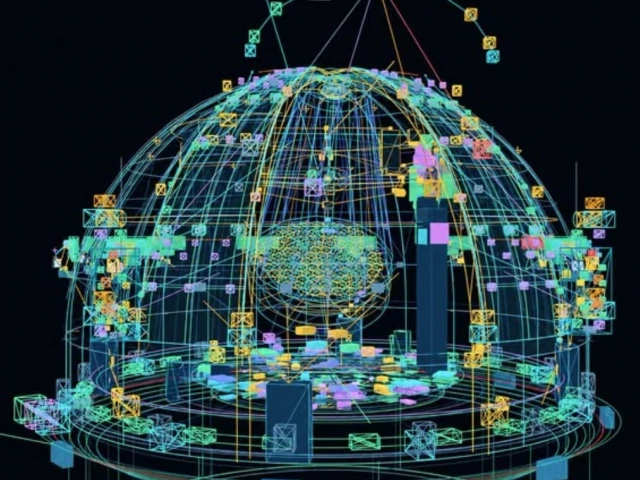
The system simulates telescope components and observations to test controls, train agents and optimise procedures
It simulates telescope systems and observations to test controls, train agents and optimise procedures. PHOTO: XINHUA
China’s StarWhisper Telescope has been cited in Stanford University’s AI Index Report 2026 as a leading 2025 example of AI agents in physics, astronomy, chemistry and materials science, signaling growing international recognition for the country’s AI-driven observation efforts.
Led by the National Astronomical Observatories of the Chinese Academy of Sciences (NAOC), the telescope explores how large models and AI agents can be integrated with telescope control systems, enabling agents to help plan tasks and carry out observations based on researchers’ requirements, scientific objectives, equipment status and observing conditions.As large models, AI agents and embodied intelligence advance rapidly, AI is moving beyond data analysis into the operation of scientific instruments and the conduct of research. The NAOC launched its AI for Astronomy program to seize this shift.
The program explores AI applications in astronomical data processing, scientific discovery, telescope control and coordinated observations across multiple facilities. Its goal is to move from isolated algorithms to an intelligent tool system spanning the entire research process.
Recently, the team reported new progress centered on the StarWhisper Telescope in three areas: digital simulation of research-grade telescopes, coordination between scientific models and observation-control systems, and autonomous observation by AI agents.
The telescope has expanded its simulation capabilities with a digital simulation system for large-aperture research telescopes, creating an experimental environment where AI agents can take part in observation planning and validate control strategies.
China’s StarWhisper Telescope has been cited in Stanford University’s AI Index Report 2026 as a leading 2025 example of AI agents in physics, astronomy, chemistry and materials science, signaling growing international recognition for the country’s AI-driven observation efforts… pic.twitter.com/qgjsG04Rlm
— China Xinhua Sci-Tech (@XHscitech) September 19, 2026
Research-grade telescopes are complex instruments whose observation processes are shaped by the optical tube, mount, camera, sensors, control systems and weather. For AI agents to play a substantive role in telescope operations, they first need an environment that can sense equipment status, understand observation conditions and test control strategies.
Read More: Alibaba open-sources AI model detecting cancer, 150 medical conditions
rawing on its long experience in telescope operation and control, along with an agent toolchain developed in recent years, the NAOC research team built the digital simulation environment quickly.
Without consuming actual telescope observing time, the system can simulate telescope components, sensor states, environmental changes and observation workflows, laying a foundation for testing control strategies, training agents and optimizing observation procedures.
The team is also exploring a system that links scientific models, environmental models, telescope control systems and AI agents, enabling agents to monitor and invoke different tools and devices.
AI agents can further weigh scientific-target priorities, the telescope’s real-time status and target visibility windows to autonomously complete a closed loop of state perception, task planning, plan generation and workflow validation.
To date, the agents have flagged eight very early supernova candidates, two of which triggered follow-up observations when weather conditions permitted.

