

“Pakistan’s diplomatic efforts have helped to prevent the return to full-blown war on several occasions, and these efforts are much recognised and appreciated across Europe,” Kallas said while addressing a joint press conference along with Deputy Prime Minister and Foreign Minister Ishaq Dar after the 8th EU-Pakistan Strategic Dialogue.
Kallas, who also serves as vice-president of the European Commission, is visiting Pakistan at the invitation of Dar.
Pakistan has been playing a key mediation role since hostilities erupted after US and Israeli attacks on Iran on February 28, followed by Tehran’s retaliatory strikes and the closure of the Strait of Hormuz.
Islamabad brokered a two-week ceasefire between the United States and Iran on April 8 and later hosted direct talks between the two sides on April 11 and 12.
The earlier talks ended without a permanent agreement, but Pakistan continued backchannel efforts to narrow differences between Washington and Tehran.
During the press briefing today, Kallas said that with Pakistan’s support, there is now a tenuous diplomatic opening to extend the ceasefire and reopen the Strait of Hormuz.
“Yet any temporary understanding between the US and Iran must be followed by deeper talks about Iran’s nuclear stockpile and other critical issues… lasting stability will require more encompassing solutions,” she said.
She added that the European Union was ready to contribute to a sustainable and peaceful solution. “We bring economic leverage, hard-won nuclear expertise, long-standing relationships with partners across the Gulf, and direct engagement with Iran itself,” she noted.
‘A major regional power’
Meanwhile, the EU foreign policy chief also called Pakistan a “major regional power” and an important partner for the European Union. “Today in our strategic dialogue, we reaffirmed our shared commitment to strengthening EU-Pakistan ties even further,” she added.
On trade in particular, there is already a strong momentum, she said, adding that the European Union remains by far Pakistan’s largest export destination and it is actually larger than China and the US combined.
“Pakistan is the world’s leading beneficiary of European Union trade preferences, the GSP Plus,” she said, noting that but GSP Plus has clear conditions: continued preferential access to the EU market as well as progress in implementing the international conventions underpinning the scheme.
This includes good governance, environmental protection, and particularly labour and human rights, she added.
Furthermore, Kallas said that she sees a “concrete goal” for the EU in helping to make any eventual agreement durable, whether through maritime operations, economic incentives that support long-term stability, or other issues.
Here in the region, she said, Pakistan has been locked in conflict with Afghanistan.
“The fighting in recent weeks has had grave humanitarian consequences and also risks fuelling further instability and radicalisation, and this is why we have constantly called on both sides to exercise restraint and de-escalation,” the EU official said.
She noted that Pakistan has the right to defend itself and its people in line with international law, but “dialogue, not air strikes, are the best offer in this situation”.
‘Long-term partnership’
Addressing the presser, DPM Dar welcomed the EU delegation and reaffirmed Pakistan’s commitment to strengthening ties with the European Union.
He said the continued engagement of EU leadership and Kallas with Pakistan was highly appreciated and noted that both sides had remained in close contact on regional and international developments, particularly during the India-Pakistan conflict and the US-Iran dispute.
He added that the Pakistan-EU Strategic Vision could provide fresh direction to a long-term partnership, while the continuity of strategic dialogue reflected a dynamic and forward-looking relationship.
He said Pakistan attached great importance to its relationship with the European Union and noted that the last visit by an EU foreign policy chief to Pakistan took place seven years ago.
Dar said both sides had jointly chaired the strategic dialogue and recalled that a previous round of consultations had been held in November last year. He also thanked the EU for its cooperation during the US-Iran crisis.
The foreign minister said discussions also covered security issues and counterterrorism cooperation, including concerns over the presence of Fitna al-Khawarij and Fitna al-Hindustan elements in Afghanistan.
Strategic dialogue
The strategic dialogue marked the eighth formal round of high-level consultations between Pakistan and the European Union, focusing on security, regional developments, trade, economic cooperation and multilateral engagement.
The deputy prime minister, in his opening remarks at the strategic dialogue, said that it could serve as an important foundation for deepening political understanding, expanding sectoral cooperation and strengthening institutional linkages between Pakistan and the European Union.
He said EU Strategic Vision aimed at providing long-term direction and strategic cooperation toward partnership, building upon the Strategic Engagement Plan 2019 and the Cooperation Agreement 2004.
Dar said that the continuation of the Strategic Dialogue demonstrated the shared resolve to impart greater momentum to Pakistan-EU relations and to shape a forward-looking partnership.
He said that Pakistan held a deep appreciation for the EU leadership and referred to the EU HRVP’s active engagement during the Pakistan-India war, as well as the current conflict, the US-Iran conflict as both sides kept exchanging notes.
Highlighting considerable untapped potential for cooperation, he said both sides could work together, particularly in trade and many other areas.
In her remarks, Kallas said that the momentum of 2026 was to develop EU-Pakistan relations into a more forward-looking footing.
She said that while Pakistan continued to be the world’s leading beneficiary of the GSP+ system which showed that the partnership was not only commercially significant, but was also a driver of growth.
She said that besides trade and investment, both sides could also explore the deepening of ties, including in resilience building, climate, digital infrastructure, migration and mobility.
Kallas to meet senior leadership
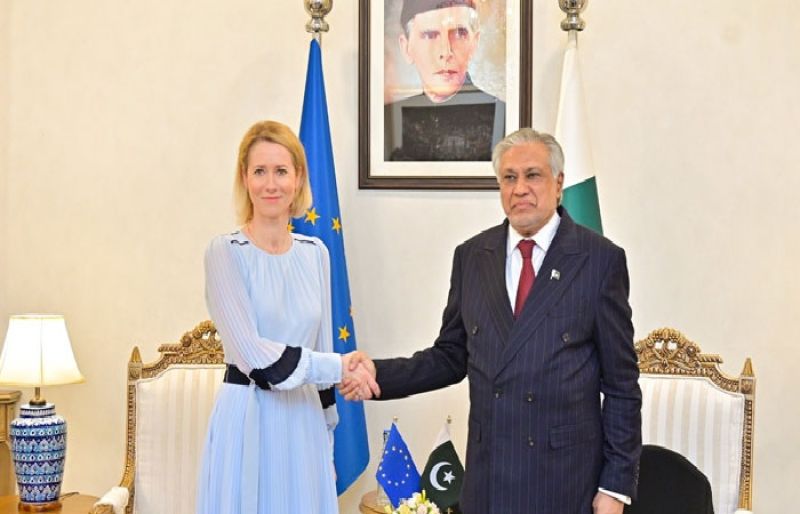
Earlier in the day, the EU top diplomat was welcomed by DPM Dar ahead of a strategic dialogue being held in Islamabad. Visuals shared by the Foreign Office showed Kallas being welcomed at the Ministry of Foreign Affairs and meeting officials.
During the visit, Kallas — also the European Commission’s vice president — will also hold meetings with President Asif Ali Zardari, Prime Minister Shehbaz Sharif and Chief of Defence Forces and Chief of the Army Staff Field Marshal Asim Munir, the EU said in a separate statement.
Kallas is also expected to meet representatives from think tanks and academia during her stay in Pakistan, reflecting the EU’s broader engagement with policymakers, researchers and civil society stakeholders.
The visit comes as Pakistan and the European Union continue to maintain close cooperation on trade, development, climate issues, migration and regional stability, with both sides seeking to deepen engagement through regular high-level contacts and institutional dialogue.
The EU remains Pakistan’s second-largest trading partner, with GSP+ enabling duty-free or low-duty access for many Pakistani exports to European markets.
Pakistan was awarded GSP+ status on 1st January 2014 after the country had ratified 27 international conventions and committed to implement them.
GSP+ has proven to be pivotal for EU-Pakistan bilateral trade ties. From 2014 to 2022, Pakistan’s exports to the EU increased by 108% whereas imports from the EU increased by 65% and the total trade volume increased from 8.3 billion euros in 2013 to 14.85 billion eurors.
The country’s garments, bedlinen, terry towels, hosiery, leather, sports and surgical goods and similar products enter the EU market availing the GSP+ concessions.

