


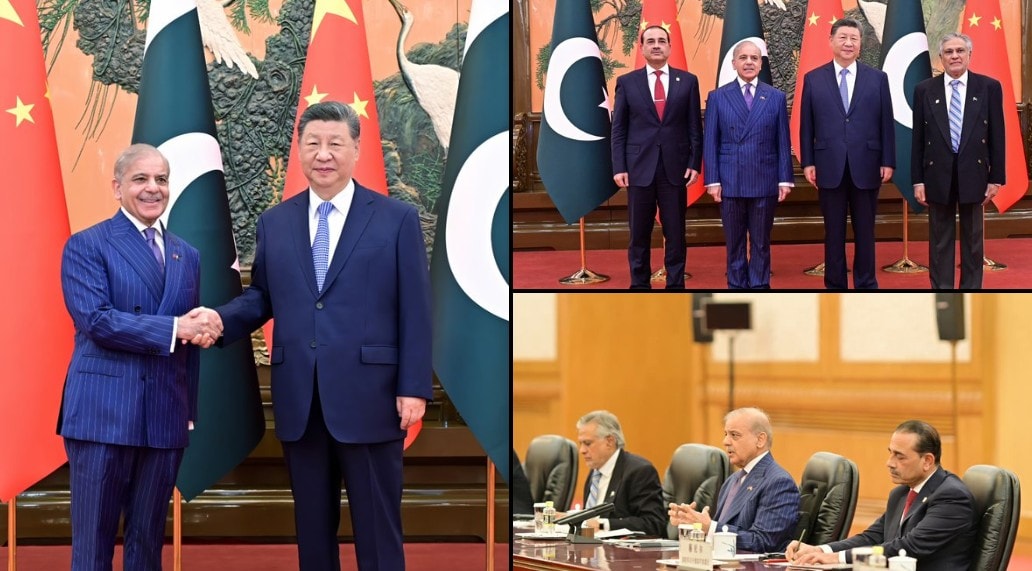
ISLAMABAD – Pakistan and China agreed to speed up CPEC 2.0 with focus on stronger connectivity, expanded energy cooperation, and increased investment. In meetings with Chinese leaders including Xi Jinping and Li Qiang, PM Shehbaz Sharif reaffirmed their commitment to deepen strategic ties and turn CPEC into a broader regional development and trade platform.
Sharif concluded a landmark 4-day visit to Beijing with both nations unveiling an ambitious roadmap to dramatically deepen their strategic partnership, expand economic cooperation, and strengthen regional influence in what analysts are calling a major geopolitical development for Asia.
The breakthrough came in the form of a sweeping joint statement after high-level meetings between PM Shehbaz, Chinese President Xi Jinping, and Chinese Premier Li Qiang. The talks covered everything from security and artificial intelligence to regional diplomacy, counterterrorism, and the accelerated launch of CPEC 2.0.
Both countries declared their decades-old friendship a “rock-solid strategic asset” capable of withstanding shifting global dynamics and pledged to fast-track the creation of a closer China-Pakistan Community with a Shared Future in the New Era.
One of key outcomes of the visit was agreement to advance “high-quality development” of the China-Pakistan Economic Corridor under the upgraded CPEC 2.0 framework.
Pakistan and China announced that third-party countries and investors would now be welcomed into CPEC projects under mutually agreed arrangements. Two sides agreed to quickly convene a meeting of the CPEC Joint Cooperation Committee and push forward strategic connectivity projects, including the phased realignment of the Karakoram Highway between Thakot and Raikot.
Gwadar Port was once again placed at the center of regional trade ambitions, with both countries vowing to transform it into a major connectivity and logistics hub linking South Asia, Central Asia, and the Middle East. Pakistan and China also pledged to maximize the use of the Khunjerab Pass to strengthen cross-border trade and land connectivity.
Pakistan assured Beijing that extraordinary measures would be taken to strengthen the protection of Chinese citizens, companies, and infrastructure projects operating inside the country. The assurance comes amid China’s growing investments and security concerns linked to regional instability.
China openly backed Pakistan’s ongoing fight against terrorism, while both countries jointly called on the international community to avoid “double standards” and the politicisation of counterterrorism efforts.
The statement warned against militant groups such as the Tehreek-e-Taliban Pakistan (TTP) and the Eastern Turkistan Islamic Movement (ETIM), stressing that no organisation should be allowed to use any territory to threaten regional peace and security.
Islamabad strongly reiterated its commitment to the One-China principle, declaring Taiwan an inseparable part of Chinese territory and firmly opposing all forms of “Taiwan independence.” Two sides also share views on Beijing’s positions on Xinjiang, Xizang, Hong Kong, and the South China Sea, underlining the growing strategic alignment between the two allies.
In return, China reaffirmed its unwavering support for Pakistan’s sovereignty, territorial integrity, national security, and economic development.
Pakistan also endorsed China’s proposal to establish the World Artificial Intelligence Cooperation Organisation and agreed to work closely with Beijing on shaping global artificial intelligence governance. Two countries also aligned themselves on broader international issues, backing a multipolar world order, stronger UN-centred global governance, and opposition to unilateral actions and rising militarism.
Pakistan reaffirmed support for China’s major global initiatives, including the Global Development Initiative (GDI), Global Security Initiative (GSI), Global Civilization Initiative (GCI), and Global Governance Initiative (GGI).
China reiterated that the Jammu and Kashmir dispute should be resolved peacefully in accordance with the UN Charter, relevant UN Security Council resolutions, and bilateral agreements.
The two countries reviewed recent developments in Afghanistan and welcomed the informal trilateral talks among China, Pakistan, and Afghanistan held in Urumqi earlier this year. Both sides agreed to maintain close coordination on Afghan peace and regional stability.
China praised Pakistan’s role in facilitating a temporary ceasefire between the United States and Iran and acknowledged Islamabad’s diplomatic engagement through the Islamabad Talks initiative. Both nations expressed readiness to jointly contribute toward peace and stability in the Gulf and broader Middle East region.
PM Shehbaz also attended events celebrating 75 years of diplomatic relations between Pakistan and China, highlighting the enduring nature of a partnership often described by both countries as “higher than the mountains and deeper than the oceans.”
The statement additionally welcomed recent high-level exchanges, including the China visits of Asif Ali Zardari and Sardar Ayaz Sadiq earlier this year.
China also reaffirmed support for Pakistan as the next rotating president of the Shanghai Cooperation Organisation and welcomed Pakistan’s role as a non-permanent member of the UN Security Council for 2025–2026.
Pakistan, China reach new broad consensus on further deepening bilateral ties

