


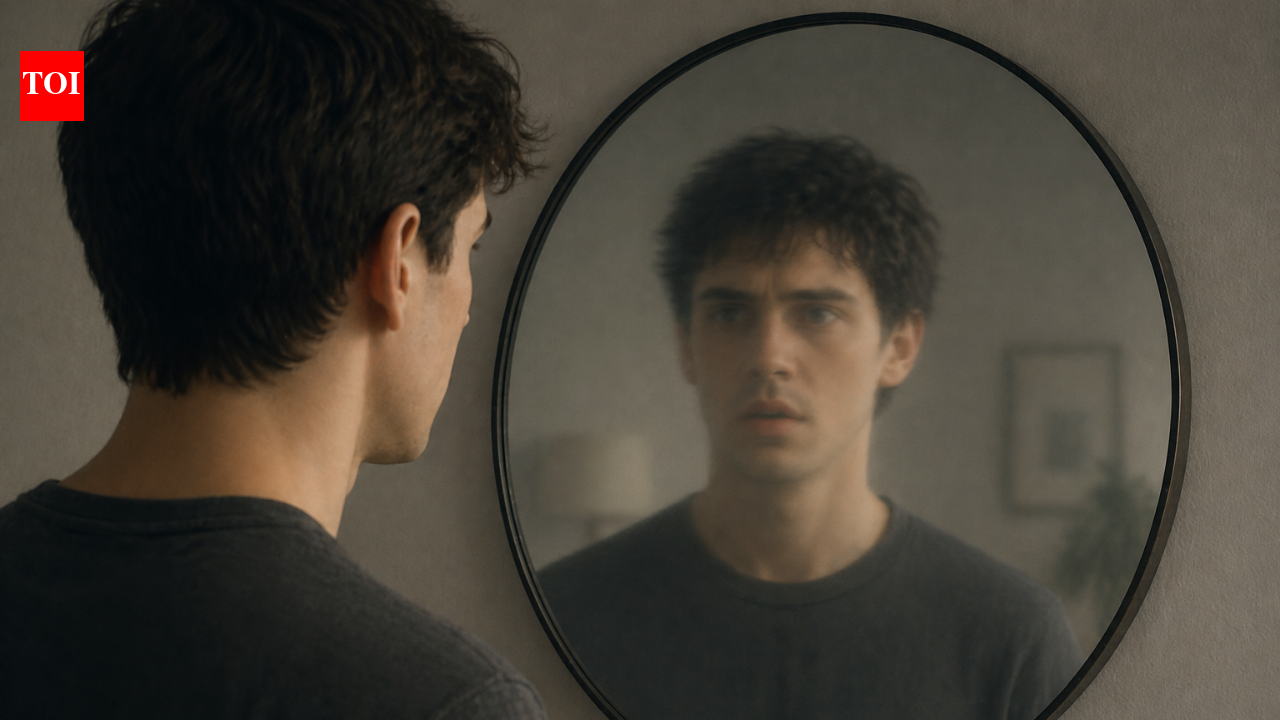
Most people have experienced Deja vu, the strange sense that a moment has already happened. Far fewer recognise its counterpart, Jamais vu, where something deeply familiar suddenly feels unfamiliar or new. This can happen when a common word looks misspelt after repeated reading, or when a well-known place briefly feels strange. Although unsettling, the experience is usually brief and harmless. Researchers describe it as a temporary mismatch between memory and perception, where recognition fails even though the brain still holds the correct information. While the exact cause is still being studied, jamais vu offers insight into how the brain processes familiarity, attention, and memory.
What is jamais vu, the exact opposite of deja vu
Jamais vu, a French term meaning “never seen,” refers to a momentary loss of familiarity with something that is actually well known. Unlike deja vu, where the brain incorrectly signals familiarity, jamais vu involves the opposite effect, where recognition temporarily drops out. People often notice it when a familiar word suddenly appears incorrect after repetition, or when a routine environment briefly feels unfamiliar. The experience is typically short-lived and resolves without lasting effects.Scientists believe jamais vu reflects a temporary disruption in how the brain links memory with perception. Research led by Chris Moulin at Université Grenoble Alpes has shown that the phenomenon can be triggered in controlled conditions. In these experiments, participants asked to repeatedly write or read the same word began to report that it looked strange or incorrect, even though they knew it was spelled correctly.This suggests that excessive repetition can overload the brain’s recognition system, causing a breakdown in the feeling of familiarity. Neuropsychologist Karen D. Sullivan describes this as “recall without recognition,” where memory remains intact but the sense of familiarity temporarily fails. In simple terms, the brain knows the information but momentarily fails to recognise it as familiar.
Why does it happen?
Researchers suggest that jamais vu can arise from everyday cognitive processes such as repetition, fatigue, stress, and reduced attention. According to Dung Trinh, disruptions in attention or temporary imbalances in brain activity may lead the brain to misclassify familiar information as new.In practical terms, when the brain becomes overloaded or less focused, it may stop processing familiarity efficiently. This results in a brief but noticeable sense that something well known suddenly feels unfamiliar.
Is it linked to medical conditions?
Although usually harmless, jamais vu has also been observed in certain neurological contexts. Neurologist Jacqueline A French explains that the phenomenon can occur during the aura phase of Epilepsy, particularly when electrical activity affects the temporal lobe, a region closely linked to memory.It has also been reported in people experiencing Migraine auras, as well as in conditions involving memory or language disruption. In such cases, the experience may be more intense or occur more frequently than in the general population.For most people, occasional jamais vu is not a cause for concern. It tends to be brief and resolves quickly on its own. However, experts suggest that if the experience happens frequently, lasts longer than a few moments, or is accompanied by confusion or distress, it may be worth seeking medical advice.Persistent or recurring episodes could indicate an underlying neurological or psychological condition that requires evaluation.
What it reveals about the brain
Jamais vu highlights how delicate the brain’s sense of familiarity is. Even a slight disruption in the coordination between memory and perception can change how reality is experienced. Researchers study this phenomenon to better understand how the brain distinguishes between what is known and what is new.Although less well known than deja vu, jamais vu provides valuable insight into the mechanisms of memory, attention, and perception. It shows that even the most familiar aspects of our lives depend on finely balanced brain processes that can occasionally misfire.

