


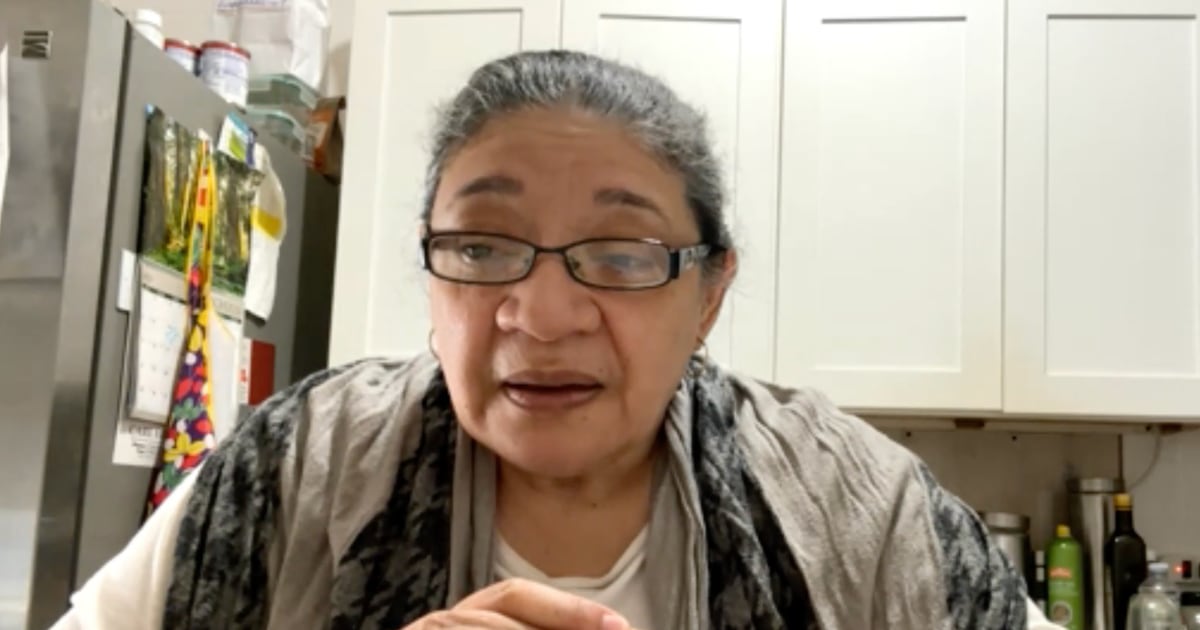
In the 30 years she’s lived in New York, Odalys González Silvera said she’d seen everything. But she wasn’t prepared for what happened to her recently.
Subscribe to read this story ad-free
Get unlimited access to ad-free articles and exclusive content.

“Although I sought advice and researched a number of things, unfortunately I fell victim to immigration fraud. I think this internet thing doesn’t help,” she said.
González Silvera, 61, a Venezuelan immigrant and a legal resident of the U.S., runs a small grocery store distribution business in the Bronx. She said her life changed dramatically after she sought legal help for a family member in immigration detention in Arizona.
After seeking a lawyer there who was unable to make progress on the case, González Silvera said she contacted a Facebook account that appeared to belong to a law firm called “Berman & Associates,” where a person who identified himself as attorney Enrique De Jesus Duarte promised her that he could secure the family member’s release “within a maximum of 15 days.”
In several WhatsApp video calls, González Silvera said, that person explained the case’s progress to her and then sent her documents via chat and email similar to those used by U.S. Citizenship and Immigration Services (USCIS) that seemed to show that the case was progressing well.

“They show you an office with all their things, their diplomas and the American flag. It’s a really good show, with scenery and everything. I, who was careful about so many things, ended up in a trap,” González Silvera said.
Legal and immigration experts told Noticias Telemundo that fraud schemes through social networks have become more common in recent months amid the surge in immigration arrests and detentions under President Donald Trump’s administration.
A review of the Facebook account González Silvera responded to found it is no longer active. There was no response after an attempt to reach the alleged law firm through contact information provided on a website. Additionally, Noticias Telemundo requested comment from two law firms called Berman & Associates, but neither responded. There was also no evidence that these firms or any of their lawyers are connected to the González Silvera case.
Noticias Telemundo also contacted an attorney named Enrique De Jesús Duarte, who responded in an email that he had to create a website “aimed at alerting the public about the possibility that one or more people are trying to impersonate me.” Duarte added that he could not help González Silvera’s family member because he has never handled immigration cases. “I am sorry to hear that someone has been the victim of identity theft,” he said.
Noticias Telemundo searched public records of U.S. lawyers — including state databases and professional directories — for the names used by the people who contacted the victims interviewed in this story. In several cases, no verifiable matches were found. In others, the names belonged to real lawyers who indicated they had no connection to the events described in this report.
As part of this report, there were attempts to contact the accounts, phone numbers and email addresses used in the alleged schemes, as well as the firms and individuals mentioned by the victims. However, at the time of this story’s publication, we had not received any response, nor did we find any evidence that those firms or any lawyer were related to the González Silvera case.
The rise of scams
From the very beginning, González Silvera began paying the scammers via Zelle electronic transfers. She first transferred $870 for them to take the case, then $1,230 for filling out a form, then $2,427 for a supposed bond, and she also had to send $961 for the lawyer’s supposed “travel expenses,” even though the lawyer never visited her family member. In total, she spent $5,488.
“I’m not going to get the money back, but this is a learning experience,” she said, adding that the worst part was getting her detained family member’s hopes up.
González Silvera realized she was being scammed when they started asking her for an additional $1,241 to buy tax stamps related to the Venezuelan regime.
“That’s when I said, ‘But what tax stamps if Venezuela has no diplomatic representation in the United States?’ But it was already too late,” she said.
González Silvera’s case is not unique.
Noticias Telemundo recently published the story of Evelyn Molina, a Peruvian immigrant and asylum-seeker who was scammed by a purported law firm on Facebook that promised her residency through a fictitious virtual hearing. This revealed a pattern of scams involving fake law firms and lawyer identity theft targeting desperate immigrants.
“With recent changes in ICE practices, these scammers are increasingly using sophisticated artificial intelligence tools through social media platforms like Facebook, Instagram and especially WhatsApp,” said Pedro Alemán-Perfecto, an immigration policy advocate at CLINIC, the Catholic Legal Immigration Network. “We’ve seen approximately 30 or 40 cases of fraud in the last year, and that’s a lot.”
The Federal Trade Commission warns that digital fraud is on the rise: In 2024 alone, 2.6 million reports of this crime were registered.
‘People don’t report it out of fear’
Following the report on Evelyn Molina’s case, Noticias Telemundo received more than a dozen complaints from Hispanic people who claim to have been victims of similar immigration-related scams.
Six immigrants in five states — New York, Michigan, Florida, Iowa and Washington — lost between $1,300 and $11,000 to criminal networks operating on Facebook, Instagram and WhatsApp. All the accounts shared the same pattern: Social media ads, promises of quick solutions, fake video call hearings or consultations, and wire transfers made to individuals.
“Systems like Zelle, Venmo and PayPal don’t have the protections of a regular bank. If someone claiming to be a lawyer asks you for money that way, it’s a red flag,” said Jacqueline Watson, an immigration attorney and the first vice president of the American Immigration Lawyers Association.
A national poll by KFF and The New York Times released in November found that 41% of U.S. immigrants — including people who had become citizens or obtained legal residency — feared that they or a family member could be detained or deported, a significant increase from 2023, when 26% of immigrants felt the same. One in five (22%) said they personally knew someone who had been arrested, detained or deported since Trump took office, nearly three times the 8% who said so just in April of the same year.
Three out of 10 immigrants (30%) reported being afraid and said they limited their participation in activities outside the home since Trump became president — including avoiding travel, seeking medical care or going to work.
According to some experts, this paralyzing fear and desperation are factors that scammers exploit to put their criminal schemes into action.
In most of the cases analyzed by Noticias Telemundo, the affected individuals decided not to report the scams for fear that it could affect their immigration status or processes.
“Why should we complain? Now immigrants have no rights here, we are worthless,” González Silvera said.

Brayan López, a 26-year-old Mexican immigrant who works in maintenance in Detroit, experienced a similar scam to González Silvera’s. He found a fake lawyer on a Facebook page, identified as Tomás Huerta, who subjected him to a supposed official hearing via WhatsApp.
“The video call seemed fake to me because the guy was even wearing a wig. It was like a court hearing, and they had the American flag in the background,” said López, who added he lost $1,300 in the scam. “People don’t report it for fear of being deported. That’s why they don’t talk about what happens to them.”
Julián Jiménez, a 40-year-old Colombian former police officer living in Kissimmee, Florida, has been waiting for asylum for six years. He said he trusted a group of scammers that used the name of Catholic Charities, one of the most respected immigrant aid organizations in the country.
On Facebook, Jiménez clicked on ads for a supposed branch of Catholic Charities in Washington, D.C. There, according to Jiménez, he was contacted by a man who identified himself as attorney Óscar García. García called him, reviewed his case, and promised him a path to residency, charging him a total of $4,500 in several installments. His case, of course, went nowhere.
“They’re using our religion to scam us. It’s very sad that they’re playing with the feelings of people who want to be in this beautiful country,” said Jiménez, who hasn’t reported his case to the authorities. “We’re afraid to approach the appropriate authorities because of all the arrests that are happening right now.”

Catholic Charities has publicly warned that its representatives are being impersonated to scam immigrants.
“Scammers are using the name, images, and likeness of Catholic Charities USA — or just the name Catholic Charities in general — to scam immigrants by promising them services and then not following through” Cecilia Baxter, an attorney with Catholic Charities, said in a recent interview with the Catholic Worldwide Network.
Nelson Torres Sifontes, a 40-year-old Venezuelan living in Tampa, Florida, said that following Trump administration restrictions on temporary protected status and asylum, he turned to Facebook to try to improve his immigration status. He contacted someone who identified herself on Facebook as “Attorney Luciana Miller,” who promised to obtain his green card quickly.
Noticias Telemundo found no evidence of a lawyer named Luciana Miller in the directories of the American Bar Association, in other U.S. professional directories, or in web searches within the United States.
Torres said that they first charged him $370, and then $2,000. Although Torres says they sent him supposed USCIS documents about his case, he became alarmed when they demanded an additional $5,000, which he had to pay within a month.
He told Noticias Telemundo that what impressed him most was the sophistication of the scam, because the fraudsters replicated a virtual immigration hearing down to the last detail.
“It was so perfect. It’s like when you go to a judge, everything was identical, but it was virtual. A person was dressed as if they were an official, with the United States flag. And that’s where I let myself get caught up,” said Torres, who has not filed any complaint with the authorities.
“I would like to hire a lawyer, but I’m afraid because an acquaintance of mine was already taken away and he also had TPS,” he said.
Rogelio Martín Morales, a 43-year-old Guatemalan immigrant living in Fort Dodge, Iowa, was facing delays in his asylum case when he decided to contact an immigration law firm through Facebook, which he began making small payments to over the course of a year. However, the law firm turned out to be fake. He said he ended up losing about $11,000 through Zelle, bank transfers and remittances to individuals.
“Sometimes it makes me sad. One day I even started crying. … It’s been very hard,” Morales said.

Morales said the scammers set up fake hearings via video call and sent him purported official documents. According to Morales, he realized it was a scam when the supposed lawyers told him that USCIS had sent some documents to his home, but because he was at work, the mail carrier returned them, and to get them back he would have to pay even more money.
“I didn’t report that because right now I’m afraid, mostly that they’ll catch me or take me out of this country,” he said.
Of the people who contacted Noticias Telemundo to share their cases, only one family filed a complaint with their local sheriff’s office, but not with immigration authorities or the FBI.
This was the case of Miguel Melillo, a 51-year-old Venezuelan resident of Vancouver, Washington, who spent two months negotiating with a purported law firm called “Sánches & Asociados,” which he found through an Instagram ad.
Noticias Telemundo found no evidence of a firm named “Sánches & Asociados” in U.S. attorney directories, professional registries or web searches.
Melillo says his first contact was with a woman who identified herself as attorney Victoria Hernández, who supposedly reviewed his case. He then had a video call with someone who presented himself as a USCIS official in a space resembling a government office, complete with the American flag and diplomas on the walls.
Then they explained the steps for the citizenship interview. When that day arrived, Melillo and his wife woke up at 5 a.m. waiting for the call. When they were finally contacted at 9 a.m., something caught their attention.
The USCIS officer, Melillo said, was the same director of the law firm, only he had grown a mustache and the office was different. “The scene behind it was something else entirely — he had American flags and things like that,” Melillo recalled. “Everything was well prepared.”
Melillo said the law firm asked for $3,687 to “process” his green card. However, Melillo says he only lost $2,500 in total because he stopped paying when he realized the emails he was receiving from USCIS didn’t have the “.gov” domain, typical of U.S. government agencies, but instead ended in “.net” or “.com.”
Noticias Telemundo requested official comments and data on these types of scams from the Department of Justice, the FBI and USCIS. Only USCIS responded, through spokesperson Matthew J. Tragesser, who said in an email that the agency has declared “all-out war on immigration fraud in all its forms.”
“Immigration scammers contribute to an environment of disorder, undermining our immigration system and posing risks to national and public safety,” Tragesser said.
USCIS pointed to a recent federal case in the Eastern District of New York in which five people were charged in February 2026 for allegedly impersonating immigration judges, agents and lawyers through a network that operated on Facebook, with more than $100,000 in fraudulent transactions identified.
Noticias Telemundo also contacted Meta, the company that owns Facebook, Instagram and WhatsApp, the three platforms where the frauds analyzed in this reporting originated. The company launched an investigation into the accounts on its platforms linked to these cases and proceeded to delete them.
Daniel Roberts, a spokesperson for Meta, responded in a statement saying the company does not want “this type of content on our platforms. It violates our policies, and we remove it as soon as we detect it.” Roberts said that Meta’s work regarding these scams “never ends” because criminals “constantly adapt and develop new methods to circumvent our systems.”
Meta recently revealed that in 2025 it removed more than 159 million fraudulent ads, 92% before anyone reported them, and dismantled 10.9 million accounts on Facebook and Instagram linked to criminal scam hubs.
The FTC, for its part, reported that in 2024, U.S. consumers lost $12.5 billion to fraud, a 25% increase over the previous year, with identity theft scams being the most frequent category, with losses of $2.95 billion.
How to avoid immigration-related scams
Experts agree on some basic recommendations for people seeking legal advice related to their immigration status or cases.
First, verify the attorney’s license. All states have a website where you can confirm whether an attorney or accredited representative has an active practice license.
Don’t pay via Zelle or instant transfer systems. Legitimate legal organizations and private lawyers always present a formal contract and collect payment in a planned manner, not instantly.
Go to offices in person: Reliable organizations always try to meet with the client in person before starting any procedures.
Be wary of people who say they can resolve immigration cases quickly. “If they are promising to complete your case in a month, that is not going to happen,” said Alemán-Perfecto, the CLINIC immigration policy advocate.
Don’t sign blank forms. Scammers often send forms similar to official documents via social media, but they are blank so that people sign them quickly without having the opportunity to review them carefully.
Consult with two or three other legal representatives before deciding whom to use. Experts insist that it’s always important to compare opinions.
Use reliable free resources. Websites such as cliniclegal.org, USCIS and other immigration organizations offer free resources and guidance.
González Silvera agreed with the experts’ advice and said she decided to share her story because “people need to understand that they must be very careful with these scams.”
In the meantime, she has hired a pro bono attorney to help with her family member’s case.
González Silvera has a recommendation for those seeking legal advice on immigration cases.
“I think immigration matters should all be done in person, going to the office, meeting the people. I thought something could be done well online,” she said. “But that didn’t work out at all.”
An earlier version of this article was first published on Noticias Telemundo.

