


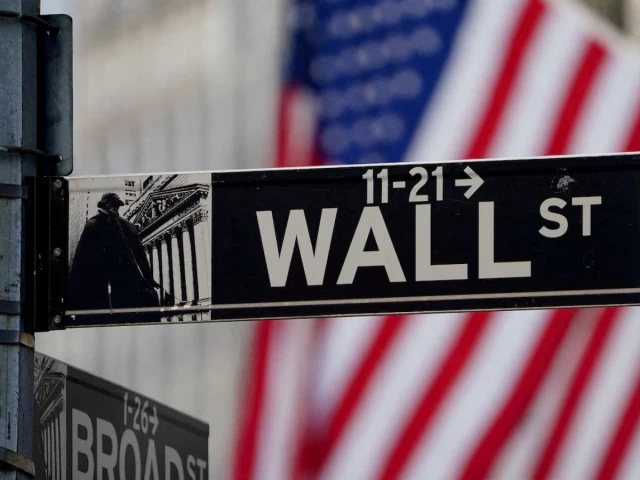
The Wall Street sign is pictured at the New York Stock Exchange in the Manhattan borough of New York City, New York, U.S., March 9, 2020. REUTERS
The traditional relationships between global financial assets have broken down since the outbreak of the Middle East conflict, leaving investors navigating markets with what analysts describe as a “faulty instrument panel”.
Despite geopolitical tensions and uncertainty over energy supplies and long-term economic damage, stocks on S&P 500 continue to hover near record highs, masking underlying stress across asset classes.
Strategists say the next few months are unlikely to resemble pre-conflict conditions.
“The growth factor is recovering, but remains below late-2025 levels, the rates (monetary policy) factor remains elevated, correlations are shifting, and drawdown risk is rising. Something new is forming,” said Mark McCormick.
Bonds fail stress test
Traditionally, stocks and bond yields move in opposite directions as investors hedge equity risks by buying bonds. However, that relationship has become increasingly erratic, particularly after the pandemic and now the war.
The International Monetary Fund had already warned before the conflict that investors may need to rethink risk strategies in a “new era” where traditional hedges fail.
Two-year bond yields—highly sensitive to inflation and interest rate expectations—have been at the centre of volatility. The rolling correlation between two-year US Treasury yields and the S&P 500 has plunged to around -0.8 from a five-year average of 0.23, and stands near -0.63 since the war began.
“There definitely wasn’t a move into sovereign fixed income in March, which, at least at the front end, you might have expected,” said Michael Metcalfe.
“This was a hard test for fixed income, because it was an inflation shock and also potentially a growth shock, which doesn’t help the long-term fiscal concerns,” he added.
Gold loses safe-haven appeal
Gold, traditionally a refuge in times of crisis, has also behaved unusually. Instead of rising, it has moved closely with equities and even cryptocurrencies, and remains about 10% below pre-war levels.
Its negative correlation with the US dollar has weakened to around -0.19 from a typical -0.4, while its correlation with stocks has climbed to about 0.55, more than double its five-year average.
Meanwhile, the inverse relationship between the dollar and stocks has strengthened sharply, with correlation hitting -0.94—an almost perfect inverse link.
Cryptocurrencies have also failed to provide diversification. Bitcoin’s correlation with equities has surged to 0.96 from about 0.4 before the conflict.
Currency signals blur
Currency markets have also defied expectations. Normally, higher interest rates in one region strengthen its currency, but that link has weakened.
The European Central Bank is expected to raise rates twice this year, while the Federal Reserve is leaning towards cuts. Yet the euro, trading near $1.17, has barely recovered from war-driven losses.
“Extraordinary events can have unusual effects on financial markets, often altering traditional relationships between financial variables,” analysts at UniCredit said.
They added that rate differentials are unlikely to regain their influence on euro-dollar movements until war-related risk premiums subside.
Inflation link breaks
Rising oil prices—typically associated with higher inflation expectations—have also failed to follow historical patterns.
Long-term US inflation expectations, measured through forward swaps, have edged down to about 2.4% despite oil prices remaining roughly 40% higher.
The correlation between oil prices and inflation expectations has flipped negative to around -0.7, compared to a five-year average of 0.2.
According to Deutsche Bank, this divergence may reflect expectations of rising US fiscal deficits as Washington funds the war, or a broader disconnect between inflation expectations and underlying fundamentals.
As a result, analysts warn that markets are increasingly “divorced from fundamentals”, complicating investment decisions in an already volatile geopolitical environment.

