


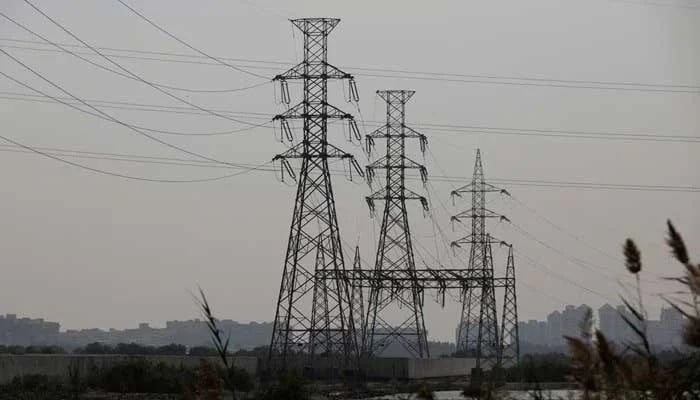
- Rising demand forecast driven by recovery, industrial growth.
- Power consumption is currently declining nationwide.
- Solar rooftop and net metering reducing grid demand.
Pakistan is projected to need an additional 62,660 to 70,720 megawatts of power generation capacity by 2035 to sustain the expected economic growth of 3.5% to 6.4%, according to the revised Indicative Generation Capacity Expansion Plan (IGCEP) 2025–35.
The 10-year plan, developed by the Independent System and Market Operator in coordination with the National Electric Power Regulatory Authority (Nepra) and other stakeholders, provides a roadmap for expanding both generation and transmission infrastructure nationwide, including the K-Electric network, The News reported.
Based on three demand scenarios tied to GDP growth — 3.52% (low), 4.95% (medium), and 6.37% (high) — the country’s capacity addition needs have been estimated at 62,657MW, 66,459MW and 70,720MW, respectively.
The projections reflect expectations of rising electricity demand driven by economic recovery and industrial growth. However, the assumptions come amid a noticeable decline in power consumption.
The plan notes that the system’s load factor has fallen from 70-73% to around 58-60%, indicating significant underutilisation of existing capacity. Distribution companies have also reported a drop in grid consumption due to economic pressures and the rapid uptake of rooftop solar and net metering.
Despite this trend, planners consider the decline temporary and expect demand to stabilise over time, supported by demand-side management measures aimed at improving system efficiency and raising the load factor to around 70% by 2035.
The IGCEP signals a clear shift in the energy mix towards domestic and renewable sources. By 2035, hydropower is projected to account for 34% of installed capacity, while variable renewable energy — including solar and wind — will make up 27%.
In contrast, reliance on imported fuels is expected to decline, with furnace oil phased out entirely, and imported coal and RLNG contributing 7% and 13%, respectively.
The plan includes significant additions across technologies, including 21,400MW of hydropower, up to 13,200MW of solar, and as much as 11,500MW of wind capacity, depending on the growth scenario. It also incorporates 8,224MW of RLNG, 4,730MW of nuclear and smaller contributions from local coal, gas and bagasse-based plants.
At the same time, the financial implications remain substantial. Total investment in generation is estimated between $46 billion and $54 billion, with an additional $4.6 billion to $6 billion required for transmission expansion under the parallel Transmission System Expansion Plan.
The revised plan also introduces flexibility through the concept of least-cost violation to accommodate strategic projects, including large hydropower and solar schemes, while factoring in the growing role of distributed generation. Net metering alone is projected to add 8,120MW to the system over the planning horizon.
Meanwhile, electricity supply from the national grid to K-Electric is expected to increase to 3,456MW by 2035, up from the currently contracted 2,050MW, reflecting evolving system integration requirements.
While the plan aims to ensure adequate base-load capacity through hydropower, nuclear, and gas-based plants to manage renewable intermittency, analysts say its success will depend on how demand evolves in the coming years.
With consumption patterns shifting and decentralised solar generation expanding rapidly, concerns remain that overly optimistic demand projections could lead to excess capacity and higher costs for consumers if growth does not materialise as anticipated.

