


Says ‘It is not just inflation, but impacts on growth, exports, remittances and investment flows’
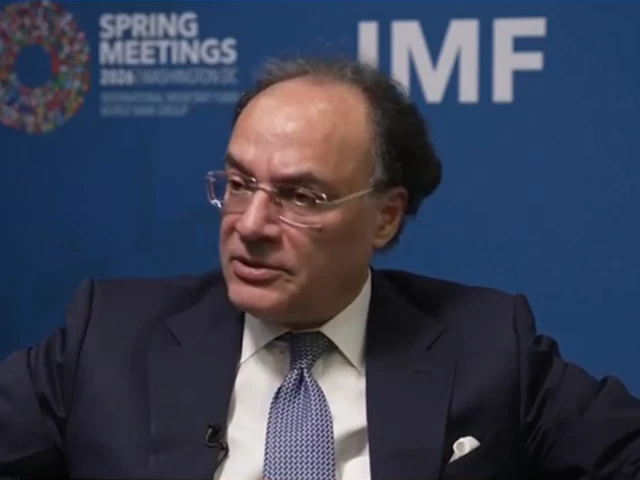
Finance Minister Muhammad Aurangzeb in an interview at the World Bank Spring Meetings 2026 with China Global Television Network’s program “The Heat”. PHOTO: SCREENGRAB
Finance Minister Aurangzeb on Saturday said Pakistan’s economy remained stable amid rising global uncertainty triggered by the Gulf conflict, but warned that prolonged geopolitical tensions could weigh on inflation, growth, and external balances.
In an interview with China Global Television Network (CGTN)’s programme The Heat, Aurangzeb said the government was currently managing the “first-order impact” of surging energy prices through careful procurement, pricing strategies and a shift from blanket to targeted subsidies.
“We have been very focused on the procurement of molecules, the pricing, the logistics, how much time it takes, also over a period of time,” he said, adding that uncertainty over the duration of the conflict remains the key risk.
Read: Trump sees ‘good news’ on Iran, still threatens renewed strikes
Despite external pressures, he said Pakistan’s macroeconomic indicators had shown resilience, noting that the country posted a current account surplus of around $1 billion in March, driven by strong remittances and IT exports. Foreign exchange reserves were projected to reach $18 billion by the end of the fiscal year on June 30.
Aurangzeb cautioned that prolonged instability could have broader implications. “Inflation is one [of such indices], and although we are trying to protect our vulnerable part of the population, the targeted subsidy has been for two-wheelers, public transportation, and agriculture, for small farmers,” he said.
“We are also looking at elasticities and sensitivities around export volumes, around remittances, around institutional flows, whether they’re on the fixed income side or the equity side, and overall current account balance or payment discussion.”
The minister maintained that Pakistan was on track to achieve around 4% GDP growth in the current fiscal year, citing a rebound in large-scale manufacturing and better-than-expected agricultural recovery following last year’s floods. Growth prospects for the next fiscal year, he added, would depend heavily on how long the global crisis persists.
On remittances, Aurangzeb highlighted their continued importance, with inflows expected to reach approximately $41.5 billion this fiscal year, up from just over $38 billion last year. He said contributions from key markets such as Saudi Arabia and the UAE remain stable for now, as most Pakistani workers are engaged in essential services.
Read more: Aurangzeb secures $3b Saudi deposit extension
The minister also pointed to increased inflows through the Roshan Digital Account (RDA), which caters to overseas Pakistanis investing in financial instruments and real estate. March saw inflows rise to $261 million, significantly above the usual monthly average.
Interestingly, Aurangzeb noted that disruptions in regional trade routes had led to increased activity at Pakistani ports, particularly Karachi and Gwadar, the latter developed with Chinese assistance. “It’s a question of, again, duration and intensity,” he said when talking about translating this momentum into long-term gains.
Addressing climate challenges, the finance minister described climate change as an “existential issue” for Pakistan. He outlined efforts to expand renewable energy capacity, including 8,000 megawatts of solar power, and improve climate forecasting using artificial intelligence through a national data management system.
He added that Pakistan was also mobilising climate financing through partnerships with institutions such as the World Bank Group, International Monetary Fund and the Asian Development Bank.
On long-term economic strategy, Aurangzeb reaffirmed Islamabad’s commitment to advancing the second phase of the China-Pakistan Economic Corridor, which focuses on industrial cooperation, agriculture and export-led growth.
Also read: SPI inflation hits 75-week high
“Phase two is all about monetisation of the infrastructure, which was created in phase one. Phase two is essentially business-to-business in terms of industries getting relocated to Pakistan and export from here, because China is moving up the value chain,” he said, adding that technology transfer in agriculture and increased use of AI and modern farming techniques could significantly boost productivity.
Aurangzeb also revealed that bilateral trade with China was expanding, with nearly a quarter now being settled in Chinese yuan, reflecting deepening economic ties. However, while acknowledging emerging opportunities, the finance minister emphasised that risks remain elevated due to the current conflict.

