


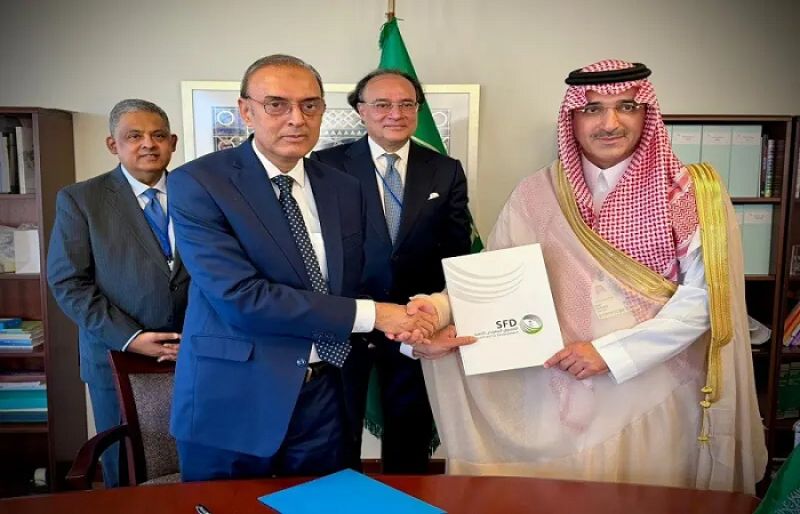
Pakistan and Saudi Arabia have signed Saudi Deposit Extension Agreement during a ceremony in Washington. Federal Minister for Finance and Revenue Senator Muhammad Aurangzeb witnessed the signing of the important financial agreement in Washington, D.C., in the presence of the Ambassador of Pakistan to the United States, on the sidelines of the World Bank-IMF Spring Meetings 2026.
The agreement, signed between the Saudi Fund for Development (SFD) and the State Bank of Pakistan (SBP), provides for the extension in the maturity of a US$3 billion deposit placed by SFD with the State Bank of Pakistan.
The agreement was signed by Sultan bin Abdulrahman Al-Marshad, Chief Executive Officer of the Saudi Fund for Development, on behalf of SFD, and Jameel Ahmad, Governor of the State Bank of Pakistan, on behalf of the SBP.
The extension of the deposit reflects the strong and longstanding economic partnership between Pakistan and the Kingdom of Saudi Arabia, and will further support Pakistan’s external sector stability.
Pakistan appreciates China’s continued support at IMF
Federal Minister for Finance and Revenue Senator Muhammad Aurangzeb also held a productive meeting with Dr Pan Gongsheng, President of the People’s Bank of China (PBOC) in Washington.
During the meeting, the Finance Minister expressed appreciation for China’s continued support for Pakistan at the International Monetary Fund (IMF), particularly within the IMF Executive Board.
Aurangzeb informed Dr Pan that Pakistan has successfully concluded a Staff-Level Agreement with the IMF for the third review under the Extended Fund Facility (EFF) and the second review under the Resilience and Sustainability Facility (RSF), with approval by the IMF Executive Board expected shortly.
The Finance Minister also provided an update on Pakistan’s plans for its inaugural Panda Bond issuance and requested expedited approval from the National Association of Financial Market Institutional Investors (NAFMII).
He further apprised the PBOC President that Pakistan has recently met its Eurobond repayment obligations and has received additional financial support from the Kingdom of Saudi Arabia.
Aurangzeb highlighted the immediate economic impact of the ongoing regional conflict, noting that the government has activated targeted subsidies and demand management measures to mitigate its effects.
The meeting concluded with Dr Pan extending an invitation to the Finance Minister to visit Beijing in near future.
Minister engages global investors at JP Morgan seminar
Finance Minister Aurangzeb participated in the JP Morgan Investment Seminar titled “Pakistan: Economic and Monetary Policy Outlook”, where he engaged with global institutional investors on the sidelines of the World Bank–IMF Spring Meetings 2026.
Governor State Bank of Pakistan also joined the session.
Opening the discussion, the Finance Minister informed participants that Pakistan has successfully concluded a Staff-Level Agreement with the IMF for the third review under the Extended Fund Facility (EFF) and the second review under the Resilience and Sustainability Facility (RSF).
Aurangzeb expressed confidence that Pakistan will continue to meet all its external obligations in a timely manner, highlighting the financial support committed by the Kingdom of Saudi Arabia as a key factor in strengthening the country’s external position.
He also briefed investors on progress towards Pakistan’s inaugural Panda Bond issuance, as part of the government’s broader strategy to diversify financing sources and deepen engagement with international capital markets.
He provided a detailed overview of the government’s energy supply management strategy in the wake of the ongoing regional conflict, noting that measures such as demand management, market timing adjustments, and full price pass-through – supported by targeted digital subsidies for vulnerable segments – have been implemented to manage the impact.
The session concluded with an interactive question-and-answer segment, during which investors raised queries relating to potential additional IMF financing, progress on the privatization programme, and Pakistan’s strategic role in the evolving regional environment.

