



The world is producing enough food, yet 37.4 million people are living at IPC Phase 4 in 2025. That is the emergency level of food insecurity, where families face extreme food gaps, very high malnutrition, and rising deaths. This marks the highest figure since 2021, when the total peaked at 39.2 million. As reported by World Food Program USA, it is also more than 2.5 times the 14.5 million recorded in 2016.
The raw number, however, is only part of the story. The geography of hunger is narrowing. In 2025, 85.7% of people in Phase 4 lived in “watchlist” countries, up from 78.6% a year earlier. That is 32 million people, against just 5.4 million in the rest of the world.
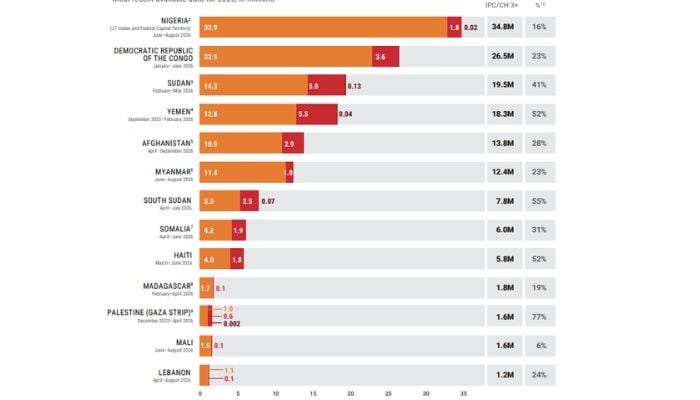
Number of people facing high levels of acute food insecurity in hunger hotspots (FAO-WFP)
The most alarming trend sits at the top of the scale. The number of countries with populations in IPC Phase 5, the catastrophe category, has tripled from two in 2016 to six in 2025, including Haiti, Mali, Gaza, South Sudan, Sudan, and Yemen. Together, they held about 1.41 million people in catastrophic hunger in 2025.
The distribution is stark. Gaza (about 641,000) and Sudan (about 637,000) account for roughly 90% of the total. South Sudan follows with 83,000, then Yemen with 41,000, Haiti with 8,400 and Mali with 2,600.
FAO and WFP’s latest early-warning analysis identifies 13 hunger hotspots through November, 2026. Armed conflict is a primary driver in 12 of them. Sudan has 14 areas at risk of famine, and 15 areas hold population at risk to face catastrophe. Nigeria joined the highest-concern category this year, with Borno State facing alarming conditions.Somalia’s Burhakaba district was added after a failed rainy season and rising prices.
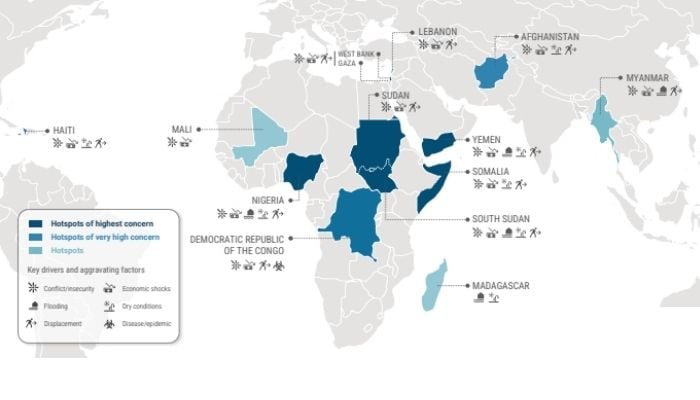
Map of early warning hunger hotspots: June to November 2026 (FAO-WFP)
José Graziano da Silva, a former FAO director-general, argued in his analysis titled “Food Under Fire: Breaking the vicious cycle of conflict and hunger” that the world no longer lacks information. Satellite data, market monitoring, and early-warning systems all exist. Ten years after the UN Security Council first took up the issue, and eight years after Resolution 2417 condemned starvation as a method of warfare, he says the failure is one of enforcement in early action. In Gaza and Sudan, he notes, the destruction of food systems and obstruction of aid have made hunger an increasingly open weapon.
This raises another connected issue of collapsing funding. Humanitarian assistance to food sectors in crisis countries fell an estimated 59% between 2022 and 2025, returning to 2016-17 levels. As reported by AP, the Trump administration terminated around 83% of USAID global programs. Reuters reported that major emergency food contracts, affecting millions in regions like Afghanistan, Syria, Yemen, Sudan, and various refugee camps in Kenya and Thailand were abruptly slashed or cancelled, leading to severe rations drops, shuttered communal kitchens, and rising acute hunger.
The share of people facing acute hunger has doubled since then. By June 2026, only a third of global humanitarian requirements had been funded, and aid agencies are prioritizing 87 million people for life-saving help out of 135 million targeted.
The cuts reach the data too. WFP survey interviews dropped from 1.1 million down to 800,000 and several analyses, including WFP’s household surveys (the primary field interviews used to track vulnerable families and assess deep food security trends) have moved from twice yearly to annual cycles. The number of active real-time monitoring country offices plummeted from 35 in 2022 to just 18. This makes it harder to see where the next crisis is forming.
In 2026, three pressures i.e., war and energy, El Nino, and inflation are now compounding the structural crisis. Disruption around the Strait of Hormuz, which carried about a fifth of global oil and a third of fertilizer trade, pushed fuel prices up 40% in a single month in March. Urea prices jumped nearly 46% between February and March. Import-dependent economies such as Yemen, Lebanon, Somalia, and Myanmar are absorbing the cost through higher food prices and costlier air shipments.
El Nino is also expected to strengthen into early 2027, raising the odds of drought in southern Africa and the Sahel and flooding in parts of East Africa and Central Asia. The September Global Crop Monitor update warns of disrupted rainfall and extreme heat, with impacts depending on each country’s capacity to respond.
This data points to uncomfortable conclusions. First, hunger is now primarily a political problem as it is weaponized through conflict and geopolitical leverage. In contemporary conflict zones, hunger is rarely an inevitable consequence of war; it is a manufactured outcome driven by political strategy and deliberate weaponization.
Second, famine is a failure of timing. FAO and EFP emphasize that modern famines are almost always foreseeable and preventable, and that acting at Phase 3 or 4 costs far less than responding after a famine declaration. Yet funding is flowing in the opposite direction.
Third, concentration cuts both ways. Because hunger is clustered in a few dozen places, targeted action would work. By enforcing humanitarian law, protecting the livelihoods alongside food aid, and anticipatory financing triggered automatically by early warnings can improve conditions if governments choose them.

