


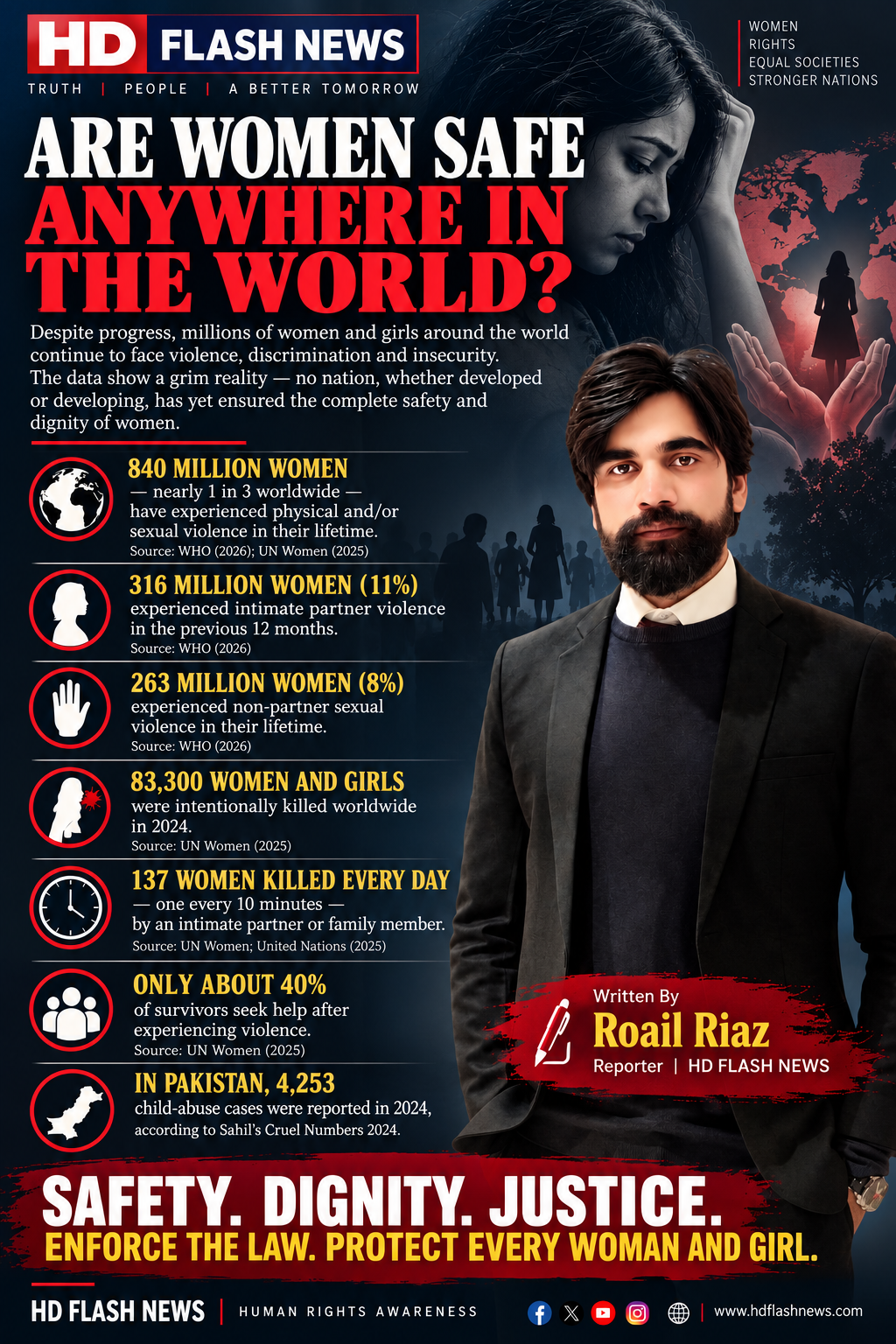
Written By: Roail Riaz | Reporter, HD Flash News
Women are the pride of our homes, our nation, and the entire world. They enrich our lives, strengthen families, and contribute significantly to the progress of societies. Yet, despite their invaluable role, millions of women and girls continue to face violence, discrimination, exploitation, and restrictions on their fundamental rights.
The question remains: Are women truly safe anywhere in the world?
Women: The Foundation of Families and Societies
Women play an essential role in building strong families and prosperous nations. Their journey is often marked by sacrifice, beginning as daughters, continuing as wives, and reaching another profound dimension when they become mothers. They contribute to the well-being of their families, nurture future generations, and promote compassion, understanding, and social harmony.
If women contribute so much to our families and communities, it is our moral responsibility to respect them, protect their rights, and ensure that they receive the dignity and opportunities they deserve. Women are not merely participants in social progress; they are among its strongest driving forces.
Empowering women means empowering society as a whole.
Violence Against Women: A Global Human Rights Crisis
Despite significant advances in education, technology, legislation, and public awareness, violence against women remains one of the world’s most persistent human rights challenges. Women across developed and developing countries continue to experience physical, sexual, and psychological abuse, harassment, discrimination, abduction, and restrictions on their freedom.
In many societies, women are still denied the freedom to make important decisions about their education, life partners, careers, and futures. Deep-rooted gender inequality and male-dominated social structures continue to limit their opportunities and independence.
Although many countries have enacted laws against sexual harassment and violence, weak enforcement, social stigma, fear of retaliation, and barriers to justice often prevent victims from receiving adequate protection.
No society can claim to be fully developed or civilized while women continue to live in fear.
Global Statistics Reveal the Scale of the Problem
The figures cited in the original article, attributed to the World Health Organization (WHO) and UN Women, illustrate the magnitude of violence against women worldwide.
- 840 million women: Approximately 31.6% of women worldwide, or nearly one in three, have experienced physical and/or sexual violence during their lifetime.
- 316 million women: Approximately 11% experienced intimate partner violence during the preceding 12 months.
- 263 million women: Approximately 8% have experienced sexual violence by someone other than an intimate partner during their lifetime.
- 83,300 women and girls: Were reportedly intentionally killed worldwide in 2024.
- Around 50,000 women and girls: Were killed by intimate partners or family members in 2024, representing approximately 60% of female homicides.
- 137 women every day: On average, women are killed by intimate partners or family members at a rate equivalent to one woman every 10 minutes.
- Around 70%: Of women in humanitarian settings reportedly experience gender-based violence, according to the figure cited in the original article.
- Only about 40%: Of survivors reportedly seek help after experiencing violence.
These figures demonstrate the urgent need for stronger prevention strategies, effective law enforcement, accessible support services, and institutions that prioritize survivors’ safety and dignity.
Sources cited in the original article: World Health Organization (WHO), UN Women Knowledge Portal, and United Nations publications. Please verify the precise figures, reporting periods, and source links before publication.
The Situation in Pakistan
Pakistan continues to face significant challenges in protecting women and girls from violence. Although legislative reforms and public awareness initiatives have contributed to progress, serious concerns remain regarding child protection, domestic violence, sexual abuse, abduction, exploitation, and access to justice.
According to the Cruel Numbers 2024 report by Sahil, 4,253 cases involving child abuse and related offences were reported through media monitoring during 2024. These included sexual abuse, abduction, missing children, and child marriage.
The report indicated that approximately nine children were affected each day and that girls accounted for 53% of the reported victims. These figures highlight the vulnerability of children and the need for stronger safeguarding mechanisms.
UNICEF Pakistan has also highlighted concerns regarding violence against children, including physical, psychological, and sexual abuse, trafficking, and exploitation. Gaps in comprehensive child protection case management and referral systems can create further barriers to prevention, reporting, and survivor support.
Incidents That Demand Urgent Attention
Several incidents discussed in the original article illustrate the serious challenges faced by women and girls in Pakistan.
In May 2025, a suicide bombing targeting a school bus in Khuzdar, Balochistan, killed schoolchildren and injured others, drawing attention to the dangers faced by children in areas affected by insecurity.
The original article also refers to a June 2026 case in which Pakistani authorities reportedly rescued a French woman and her five children from alleged captivity in Khyber Pakhtunkhwa following years of reported domestic abuse. The case highlights the difficulties victims can face when seeking safety and escaping prolonged abuse.
Other cases mentioned in the article include the reported rape and murder of a seven-year-old girl in Sargodha, the killing of a three-year-old girl following alleged sexual abuse and torture in Karachi’s Quaidabad area, and the death of an 18-year-old domestic worker in Lahore following reported assaults and complications arising from an illegal abortion.
These cases must be treated with sensitivity, and allegations should be distinguished from facts established through judicial proceedings. They also underline the importance of thorough investigations, accountability, and effective protection for vulnerable women and children.
Why Stronger Laws and Effective Protection Matter
Violence against women affects far more than individual victims. It damages families, undermines public health, restricts educational and economic opportunities, and weakens social development.
Governments must ensure that laws against sexual violence, harassment, domestic abuse, and exploitation are effectively implemented. Law enforcement agencies, courts, social services, educational institutions, and civil society organizations all have a role in preventing violence and supporting survivors.
Women and girls must have access to safe reporting mechanisms, confidential support, legal assistance, healthcare, and protection from retaliation. Child protection systems must also be strengthened so that abuse can be identified early and vulnerable children can receive timely assistance.
The international community must continue working toward Sustainable Development Goal 5, which seeks to achieve gender equality and empower all women and girls, including the elimination of violence against them.
Conclusion: Where Is a Safe Place for Our Women?
Every nation must treat violence against women as an urgent human rights issue. Governments must enforce the law firmly, institutions must protect victims, and communities must challenge the attitudes that normalize abuse and discrimination.
Women are essential to the progress and prosperity of every nation. Without their safety, dignity, freedom, and equal rights, no society can truly advance.
Today, every child might ask in fear: Where is a safe place for my mother?
Every parent might wonder: Where is a safe place for my daughter?
Every family deserves the assurance that its women and girls can live without fear of violence.
As a global community, we must confront a painful reality: Are women truly safe anywhere in this world?
Until we can answer that question with confidence and conscience, our claims of progress, justice, and civilization will remain unfulfilled.
Safety. Dignity. Justice. Every woman and girl deserves all three.

