


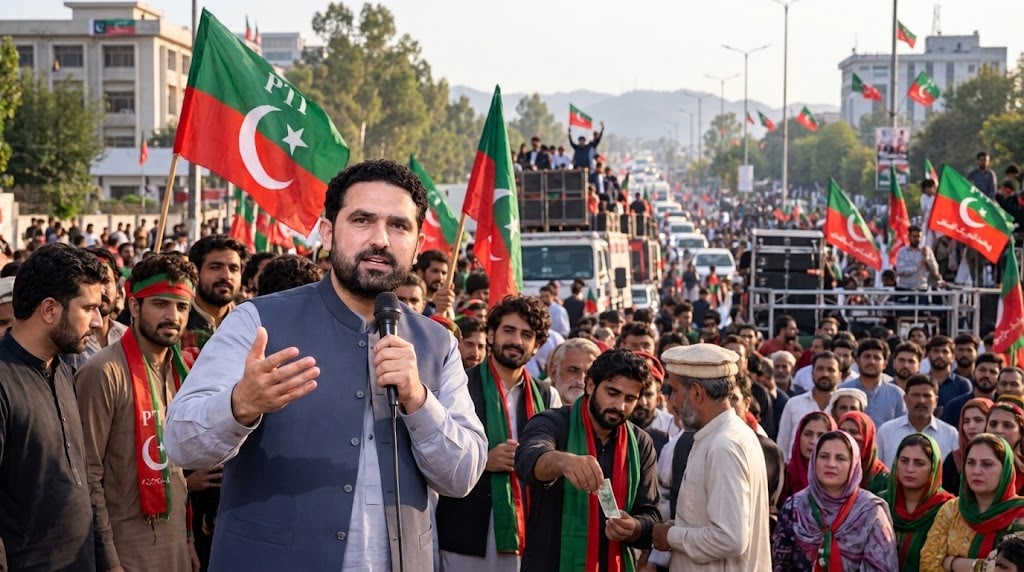
ISLAMABAD – Political tensions continue unabated between Pakistan Tehreek-e-Insaf (PTI) and the federal government as two sidees shared contrasting accounts of their latest negotiations, leaving the future of the ongoing Long March uncertain.
Khyber Pakhtunkhwa Chief Minister Sohail Afridi defended PTI’s seven-point agenda, insisting that none of the party’s demands is unconstitutional or illegal. He said the proposals were aimed at restoring political stability, strengthening the rule of law, protecting the democratic process and addressing the worsening security situation in Khyber Pakhtunkhwa.
Afridi accused the state of treating the province unfairly, saying KP was being treated like a “second-class citizen” and as though it were a stepchild. Afridi also made PTI’s position on the Long March clear, the party is willing to call it off if the federal government provides written assurances that the agreed demands and measures will be implemented. However, he warned that PTI would retain the right to continue its peaceful and lawful protest if those commitments were violated.
PTI’s Seven-Point Agenda
PTI has called for regular meetings between the Prime Minister and opposition leaders from both houses of Parliament. According to the proposal, these meetings should focus on major political, national, constitutional and legal matters, with meaningful progress expected within two months.
The party has also proposed the creation of a joint political negotiating committee comprising representatives of the federal government, the Pakistan Peoples Party and opposition parties. The committee would continue discussions on political disputes and submit recommendations for practical solutions within one month.
A major part of PTI’s demands concerns former prime minister Imran Khan and Bushra Bibi. The party wants both to be provided all legal, constitutional, human and medical rights available to them under the law and prison regulations. PTI has also called for the views of their personal or nominated doctors to be considered wherever permitted by law.
PTI further wants Imran Khan and Bushra Bibi to be allowed to meet family members, nominated lawyers and authorised associates in accordance with prison rules. PTI has clarified that such meetings should not be used for political activities prohibited by law.
Another demand focuses on the cases of prisoners. PTI wants appeals, petitions and other legal applications involving Imran Khan, Bushra Bibi, women, elderly inmates and sick prisoners to be processed according to law within ten days. It has also called for the early release of women political prisoners on humanitarian grounds.
The sixth demand centres on the worsening security situation in KP. PTI wants the federal and provincial governments to maintain continuous consultations on counterterrorism and peace efforts. It has proposed an urgent meeting within 72 hours to develop a clear and workable strategy against terrorism.
The another point directly links negotiations to the Long March. PTI says it will call off the protest once the federal government provides a written commitment guaranteeing implementation of the agreed measures.
Mohsin Naqvi
Interior Minister Mohsin Naqvi, however, offered sharply different account of the negotiations. According to Naqvi, the KP government had agreed to sign a written agreement and submit an implementation plan within 72 hours. He said the proposed plan contained a number of commitments related to counterterrorism and provincial security.
One of the key proposals involved reconsidering the Police Act 2026 in light of the province’s security challenges while ensuring that sensitive security matters remained protected from political interference.
The proposed commitments also included preventing terrorists from operating freely or establishing safe havens in Khyber Pakhtunkhwa.
Naqvi said the KP government was expected to unequivocally condemn the Tehreek-e-Taliban Pakistan, the Tehreek-e-Taliban Afghanistan and all other terrorist organisations.
Did Mahmood Achakzai’s Hard Line cause collapse of Govt-Opposition Talks?
Afghan Refugees and Counterterrorism
The proposed agreement also covered the federal government’s policy on Afghan refugees.
Under the reported commitments, the KP government was expected to support the national refugee policy, including the repatriation of Afghan nationals and the dismantling of Afghan refugee camps in the province.
The provincial government was also expected to maintain no contact with the interim Afghan government. The security framework further included substantial funding for counterterrorism operations and the police, greater provincial ownership of counterterrorism measures and stronger coordination with the armed forces.
The proposed plan also covered counterterrorism decisions in former FATA and the merged districts, along with implementation of the National Action Plan.
Final-Stage Breakdown
Naqvi claimed that the KP government ultimately backed away from these commitments during the final phase of negotiations. He stressed that security issues could not be allowed to become part of political confrontation while Khyber Pakhtunkhwa remained on the frontline of the fight against terrorism.
The conflicting positions have exposed a major gap between the two sides. PTI is demanding political engagement, constitutional guarantees, rights for its leadership and prisoners, and written assurances before ending its street protest.
The federal government, meanwhile, is pressing for concrete commitments on counterterrorism, policing, Afghan refugees and cooperation with security institutions.
PTI Long March kicks off today as Govt-Opposition Talks end in Deadlock