


Want to bookmark your favourite articles and stories to read or reference later? Start your Independent Membership today.
Already a member?
Log in
The case for raising interest rates is “not compelling” unless energy prices stay higher for longer and have a bigger knock-on effect on the wider economy, a Bank of England policymaker has said.
Alan Taylor, a member of the Bank’s Monetary Policy Committee (MPC), played down the need for pushing up borrowing costs amid increased expectations that a hike is on the horizon.
He said in a speech at the Dow Lecture at the National Institute of Economic and Social Research (Niesr): “On the evidence so far, higher energy costs still appear largely concentrated within the energy complex itself rather than spreading widely through the economy.
“Against that backdrop, the case for further rate increases is not compelling to me unless energy prices remain high for an extended period and also generate clearer signals of a transmission into broader inflation persistence, as revealed by the signposts that we are actively monitoring.”
He added the Bank must stay “alert” to developments in the economy, but that the case for an interest rate hike “should rest on evidence that second-round effects are actually gaining traction, rather than on the existence of the energy shock alone”.
So-called second-round inflation effects are those that happen as a result of higher prices, such as workers demanding wage rises to keep up with living costs, or businesses increasing prices because they expect behaviours to change.
Some policymakers at the central bank have said that there have been limited signs of second-round effects in the UK economy since inflation has been rising.
Mr Taylor’s remarks echo those made by the Bank’s Governor, Andrew Bailey, on Monday, who said there was “no question we are seeing the direct effects of the energy shock” but that the pass-through to the wider economy was currently “subdued”.
The direct effects of the energy shock, triggered by the US-Israel war with Iran, have included petrol and diesel prices spiking and the price cap on household energy bills going up.
However, Mr Bailey added: “We haven’t increased bank rates but it’s going to get harder to maintain that stance as energy prices remain higher.”
Deputy governor Clare Lombardelli also recently said that energy price pressure could drive an increase in interest rates unless there is particular weakness in the economy.
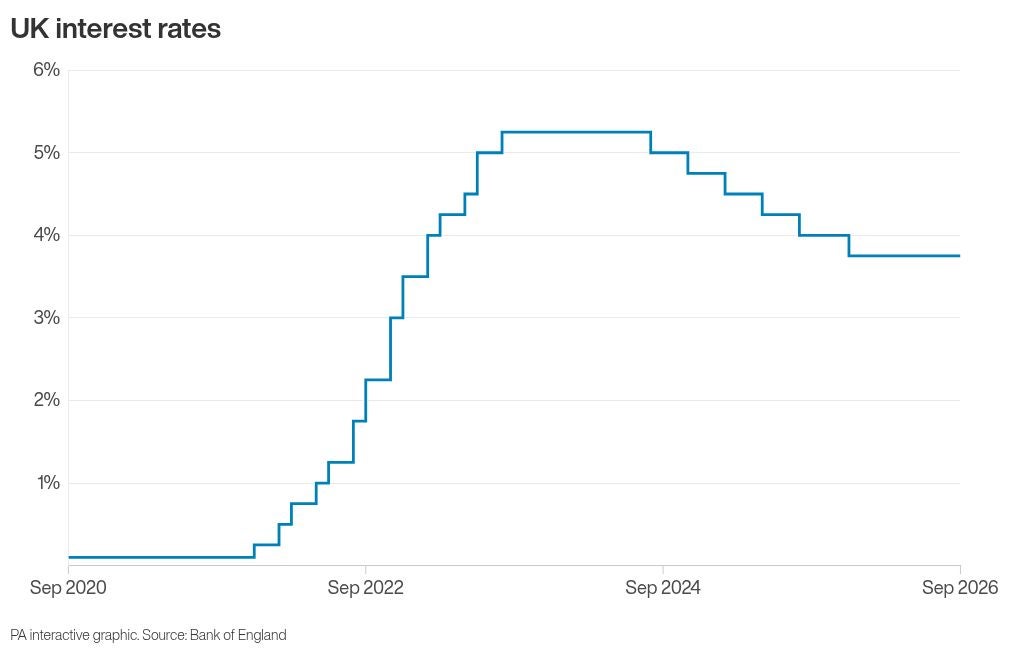
They were part of the six-to-three majority who voted to maintain UK interest rates at 3.75% earlier this month.
In contrast to his fellow MPC members, Mr Taylor pointed to the need for interest rates to come down in the future if pressures on inflation ease and the energy risks abate.
He said there will be a point when “policy will need to move in the other direction – not because the risk has disappeared, but because maintaining an unnecessarily restrictive stance would itself carry costs”.

