


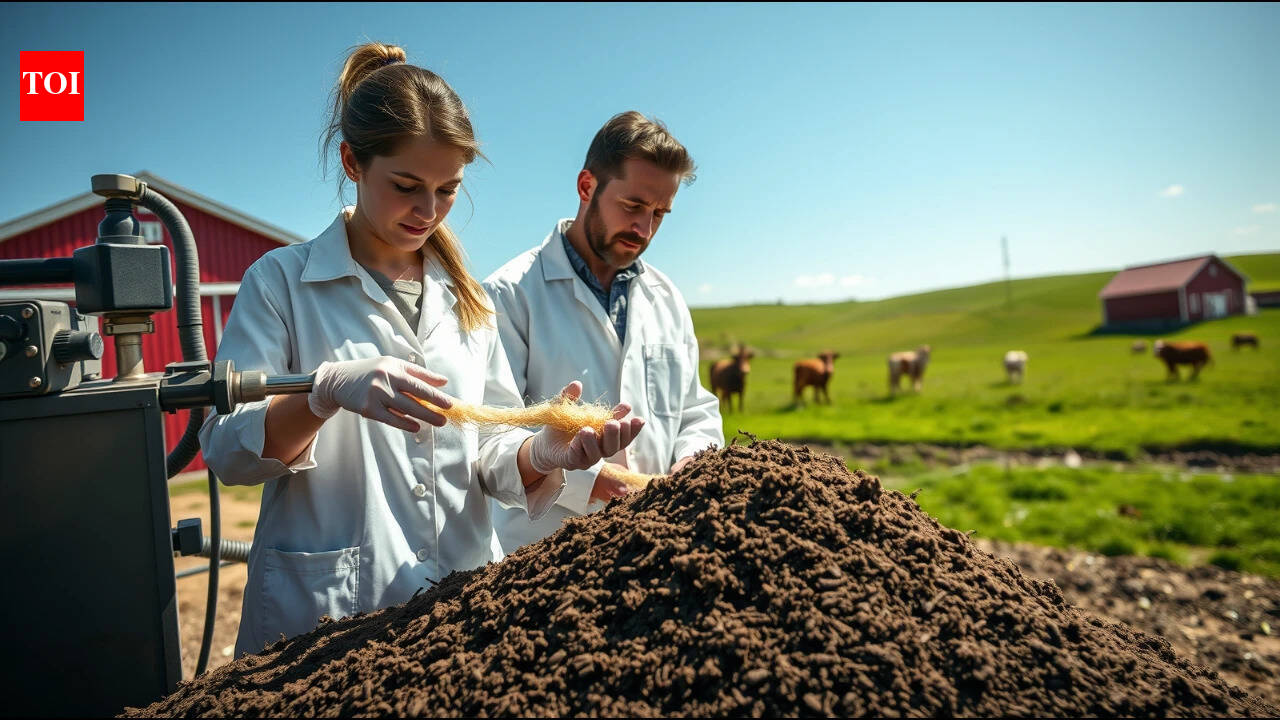
Cow manure could become a source of cellulose for making small-structure materials after researchers developed a method to extract cellulose nanofibrils from the waste and process them into fibres, films and ribbons. Researchers from University College London, Edinburgh Napier University and Teesside University described the work in a study published in the Journal of Cleaner Production titled Harnessing cow manure waste for nanocellulose extraction and sustainable small-structure manufacturing. The team produced type I cellulose nanofibrils from cow manure collected from a local dairy farm, with an average diameter of 12.8 ± 4.1 nanometres, before using the extracted material as the feedstock for a modified nozzle-pressurised spinning process. The researchers say the approach could turn an agricultural waste stream into a source of cellulose-based materials, although the study remains at the research stage and further work is needed to assess large-scale production, cost-effectiveness and solvent recovery.
Cellulose is widely used, but usually comes from plants
Cellulose is a natural polymer found in plant cell walls and is already used across a wide range of industries. The researchers note that cellulose-rich materials are generally obtained from botanical sources such as wood, plant stems and leaves, while waste streams are increasingly being investigated as alternative sources. Cow manure contains undigested plant material, including cellulose, along with hemicellulose and lignin. In the new study, the researchers treated dried manure with sodium hypochlorite and sodium hydroxide solutions to remove non-cellulosic components, producing a cellulose slurry. They then subjected the material to mechanical homogenisation to break the cellulose down into nanofibrils. The paper reports that chemical and structural analyses confirmed the resulting material as type I cellulose, while the nanofibrils had an average diameter of 12.8 ± 4.1 nm. The researchers present this approach as a way of recovering a useful material from agricultural waste rather than relying exclusively on higher-grade conventional cellulose sources.
Pressure and rotation turn the extracted material into different forms
Once the cellulose had been extracted, the researchers used a modified form of nozzle-pressurised spinning to manufacture small-structure cellulose products. The technique, also known as nozzle-pressurised gyration, combines pressure and mechanical rotation to form materials from a liquid feedstock. The technology was developed at UCL in 2013 by a team led by Professor Mohan Edirisinghe. For the manure-derived cellulose, the researchers modified the equipment so that the rotation occurred around a horizontal rather than vertical axis and incorporated a water bath. UCL said conventional attempts to spin the extracted cellulose using the existing setup did not produce fibres. Through experimentation, the team found that the horizontal configuration, combined with injecting the liquid jet into still or flowing water, allowed cellulose fibres to form. By changing the consistency of the cellulose solution, they were also able to produce films and ribbons. The paper describes the modified process as simple, efficient and low-energy, while noting that its practical scalability still requires further investigation.
The process could have applications across several industries
The researchers say the different forms produced from the extracted cellulose could have potential applications in areas including packaging, textiles, food additives, electronics and healthcare. Nanocellulose is already being investigated for uses such as wound dressings, drug delivery systems and tissue-engineering scaffolds because of properties including water retention and biocompatibility, although the new study does not demonstrate that the cow-manure-derived material is ready for these medical applications. Similarly, the research does not show that the material has already been incorporated into commercial packaging or surgical products. Instead, the experiments demonstrate that cellulose recovered from cow manure can be converted into several small-structure forms that have potential for future applications. The distinction is important because the paper itself says that the research is still in its early stages and that scalability, cost-effectiveness, cellulose yield and large-scale solvent recovery require further evaluation.
Turning farm waste into a useful raw material
The researchers see the work as an example of waste valorisation, in which a material normally treated as a disposal problem becomes a potential industrial feedstock. UCL’s Yanqi Dai, the study’s first author, said dairy-farm waste can contribute to waterway pollution, greenhouse-gas emissions during decomposition and the spread of pathogens, while also creating a disposal burden for farmers. The researchers therefore argue that recovering cellulose from manure could provide an alternative use for part of this waste stream. However, the study does not establish that farmers can currently sell manure-derived cellulose or that the process is commercially viable at farm scale. The team is still investigating how the method could be scaled up, and UCL says it is seeking opportunities to work with dairy farmers. For now, the research demonstrates something more specific and defensible: cellulose nanofibrils can be extracted from cow manure and subsequently processed into fibres, films and ribbons using a modified spinning technique, opening a possible route for converting agricultural waste into higher-value materials.

