


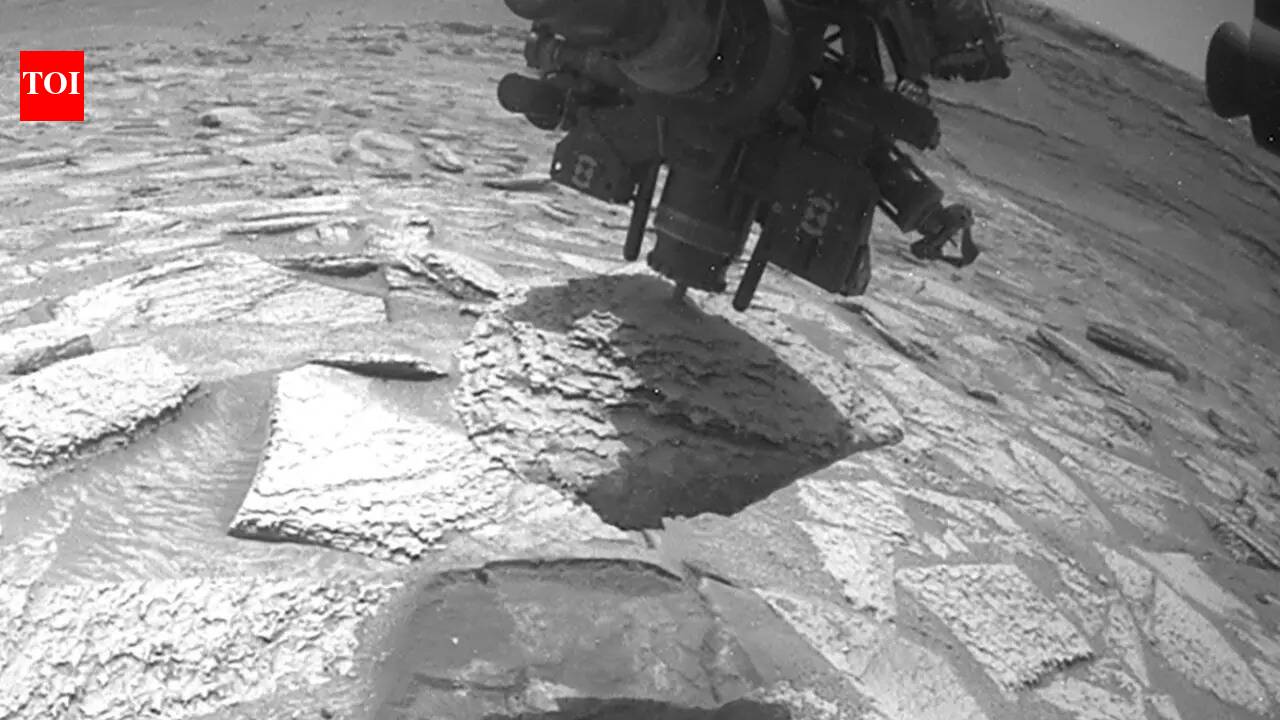
A routine drilling operation on Mars rarely sounds dramatic, but even small moments can turn unusual in ways scientists do not always expect. This is exactly what happened with NASA’s Curiosity rover during a recent sampling task on the Martian surface. The rover, which has been exploring Mars for years, was working on a rock target when something unexpected began to unfold inside the drill mechanism.According to the BBC, Curiosity’s drill is designed to break rocks into fine powder for analysis, but in this case, a fragment behaved differently. Instead of breaking away cleanly, a piece of rock appears to have clung to the drill sleeve that surrounds the rotating bit. The sleeve is not meant to carry material, which made the situation unusual from the start. Images later showed the fragment still attached even after drilling ended, creating a small but puzzling engineering challenge for teams back on Earth.
NASA Curiosity rover drill gets a rock stuck on the Mars surface
The incident began while Curiosity was working on a rock target nicknamed “Atacama.” The rover approached the site and started its usual drilling process, which is designed to break down Martian rocks into fine powder for scientific analysis. The drill, mounted on a robotic arm, is one of the most important tools on the rover. During this operation, a fragment of rock appears to have behaved in an unexpected way. Instead of breaking cleanly, a larger piece became attached to the fixed drill sleeve that surrounds the rotating bit. This sleeve is not meant to carry rocks, so the situation was unusual.Images from the rover’s cameras showed the rock clinging to the mechanism even after the drilling was completed. When Curiosity attempted to retract its arm, the rock remained attached. In a brief moment, it even looked like the rover had lifted part of the Martian surface itself. Engineers later suggested that the rock’s shape and texture might have contributed to the unusual grip.
NASA engineers respond to Curiosity rover’s Mars drill issue
Back on Earth, teams at NASA began analysing the situation carefully. The Curiosity rover is fully controlled from Earth, but every movement must be planned and tested before being sent across millions of kilometres. The first response was cautious. Engineers tried small arm movements and gentle vibrations to shake the rock loose. They also rotated the drill slowly, hoping the fragment would fall away naturally. Nothing changed. The rock remained firmly attached. Further attempts followed over the next few days. The team experimented with different angles, slightly stronger vibrations, and controlled spinning of the drill mechanism. Even with these adjustments, the rock did not move.
NASA confirms first-ever case of rock stuck to Curiosity drill sleeve
After several unsuccessful tries, the team adjusted its approach again. On 1 May, Curiosity performed a more forceful combination of tilting, rotation, and vibration of the robotic arm and drill system. This time, the strategy worked. The rock finally detached from the drill sleeve and fell back to the Martian surface. According to mission updates, the fragment cracked slightly upon landing. The moment marked the end of a small but unusual engineering challenge. It also confirmed that this was the first known case of an entire rock becoming stuck to Curiosity’s drill sleeve during its long mission.Curiosity’s drilling system is designed to collect powdered samples from Martian rocks, which are then analysed in onboard laboratories. These instruments help scientists understand the chemical history of Mars and whether the planet could once have supported life. However, Martian rocks are not uniform. Some are soft and layered, while others are brittle or unusually dense. Experts suggest that this variation can sometimes lead to unexpected outcomes during drilling operations.

