


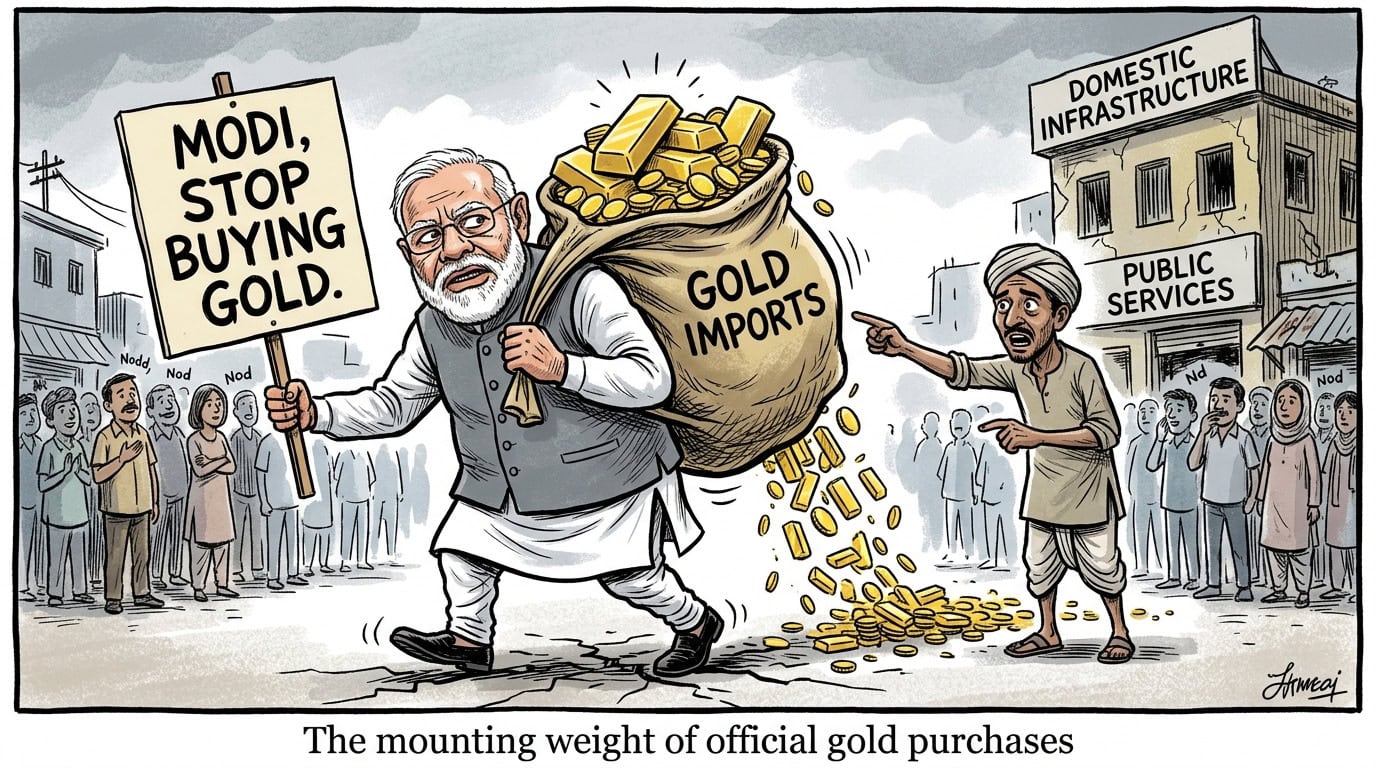
Monday morning, I got some very bad news for the Indians. Modi gold ban appeal sparks India market crash: what the prime minister’s address really means for the rupee and the economy. When a prime minister tells 1.4 billion people to stop buying gold and cancel their foreign holidays, the markets do not wait for an explanation.
There are speeches ahead of the government that the calendar demands. And then there are speeches of an entirely different order, the ones delivered on a Sunday evening, in a carefully measured tone, in which a sitting prime minister asks ordinary citizens to stop buying gold for their daughters’ weddings. Narendra Modi gave one of the latter kind. The Indian stock market on Monday answered in kind, erasing nearly four trillion rupees in a single session.
A prime minister does not make that kind of address unless the situation has already become serious. The thousand-point collapse in the Sensex was not a panic reaction to a speech. It was a recognition of what the speech confirmed. The Nifty fell sharply into the red. Midcap stocks bled. Investors, who have a practised ability to read between the lines of official language, read these lines quickly and did not like what they found.
“I would appeal to people not to buy gold for weddings for one year. Our country does not have big oil wells. Postpone travelling abroad for at least a year. Prioritise work from home. Please reduce petrol and diesel consumption by using the metro. If we must use a car, then we should try to carpool. Use electric vehicles. Reduce the use of chemical fertilisers by 50%. Prioritise made-in-India and locally manufactured products.”
What Modi said, stripped of the careful language of public address, was this: India’s foreign exchange reserves are under pressure, the rupee is vulnerable, and the country cannot, at this moment, sustain the import bill its citizens would ordinarily incur. Gold and crude oil together account for a substantial share of India’s import expenditure. When a government asks its people to curtail both in the same address, the message is not one of aspiration. It is one of the constraints.
The timing was not accidental. Reports that Donald Trump had rejected Iran’s latest overtures sent a fresh tremor through oil markets, and India, a country Modi himself reminded his audience has no significant domestic reserves, is acutely exposed to whatever instability follows. Rising tensions in West Asia translate almost directly into a more painful import bill, a weaker rupee, and inflationary pressures that the Reserve Bank of India is poorly positioned to absorb without further choking growth. The markets understood this chain of consequences immediately.
The contrast with Pakistan is instructive, if uncomfortable. Islamabad too has lived through painful fuel price increases in recent months, the result of the same global pressures now testing New Delhi’s reserves. Yet the Pakistani government has imposed no comparable restrictions on citizens, issued no appeals to forgo gold jewellery, and made no request that people defer their wedding traditions in the name of macroeconomic prudence. More strikingly, Pakistan’s stock market has been posting respectable numbers, a divergence that has not gone unnoticed in financial circles on either side of the border. The comparison does not flatter the current situation in India and raises a question that Modi’s address left unanswered: if the pressure is regional and shared, why is one government asking its people to sacrifice while the other is not?
There is a particular irony in the moment. For years, the Modi government has maintained a confident public narrative of India’s economic ascent, of a nation on course to become the world’s third-largest economy within this decade, of growth that would lift the country decisively into the front rank of global powers. That narrative has not been entirely wrong. India’s economy has, by several measures, performed with genuine strength. But a prime minister who addresses his people as fellow passengers bracing for turbulence is not delivering the same message as one who addresses them as beneficiaries of a rising tide. Both conditions can coexist. The language of Sunday evening was plainly not the language of ascent.
Analysts have not been slow to connect further dots. The Reserve Bank of India has been an aggressive purchaser of gold in recent periods. Central banks across the world have been accumulating the metal at a pace not seen in decades. BRICS nations have sustained conversations about reducing dependence on dollar-denominated trade systems. India has been quietly pushing the adoption of its digital rupee. Against that background, a prime ministerial appeal to citizens to refrain from gold purchases carries a resonance that goes beyond the immediate question of import compression. Some observers have drawn comparisons, carefully and with appropriate caveats, to the balance of payments crisis of 1991, when the Indian government airlifted physical gold reserves to London as collateral for emergency borrowing. That rupture remade Indian economic policy for a generation. Whether current pressures approach anything like that severity remains genuinely uncertain, and the comparison may yet prove premature. But the fact that it is circulating at all, and circulating widely, is itself a signal worth registering.
What is not in dispute is the economic logic of what Modi proposed, or the cost it would carry if his appeals were taken seriously. If Indian households were genuinely to reduce gold purchases, cut foreign travel, shift to public transport, and defer purchases of imported goods, the foreign exchange savings would be real. But so would the compression of domestic demand. Retail, jewellery, travel, hospitality and services have all benefited from the consumer spending that such habits represent. A government that asks its citizens to save foreign exchange is simultaneously asking them to spend less at home. The cure has its own consequences, and the government knows this, which is precisely why such an address is made only when the alternative is judged more costly.
There is nothing inherently shameful in a government speaking plainly to its people about difficulty. The most credible signal of all came not from Modi’s words but from the markets that priced his address within hours of its delivery. Four trillion rupees is a very large number. It is also a very clear sentence.

