


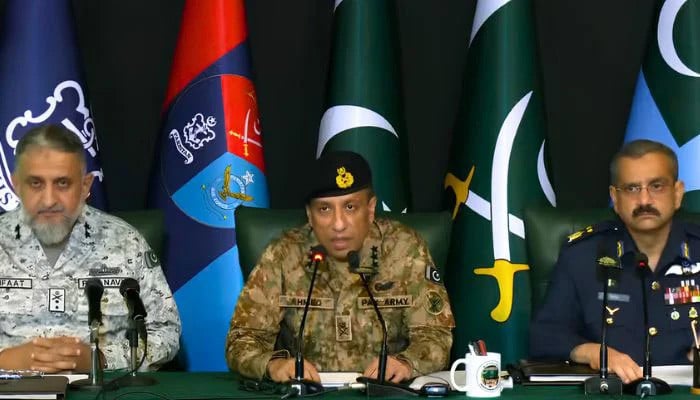
Pakistani military officials presented a strategic assessment of the outcomes of the Marka-e-Haq, highlighting the country’s position on regional stability and deterrence and their operational readiness for multi-domain warfare across land, air, sea, and cyber domains.
Marka-e-Haq (battle of truth) refers to the 19-day military conflict with India, spanning April 22 to May 10, 2025.
The briefing was addressed by Inter-Services Public Relations (ISPR) Director General Lieutenant General Ahmed Sharif Chaudhry, alongside Rear Admiral Shifaat Ali Khan and Air Vice Marshal Tariq Ghazi, who jointly outlined the military’s perspective on the conflict and its wider implications.
On May 6-7 last year, India launched an unprovoked attack on Pakistan, following an attack on tourists in the Indian Illegally Occupied Jammu and Kashmir’s Pahalgam town.
Pakistan, during the 87-hour conflict, downed eight Indian fighter jets, including French-made Rafale, and dozens of drones.
The war between the two nuclear-armed nations ended on May 10 with a ceasefire agreement brokered by the US.
Key takeaways
- Pakistan defeated “five times bigger enemy” during the May conflict: DG ISPR.
- Pakistan buried Indian narrative of painting Pakistan as a terrorism sponsor: DG ISPR.
- Lt Gen Chaudhry highlights dangerous trend of “politicisation of Indian military leadership”.
- ISPR chief highlights global acknowledgement of India’s use of terrorism narratives to externalise internal issues
- Marka-e-Haq reflected a transformed character of warfare involving multi-domain operations, non-contact warfare, synergy, proxies, and information warfare.
- Pakistan demonstrated resilience, credible deterrence, and affirms there is “no space for war” between nuclear-armed neighbours: ISPR.
- Pakistan recognised as a “geopolitically significant and responsible middle power” at global level: ISPR.
- Pakistan downed eight Indian aircraft, including Rafale, Su-30, MiG-29, Mirage 2000, and a multi-role unmanned aerial system: PAF.
- Pakistan Navy and air force ensured operational readiness, with preparedness to target India’s aircraft carrier Vikrant while safeguarding maritime routes during the conflict.
- Civil-military synergy is described as the “Bunyan-um-Marsoos effect”, reflecting unity between people, government, and armed forces.
- Military reiterates Pakistan’s commitment to regional peace alongside a strong and credible defence posture.
- Army emphasises multi-domain warfare readiness as a core component of its evolving defence doctrine.

