


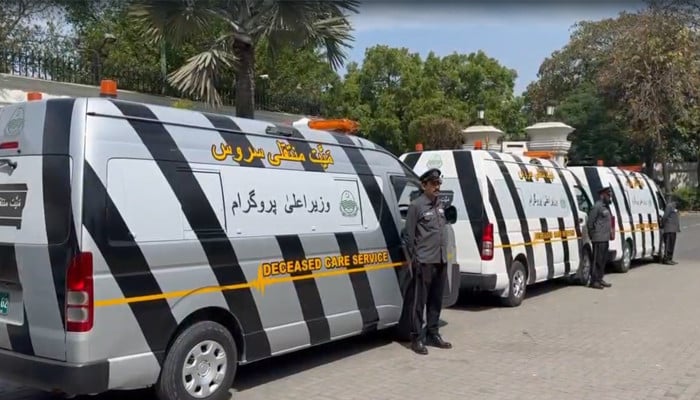
In a first by any province in Pakistan, Punjab has launched an official, government-run deceased transfer service, with Chief Minister Maryam Nawaz Sharif inaugurating the initiative on Monday.
During the initial phase, the service will operate in Lahore, Multan and Rawalpindi, where deceased individuals will be transported from government hospitals to their homes without any charges. The scope of the service is expected to gradually expand to every tehsil across Punjab by June, according to a handout issued by the CM’s Office.
Under the initiative, each tehsil will be equipped with dedicated ambulances under the “Deceased Care Service” to ensure the timely transfer of bodies. The provincial chief executive formally handed over keys of the vehicles designated for Lahore, Rawalpindi and Multan, inspected the fleet, and interacted with rescue personnel.
CM Maryam directed staff to serve with compassion and sincerity, emphasising that assisting grieving families is both a humanitarian duty and a form of public service. She also instructed personnel to provide counselling and emotional support to bereaved families in cases of patient deaths.
Highlighting existing challenges, the chief minister termed it unfortunate that private transporters often charge excessive fares during such difficult times. She strictly directed rescue workers not to accept any money, even if offered voluntarily by families.
Punjab Health Minister Khawaja Salman Rafique described the initiative as commendable, stating that it aims to make citizens feel supported in moments of grief. He confirmed that, for now, the service will operate within city limits in Lahore, Rawalpindi and Multan, with plans to involve private ambulances in the second phase for other cities.
Director General Rescue Services Dr Rizwan Naseer, in a detailed briefing, said the service can be accessed by calling 1122. Trained, uniformed drivers will be available round the clock at government hospitals, where dedicated desks will also be established.
The service will also facilitate the transfer of bodies to hospital morgues if required, while operations will be monitored through a smart rescue management and dispatch system to ensure efficiency and transparency.

