


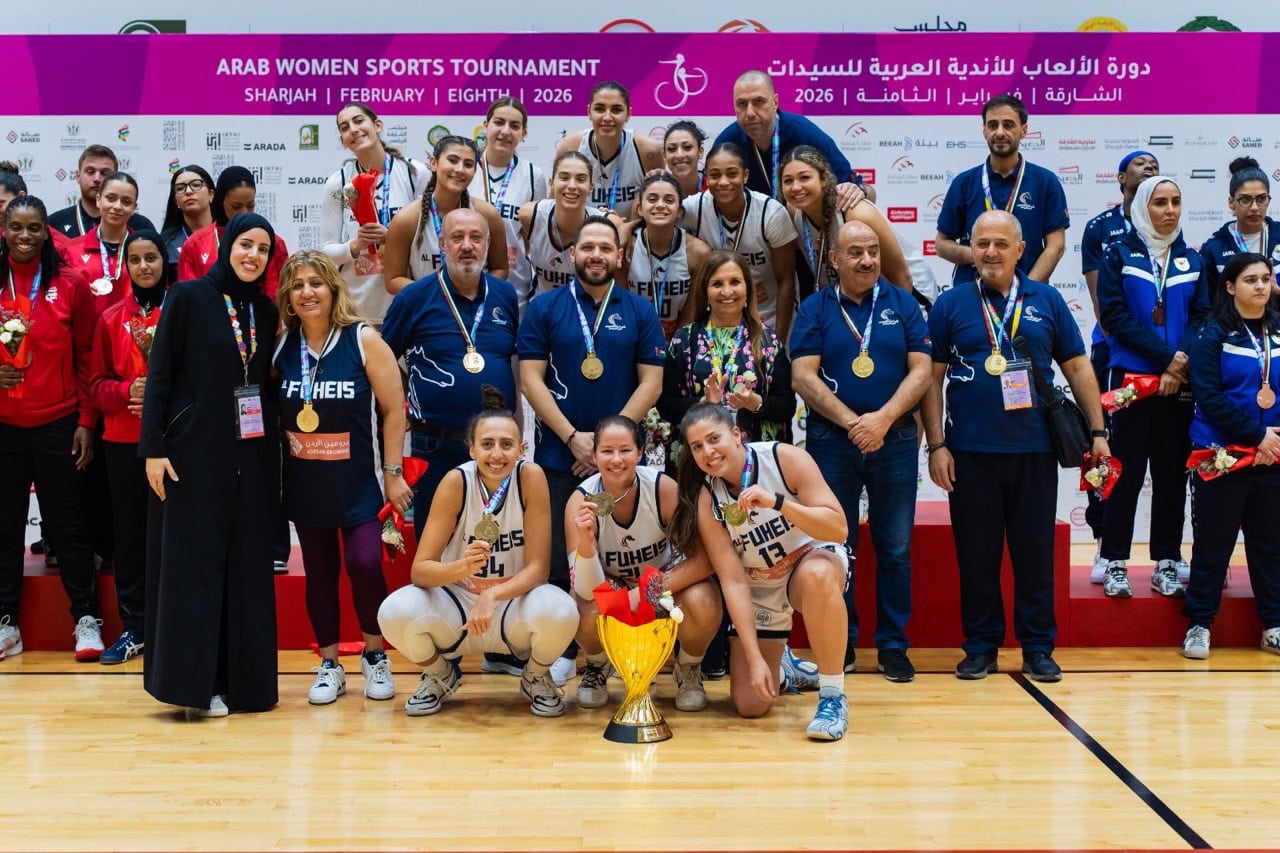
The eighth edition of the Arab Women Sports Tournament (AWST) concluded in Sharjah after 10 days of competition that brought together 65 teams from 16 Arab countries, reinforcing the event’s standing as the region’s leading women’s club championship.
Held across nine individual and team sports, the 2026 edition marked a significant step forward in both participation and technical standards. Organisers also introduced two new disciplines, taekwondo with G1 international classification and rowing, reflecting the tournament’s steady expansion in scope and competitiveness.
Sharjah Women’s Sports Club reclaimed the volleyball title in competitions held under the accreditation of the International Volleyball Federation, ending a 12 year gap since its last triumph at the tournament’s second edition in 2014.
In basketball, Jordan’s Al Fuheis Club secured the championship for a third consecutive time. Egypt’s Petrojet Club impressed on debut in table tennis, sweeping the team, doubles and singles titles.
Athletics saw the UAE top the medal standings with 18 medals. Morocco’s Wydad Athletic Club led the table in taekwondo, which featured for the first time in the tournament programme. Egypt’s Salma Khaled Badour won gold in beach rowing singles, marking the discipline’s first official podium appearance at AWST.
Sharjah Women’s Sports Club also dominated team archery, while Oman’s Salalah Club topped the fencing medal table. In shooting, Bahrain’s Safaa Al Dossari claimed rifle gold, with Riffa Sports Club leading the team standings.
H.E. Sheikh Khalid bin Ahmed bin Sultan Al Qasimi, Chairman of the Supreme Organising Committee, said the eighth edition reflected a clear approach to development in both sporting performance and broader social impact. He noted that expanded participation and higher technical standards indicated growing confidence in AWST as a pan Arab platform for clubs and athletes.
He attributed the tournament’s organisational and technical success to the guidance and patronage of H.H. Sheikha Jawaher bint Mohammed Al Qasimi, highlighting her support for sport as a tool for human development and regional cohesion.
H.E. Sheikha Hayat bint Abdulaziz Al Khalifa, Chair of the Supervision and Follow up Committee, described the edition as a step forward administratively and technically, pointing to the wide distribution of medals among teams and countries as evidence of competitive balance.
H.E. Abdulaziz bin Mohammed Al Anzi, Secretary General of the Union of Arab National Olympic Committees, said disciplined competition management and coordination among committees had strengthened confidence in the tournament’s continuity.
Organisers also reported strong spectator turnout across disciplines. H.E. Moza Al Shamsi, Director of AWST, said attendance remained high in both team and individual sports, with schools and youth groups attending competitions as part of organised visits.
Competitions were hosted across 10 venues in Sharjah and officiated by 201 referees, including 67 women, reflecting a growing pool of female officials in the region.
Participating delegations praised the organisation and technical standards, noting visible progress from previous editions. Several clubs and federations expressed interest in returning for the next tournament, citing the professionalism and competitive environment.
As AWST 2026 draws to a close, the tournament further consolidates its role as a key fixture on the Arab sporting calendar and a platform for advancing women’s competitive sport in the region.

