


Bangladesh’s ejection from the T20 World Cup raises questions about ICC neutrality, BCCI power
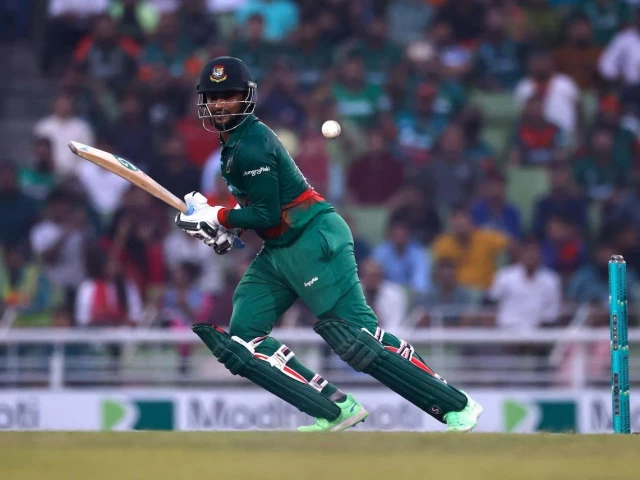
Bangladesh’s Shakib Al Hasan in action. Photo: REUTERS
Bangladesh’s request to play the T20 World Cup 2026 matches outside India was not entertained by the International Cricket Council (ICC), leading to their ejection from the marquee event. The Bangladesh Cricket Board (BCB) had refused to play their matches in India in response to the termination of Mustafizur Rahman’s contract by Kolkata Knight Riders, on the instructions of the BCCI.
There were no reasons given by the BCCI for its verdict.
The board that did not let a single Bangladeshi player compete in its biggest league wanted the entire team to assemble and play their matches in India.
The ICC dismissed the security concerns raised by the BCB, stating that “no credible or verifiable security threat to the Bangladesh national team, officials or supporters in India” was found in their elaborate assessment of the situation.
While mainstream analysis has treated this as a singular conflict between the ICC and BCB, the lack of mention of the Board of Control for Cricket in India (BCCI) signals that the world’s most influential cricketing board’s presence did not factor in.
This has also been the official stance of the BCCI. When Devajit Saikia, the BCCI secretary, was asked about the conflict earlier this month, he stated that the matter falls beyond the purview of the Indian cricketing board. “It’s not our domain to talk about that,” Saikia had said.
The ICC functions not on a specific framework, but on the caprices of the BCCI, as suggested by The Wire journalist, Ravi Raj. For instance, last year, India also adopted a similar stance by not sending the team to Pakistan, which was hosting the Champions Trophy 2025.
Their request was promptly heard, and their matches were shifted to Dubai. But the same request from Bangladesh has not been given the same consideration. The ICC is now more wary of setting a “precedent that would jeopardise the sanctity of future ICC events”, and “undermine its neutrality as a global governing body.” The precedent was set a year ago by the BCCI, and the BCB was simply following the same script.
Read: Bangladesh says will not play T20 World Cup matches if in India
Jason Gillespie, the former Australian cricketer, pointed out this inconsistency when he posted on X: “Has there been an explanation from the ICC why Bangladesh could not play their games outside of India?” The tweet is deleted as of now following abuse from netizens.
“In the past, India refused to play Champions Trophy matches in Pakistan and were allowed to play those games outside the country. Can someone make this make sense?” Gillespie wrote in the post.
BCCI receives about 38.5% of ICC’s annual earnings (~US$ 230 million) in the 2024–27 revenue cycle under the new ICC finance model. According to international media, the ICC’s revenue-sharing formula hinges on the commercial value each board generates, a space dominated by the BCCI.
In August, the ICC confirmed a four-year broadcast deal with India’s Disney Star worth a reported $3 billion — far exceeding any other rights agreement for its events. A significant amount of ICC’s revenue, about 80%, is generated through India’s consumer base.
The current chair of the ICC, Jay Shah, is the youngest to hold this position. He previously served as the president of the BCCI and was elected unopposed to his current position. He is also the son of India’s home minister, BJP’s Amit Shah.
Raj says that the BCCI’s conflict with either the Pakistan Cricket Board (PCB) or the BCB shows the fractured geopolitical relationship between these South Asian nations.
For instance, last year during the Asia Cup, the Indian team went against the prevailing sentiment by not forfeiting their match against Pakistan, despite, in the aftermath of the Pahalgam attack.
Perhaps Kolkata Knight Riders could have objected rather than simply obeying the diktat from the board. Not necessarily because they think the termination is unfair, but purely on sporting grounds as well, but that is not how it played out.

