


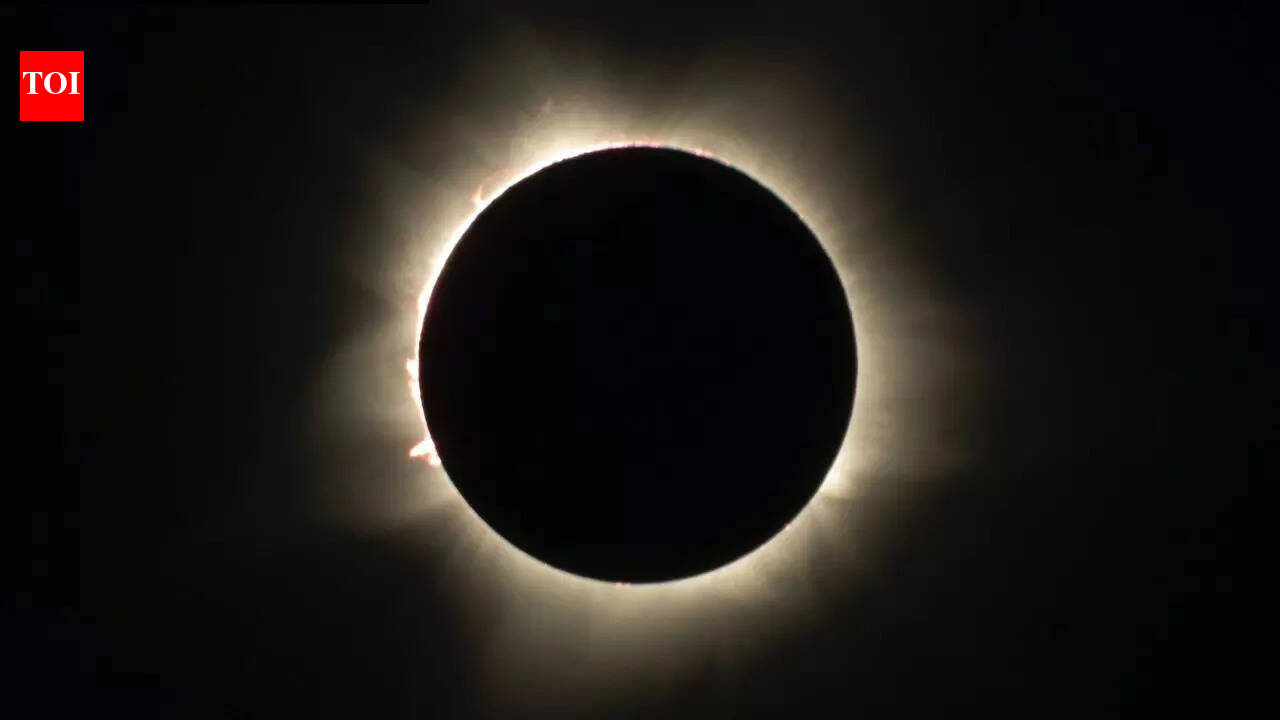
The total solar eclipse of August 12, 2026, will sweep across parts of the northern hemisphere, briefly turning day into dusk along a narrow path. Greenland, Iceland, and northern Spain will lie directly beneath the moon’s shadow, while much of Europe, Scandinavia, West Africa, and parts of North America will see a partial eclipse. Timings are now precise to the second, and locations are mapped down to individual landmarks. For people living in Iceland and northern Spain, the occasion will be a rare alignment, one that has not occurred in generations. Elsewhere, the event will be visible but incomplete, a reminder of how tightly constrained total eclipses really are.
The 2026 total
The Moon’s umbral shadow will first touch Earth in the high Arctic before crossing Greenland and then Iceland. From there it moves south across the Atlantic, reaching Spain just before sunset. Only a narrow corridor will experience totality. Outside that strip, the sun will remain partly visible. The full path stretches more than 8,000 kilometres, but its width is limited, usually a few hundred kilometres at most. This is why travel plans matter for eclipse watchers.
Iceland sits directly under the Moon’s shadow
In Iceland, the eclipse will be especially striking. The shadow makes landfall at Straumnes Lighthouse in the Westfjords at 17:43:28 UT. From there it races south at around 3,400 kilometres per hour. The path crosses the Snæfellsnes peninsula, passes over Reykjavík, and exits near Reykjanestá Lighthouse. Totality in Iceland lasts nearly seven minutes from first landfall to final exit, though any single location will see closer to two minutes. At Látrabjarg, observers may see more than two minutes of full darkness.
Reykjavík will experience a rare moment of totality
For Reykjavík, the eclipse is historically unusual. The city has not seen a total solar eclipse since the year 1433. The last total eclipse visible anywhere in Iceland occurred in 1954. These long gaps are normal. Total eclipses return to the same place only after centuries. The next time the path of totality crosses Iceland will be in 2196. For the Reykjavík area, the wait is even longer.
Spain will see totality close to sunset
Northern Spain lies near the end of the eclipse path. The Moon’s shadow reaches the Spanish mainland at around 18:25:44 UT. Totality there will be brief and low in the sky, occurring as the sun approaches the horizon. This adds both drama and difficulty. Clear western views will matter, as will local weather conditions. Even a short period of cloud could hide the event.
Partial eclipse visible across much of Europe and beyond
Large parts of Europe will see a partial eclipse, including the UK, France, Germany and Italy. Scandinavia and West Africa will also be affected. In these regions, the Moon will cover only part of the Sun. While still visually interesting, partial eclipses lack the sudden darkness and visible solar corona that define totality. Eye protection remains essential throughout the partial phases.
Totality lasts minutes but depends on location
The maximum duration of totality during this eclipse is about 2 minutes and 18 seconds, occurring over the ocean west of Iceland. On land, durations are slightly shorter. In Reykjavík, totality lasts under two minutes. These brief intervals are why timing matters. A delay of seconds can mean missing the peak entirely.
Safe viewing requires preparation and restraint
Watching a solar eclipse safely requires care. During the partial phases, certified solar eclipse glasses or proper solar filters are essential. Ordinary sunglasses are not enough. Cameras and telescopes must have filters placed on the front of the lens. During totality only, it is safe to remove eye protection and look directly at the sun. That window closes quickly, and filters must go back on as soon as the sun reappears.
The alignment behind a total solar eclipse
Total solar eclipses occur because of a precise coincidence. The Sun is about 400 times larger than the Moon but also about 400 times farther away. From Earth, they appear almost the same size. When the Moon passes directly between Earth and the Sun at the right distance, it can block the Sun completely. Most months, the alignment is not exact. When it is, the shadow touches only a narrow strip of the planet.For those under that strip in August 2026, the experience will be brief and likely unforgettable. Then the shadow moves on, and the light returns quietly.

