


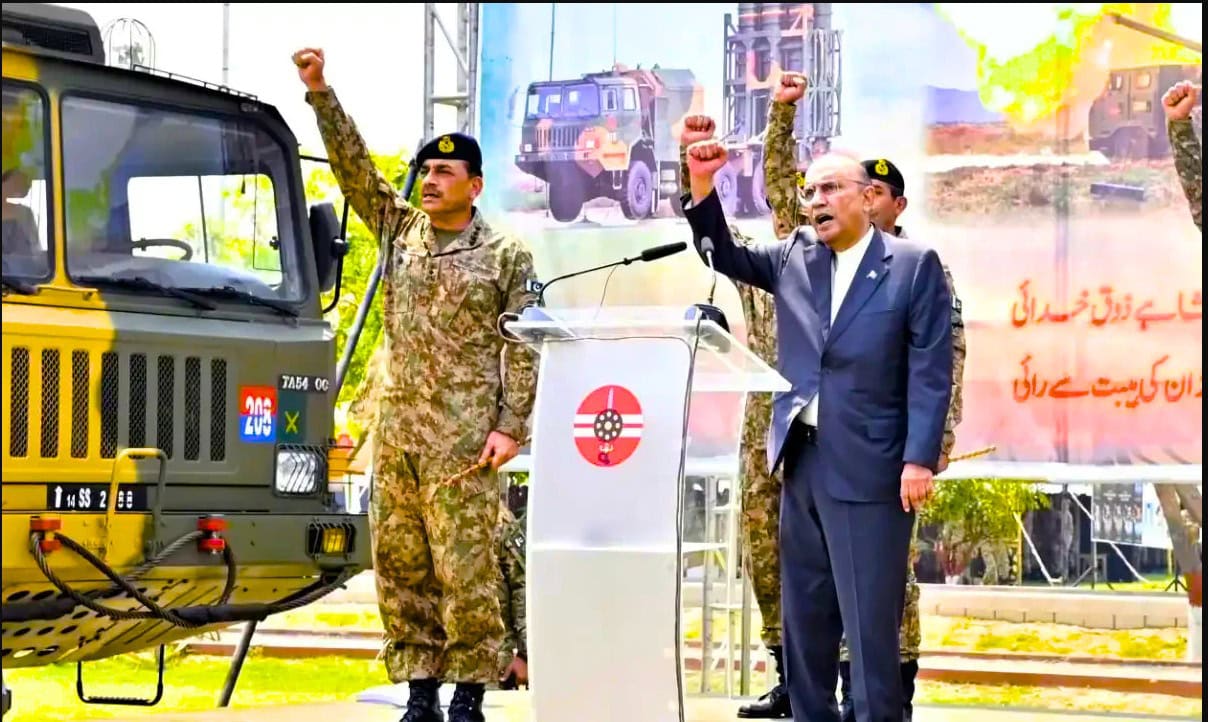
While Garhi Khuda Bakhsh marked a solemn anniversary for Benazir Bhutto on December 27, the media across the eastern border was busy inventing a crisis. The hysteria didn’t start here; it was cooked up in the panic-stricken studios of India. They are trying to rewrite President Zardari’s character—ignoring that he is a politician known for reconciliation, not a general looking for a fight. But facts don’t matter to India. Their so-called godi media experts dissected his words with fear in their eyes, desperately trying to twist a message of national pride into a declaration of war. They scream “aggression,” but any veteran observer sees the simple reality: Indian commentators are terrified of the full context, so they strip the truth away to keep their public scared.
The “Bunker” Fixation: A Cover for Defeat?
When President Zardari reflected on the conflict of May 2025, he offered a stark reminder of military reality: Pakistan destroyed Indian jets and possessed the power to kill them all, yet chose the path of mercy. One would expect this revelation of aerial dominance to be the centre of any serious defence analysis. Yet, the reaction from New Delhi has been deafeningly silent on the facts and ridiculously loud on the trivialities.
Instead of addressing the humiliating admission that their Air Force was at our mercy, Indian outlets cherry-picked a single word from the speech: “bunker.”
It is genuinely silly—and revealing—to watch an entire nation’s media machine obsess over a standard safety room while ignoring the wreckage of their own aircraft. Zardari mentioned being advised to use a bunker during the height of the crisis, which is standard protocol for any head of state during war. Yet, New Delhi seized this one word to paint a picture of fear, desperate to distract their public from the harder truth Zardari delivered. This is cherry-picking at its finest and most pathetic. They highlight the “bunker” because it suits a false narrative of bravado. They hide the President’s words about “destroying Indian jets” because it exposes their military failure. A bunker is just a room; a downed fighter jet is a defeat. India is shouting about the room to silence the memory of the defeat.
Misreading Deterrence as Aggression
The misrepresentation extends to the President’s commentary on Pakistan’s current military leadership. Zardari credited divine intervention for an Army Chief who confronted India boldly. Through the lens of a hyper-nationalist Indian media cycle, this is viewed as war-mongering. However, in the lexicon of statecraft, affirming the defensive readiness of one’s armed forces is standard deterrence. It is a signal of stability intended to assure the domestic population—the very PPP supporters rallying in the crowd—that the state is secure. To interpret a speech meant for domestic consolidation as an act of international aggression is not just disingenuous; it is diplomatically dangerous. Does the mere mention of defense now constitute an offense in the eyes of the Modi administration?
Furthermore, the warning regarding the “evil eye”—that anyone casting a malicious gaze on Pakistan would face “Zardari sitting here”—must be read for what it is: political rhetoric. Every leader, from Washington to New Delhi, employs idioms of strength when addressing their base. Yet, when such words emanate from Pakistan, nuance is discarded. The speech highlighted that Indian Prime Minister Narendra Modi “falls silent” at the mention of Pakistan—a valid critique of diplomatic stalling. Instead of engaging with the offer of dialogue implicit in Pakistan’s defensive confidence, the response has been to bang the war drums louder.
The Question India Refuses to Answer
The tragedy of this media cycle is that it obscures the underlying message of the President’s address: confidence and patience. President Zardari wasn’t drawing up an invasion map on stage; he was pointing out that Pakistan knows how to survive. When a leader says his country is safe, why should it trigger a panic attack across the border?
If New Delhi continues to interpret every assertion of Pakistani sovereignty as a declaration of war, how can the region ever move toward the dialogue it so desperately needs? It forces a tricky question: is India actually confused, or do they simply refuse to accept that a confident, stable Pakistan exists next door? The world saw exactly what Pakistan is capable of in May 2025. We proved our power then, and make no mistake—if India attempts any aggression again, we are ready to show even more. The lesson of May was a glimpse, not the limit, of our strength.

