


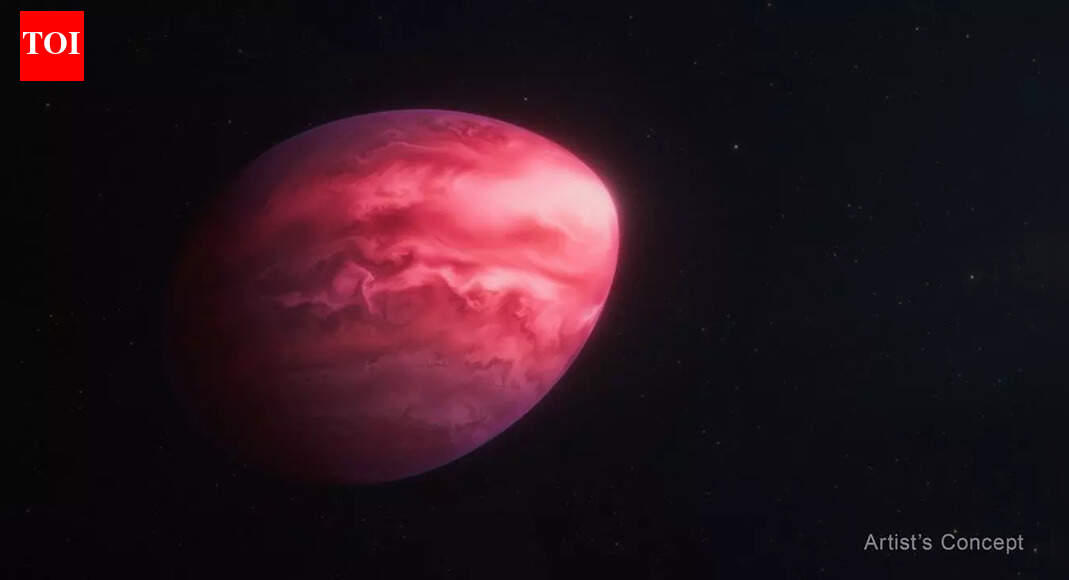
NASA‘s James Webb Space Telescope (JWST) has recently discovered a rare exoplanet, whose composition has baffled scientists as it defies all explanations. Officially named PSR J2322-2650b, the Jupiter-sized planet is outside our solar system and its atmospheric composition challenges our understanding of how it was formed. It orbits a pulsar, a rapidly spinning neutron star, just 1 million miles away and makes its year a mere 7.8 hours. A paper published in The Astrophysical Journal Letters, detailed that the planet has an exotic helium-and-carbon-dominated atmosphere where soot clouds float through the air. Deep within the planet, these carbon clouds condense and form diamonds. This composition is unprecedented among the 150 planets studied in detail, with no oxygen or nitrogen present. “This was an absolute surprise,” said study co-author Peter Gao of the Carnegie Earth and Planets Laboratory in Washington to NASA. “I remember after we got the data down, our collective reaction was ‘What the heck is this?’ It’s extremely different from what we expected.”
An extremely unique composition
The distant planet appears to be in the shape of a lemon as the pulsar’s intense gravity stretches the planet. It is unique because the scientists are able to see the planet illuminated by the host star but not the host star. It orbits a star that’s “completely bizarre” with the mass of the Sun but the size of a city. Additionally, unlike the usual molecules found in an exoplanet like water, methane and carbon dioxide, this one has molecular carbon, specifically C3 and C2. Temperatures on the planet range from 1,200 degrees Fahrenheit at the coldest points of the night side to 3,700 degrees Fahrenheit at the hottest points of the day side.The International Astronomical Union defines an exoplanet as a celestial body below 13 Jupiter masses that orbits a star, brown dwarf, or stellar remnant, such as a pulsar. Of the 6,000 discovered exoplanets, this is the only one reminiscent of a gas giant orbiting a pulsar. “But it’s nice to not know everything,” said study co-author Roger Romani, of Stanford University and the Kavli Institute for Particle Astrophysics and Cosmology Institute to NASA. It seems the mysteries of the universe are ever-evolving and this one has scientists awestruck to explore and excited to solve.

