


- DPM Dar says Pakistan acts cautiously in mediation role.
- PM, CDF remain engaged in diplomatic efforts: Dar.
- Prolonged conflict may impact oil, economy: DPM.
Deputy Prime Minister Ishaq Dar on Tuesday blamed Israel for seeking to derail Islamabad’s efforts to facilitate ceasefire talks between the United States and Iran by launching an attack on Tehran at a moment when both sides were preparing to engage.
“A major Israeli attack on Iran and the subsequent strike on Jubail in Saudi Arabia had made the situation more dangerous and sensitive,” he said while briefing the Senate on the current regional situation in the Middle East and Islamabad’s mediation efforts.
Pakistan emerged as a key mediator in one of the region’s worst conflicts, which erupted after joint US-Israeli attacks on Iran on February 28.
The war has since resulted in a sharp increase in global fuel and energy costs, triggered by the effective blocking of the Strait of Hormuz by Tehran.
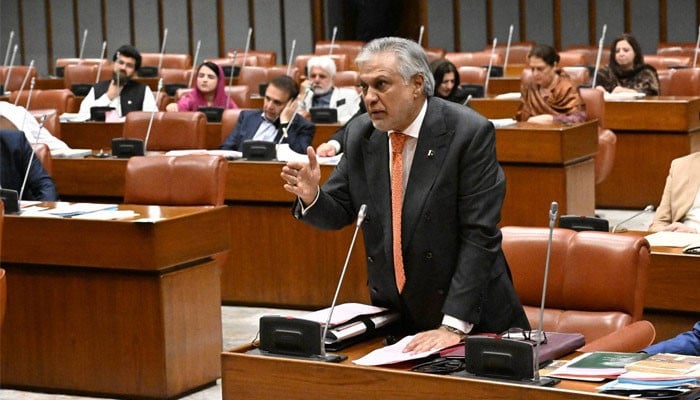
Speaking in the Upper House on the current Mideast situation, DPM Dar, who also holds the portfolio of foreign minister, thanked Leader of the Opposition Senator Raja Nasir Abbas for acknowledging the government’s efforts and said Pakistan had remained actively engaged from the very outset of the crisis.
He said that when the first attack on Iran took place, he was in Madina after attending an OIC meeting and immediately contacted the Foreign Office, directing it to issue a strong condemnation of the Israeli attack on a sovereign country.
FM Dar said he also established immediate contact with the Iranian foreign minister and conveyed Pakistan’s support and sympathy, assuring him that Islamabad would make efforts to rally regional countries behind de-escalation.
He said Pakistan had since remained in continuous contact with countries in the region and beyond, including China, Japan, the United Kingdom, Canada and several European states, in an effort to promote restraint and prevent escalation.
The DPM said Pakistan had worked as a facilitator and mediator and had to proceed with caution so as not to undermine sensitive diplomatic efforts.
He said that Prime Minister Shehbaz Sharif and Chief of Army Staff (COAS), Chief of Defence Forces (CDF) Field Marshal Syed Asim Munir and the Foreign Office remained fully engaged in the diplomatic process.
DPM Dar said Saudi Arabia hosted a meeting of 12 countries on March 19 in Riyadh on the issue, where Pakistan represented its position and helped secure a balanced joint statement, including condemning Israel.
He said a four-country group comprising Saudi Arabia, Egypt, Turkiye and Pakistan had also been working for peace, and its follow-up meeting, initially planned for Istanbul, was later shifted to Islamabad.
FM Dar further informed the Senate that the foreign ministers of the three countries visited Pakistan on March 29, where bilateral meetings as well as a quadrilateral meeting were held as part of efforts to advance peace diplomacy.
He went on to say that Pakistan had also engaged China at a high level, and during his visit there on March 31, the two sides discussed a five-point peace initiative for the region, which was later made public.
Dar said the United Nations Secretary-General had also telephoned him to appreciate Pakistan’s role and offered support for its peace efforts.
He said Pakistan had tried until the last moment to create space for a pause and meaningful engagement between the parties, but regretted that fresh developments had again complicated the situation.
He cautioned that prolonged conflict in the region could have serious consequences for the wider world as well as Pakistan, including on oil prices and the economy.
The deputy prime minister expressed hope that diplomatic efforts would ultimately help restore peace in the region and lead to a dignified resolution of the conflict.

