


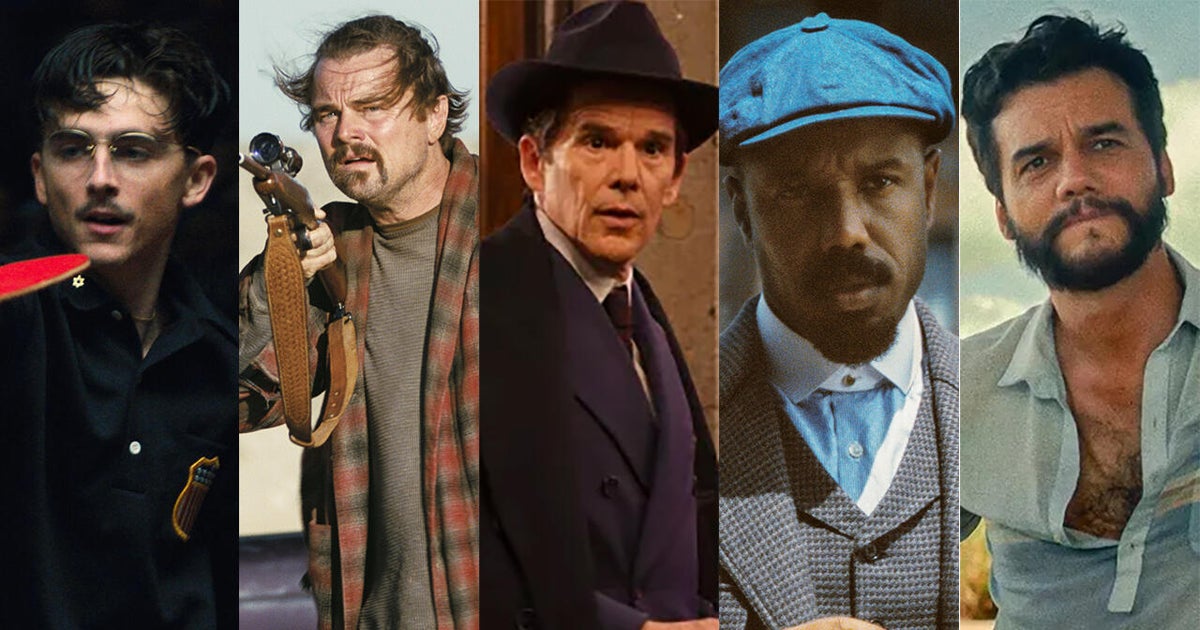
Watch scenes from the performances nominated for the Oscar for best actor, as well as interviews with the nominees below. The 98th Academy Awards will be presented Sunday, March 15.
A24; Warner Brothers; Sony Pictures Classics; Neon
Timothée Chalamet, “Marty Supreme”
The character of shoe salesman Marty Mauser (loosely based on the life of table tennis player Marty Reisman) is a classic example of a striver willing to subvert norms or personal codes of honor in order to achieve their vision of success. In the world of “Marty Supreme,” that character’s goal is mastery of a sports subculture – and in 1950s New York, there was perhaps no sports subculture more “sub” than table tennis, which makes director Josh Safdie’s period film both pertinent and quaint.
Marty (played by Oscar-nominee Timothée Chalamet) clearly has the chops, but what he needs in order to compete at the table tennis world championships is money, and he is desperate to get it. It becomes the basis of his manipulations of those around him, from hustling drunks, holding a mob figure’s dog for ransom, and bedding the wife of a potential sponsor.
Playing a striver was the attraction for Chalamet. “Knowing the grind as an actor and not being ignorant to it — my dream wasn’t a financial one like Marty Mauser’s, but it was also in pursuit of an ideal,” he told The Hollywood Reporter. “There’s this New York connection that I couldn’t even put into words and I’d fail trying to, but that’s just true to my spirit,” he said. “Having gone through a very similar struggle in New York and playing this guy’s struggle in New York, it was deeply resonant for me.”
Having first discussed the project with Safdie seven years ago, Chalamet decided to amp up his table tennis skills, practicing even as he was in production on other films. [Yes, there was a ping pong table on the set of “Dune”] The training was, he said, “somewhere between a marathon and a sprint — it’s really a tremendously athletic sport.”
In a Q&A with Ben Affleck at the American Cinematheque, Chalamet described the challenge of playing an often unlikable character – one who lies, cheats, and abandons friends and lovers, all while struggling for success in a sport few truly respected. One idea instilled by the director was for Chalamet not to be judgmental towards Marty, to take his point of view, as he was not limited by the strictures of playing a flawless hero or a horrible villain: “This guy’s messy and human and real. And I feel like we all know someone like Marty who’s equally at times, you know, inspiring, maybe believes in his dreams, as much as he is a scumbag, somebody who operates purely at self-interest.”
Chalamet is routinely reticent when discussing his work process. In a 2025 interview with “60 Minutes,” he said he wasn’t comfortable revealing the magic of his craft: “It’s nobody’s business how I go about these things. It’s within the law!” he laughed. “Otherwise, it might not be as interesting as people think. Or it could be a lot more interesting than people think. It might be more interesting than what I’m doing.”
At age 30, Chalamet became the youngest male to earn three best actor nominations (after “Call Me By Your Name” and “A Complete Unknown”), a title previously held by Marlon Brando.
- “Marty Supreme” is nominated for nine Academy Awards, including best picture.
Leonardo DiCaprio, “One Battle After Another”
Loosely adapted from the 1990 Thomas Pynchon novel “Vineland,” Paul Thomas Anderson’s “One Battle After Another” is an absurdist take on the revolutionary movements of the 1960s and ’70s, wrapped around the story of a father desperately trying to connect with his daughter. Add a martial arts sensei who operates an underground railroad for undocumented immigrants, a vengeful military officer, and a secret cabal of White supremacists, and you have one of the most brazen comic thrillers of recent years.
Oscar-nominee Leonardo DiCaprio stars as Bob, who has been hiding from authorities for 16 years under an alias in a mountain community in California. He still lives by the precepts of a revolutionary, but it’s been years, and he’s smoked a lot of weed, so when he tries to contact the central command of his former comrades, the password he needs to remember to get through to his brethren is elusive.
Beyond his role as a lapsed revolutionary, Bob has a more important and immediate function, as a parent to Willa (Chase Infiniti). Inspired by Jeff Bridges’ performance in the Coen Brothers’ “The Big Lebowski,” DiCaprio spends much of the film disheveled, in a bathrobe, and drunk or stoned.
In a conversation at the British Film Institute, DiCaprio said his character developed much further once Infiniti was hired to play Willa, and the screenplay was workshopped. The tensions between father and daughter were accentuated, which only magnified a sense of role reversal between the two, underscoring Willa’s self-reliance and Bob’s lack of control.
One element was Bob’s paranoid prohibition against Willa having a cellphone. “I think Paul at one point maybe wanted to do some sort of hyper-realistic world where there were no phones, and she arrived, you know, basically saying, ‘Are you out of your mind? I’m going to have a phone. I don’t care if my father’s off the grid or if he’s paranoid, if he’s disconnected from reality, anti-government, I’m going to have that phone.’ And that became this kind of key moment that strung itself along in the movie and created moments of tension. …
“And a lot of those great workshops that we had, that tension arose between us of her almost playing the mother figure and me just desperately trying to connect with my daughter and doing it through anger and self-medicating myself with drugs. Those workshops, I think, were very key. When we landed on set, I think we were on firm footing of what that household dynamic was.”
That dynamic is evident in this scene, in which Bob fails completely as a parental role model:
DiCaprio earned his eighth Academy Award nomination for “One Battle After Another.” (He’d previously won best actor for “The Revenant.”) Asked by Rolling Stone about his career, DiCaprio said that in the early years it felt like hitting the lottery: “It was very much like, ‘I can’t believe I’m working in this industry, and I’m getting to make decisions for myself.’ And there’s this frenetic pace that you have. But now, you know, I think as I’ve gotten older, I’ve just become even more … I don’t want to say selective, but all these different components have to come into play to make a movie and hope that it not only works but lasts, even if there are no guarantees of either of those things.”
- “One Battle After Another” is nominated for 13 Academy Awards, including best picture.
Ethan Hawke, “Blue Moon”
The composing duo of Richard Rodgers and Lorenz Hart was responsible for many treasured classics in the Great American Songbook, from “My Funny Valentine,” to “The Lady Is a Tramp” and “Blue Moon.” But by the early 1940s, the partnership broke apart. Rodgers then teamed up with Oscar Hammerstein II, and their first collaboration would prove to be an enduring landmark of musical theater, “Oklahoma!” – a success greater than anything Rodgers and Hart had achieved.
Richard Linklater’s “Blue Moon” takes place on that show’s opening night, at a celebration being held in the famed Broadway watering hole Sardi’s, where Hart, a jumble of self-pity, jealousy, and ambition, horns his way in. As played by best actor nominee Ethan Hawke, Hart tries to ingratiate himself upon his former partner (Andrew Scott), but the room already reads Hart as a Tin Pan Alley dinosaur.
Hart tries to lay on the charm with a woman he adores, Elizabeth (played by Margaret Qualley). Never mind that Hart was gay; he is besotted, and moribund to hear of her attraction to a man who mistreats her. What is love, he says, but “madness.”
Hawke has been Oscar-nominated twice before for supporting roles (in “Training Day” and “Boyhood”), as well as sharing screenwriting nominations for Linklater’s “Before Sunset” and “Before Midnight.” But the role of the lyricist was something of a stretch: The real Lorenz Hart was less than five feet tall, so Linklater used camera tricks to make the nearly six-foot actor look much shorter. Hawke also wore fake teeth, and shaved the top of his head to affect a real combover.
He also learned a mountain of dialogue, as he becomes an effusive charmer desperate to impress others. “It’s definitely the most text I’ve ever had in a movie,” Hawke told “Sunday Morning.” “I remember calling my wife after the first day – I think I had more lines than I had in the previous five films.”
Working off a screenplay by the nominated Robert Kaplow, the film’s production process took about a decade, during which Linklater and Hawke workshopped the script. According to the director, that also allowed the actor to age into the role. And with that aging came a weariness to reflect Hart’s sense of increased obsolescence as he witnesses Rodgers’ success. [Hart would die of pneumonia later that year.]
After the acclaim of “Training Day,” Hawke starred in more films, TV and on Broadway, but he says there was a time he passed on more parts than he took – and the offers started drying up. “When you’re young,” he told “Sunday Morning,” “You don’t realize that this is a young person’s game, and those kinds of job offers, there’s a shelf life on that.”
And when did that “shelf life” notion hit him? “Around the same time gray starts appearing in your beard,” he replied.
- “Blue Moon” is nominated for two Academy Awards, including best original screenplay.
Michael B. Jordan, “Sinners”
There have been several instances of actors being nominated for playing multiple characters in a film, from Charlie Chaplin in “The Great Dictator” and Peter Sellers in “Dr. Strangelove,” to Meryl Streep in “The French Lieutenant’s Woman” and Nicolas Cage in “Adaptation.” Lee Marvin actually won best actor for playing brothers in “Cat Ballou.”
For “Sinners,” Michael B. Jordan plays twins, Stack and Smoke, who open a backwoods juke joint in the segregated South. It appears at first to be a story about two ambitious men trying to make names for themselves under the cruel limitations of Jim Crow. But then the supernatural enters the picture, as vampires become an ever greater threat than the racist violence around them.
Jordan won the best actor award from the Screen Actors Guild.
He had first worked with director Ryan Coogler on 2013’s “Fruitvale Station,” and they teamed up again for “Creed,” “Black Panther,” and “Black Panther: Wakanda Forever.” When Coogler shared the idea of playing two different characters, Jordan told “Sunday Morning” his reaction was, “‘I’m a do what?’ I think it was a little bit of anxiety, I think. A little bit nerves. But then, equal amount of excitement.”
In an extended conversation with “Sunday Morning,” Jordan described his research into the roles:
“It started to run through my head: Okay, how are we going to do this? And I think that’s something that Ryan also knew was going to be good for me, which is a challenge and to kind of push me out of my comfort zone. This was the hardest thing that I’ve ever done to date. And it allowed me to imagine the best version of it, but then also the excitement of figuring out, okay, how do we problem solve? How are we going to get this done? What’s the technicality? How are we going to get into it? I had all these questions. I had all these ideas, and we just kind of took a pause, took a moment and really got back into the foundation of like, who are these brothers, you know? What are the dynamics of an identical twin?
“That’s such a unique specific relationship that only exists between identical twins,” he said. “I had an opportunity to talk to a lot of identical twins, and it was very informative and they’re kind of like celebrities in their own right, you know? Like, no matter what town you go to or wherever the twins are from, they’re known as the twins. … So, there’s a little bit of that celebrity, I guess, that comes along with being identical twins that we wanted to tap into in this movie as well.”
In this video from the Academy of Motion Pictures Arts and Sciences, VFX supervisor Michael Ralla explains the techniques used to create multiple Michael B. Jordans – from split-screens that merge two filmed performances into a single shot, to using multiple cameras built into a halo rig to capture Jordan’s performance and then place his head onto the body of a stunt double. [Ralla’s effects team, as well as cinematographer Autumn Durald Arkapaw, were among the film’s record 16 Oscar nominations.]
- “Sinners” is nominated for a record 16 Academy Awards.
Wagner Moura, “The Secret Agent”
Wagner Moura won best actor at the Cannes Film Festival for his performance in Kleber Mendonça Filho’s political thriller “The Secret Agent.” Set in Brazil in the late 1970s, a period of dictatorship (what the film ironically refers to as a time of “great mischief”), the story opens with a stranger, Marcelo (Moura), arriving at an apartment complex in Recife, which appears to be a haven for political refugees.
Like the other residents who are vague about their pasts, Marcelo easily slips into the fabric of life there, as easily as he slips into his job as a functionary at the government office responsible for issuing ID cards. We discover that, just as he is on a search for information, there are also men being paid handsomely to try to find him.
During an interview, Marcelo goes off the record about his capacity for violence towards the man he blames for his plight.
Moura, who played drug lord Pablo Escobar in “Narcos,” had not starred in a Brazilian film in a decade. (He directed 2018’s “Marighella,” about a guerrilla fighter.)
He told Vanity Fair that “The Secret Agent,” which takes place around the time of his birth, is like a memory piece: “A lot of [the film] connects you to something where, even if you didn’t live it, you feel it,” he said. “My mind worked in that sense: I thought about the photos of my father. I have this video of my parents’ wedding, and it’s in that part of the country.”
“I love the Ibsen play called ‘An Enemy of the People,’ and I always think about that play when I think about ‘The Secret Agent’: Someone is punished for doing the right thing. It feels a little naïve, but it’s what happens when values are upside-down. … This film is a lot about how the values of a government can shape the minds of people in general – but the ones that are not in conformity with that idea really pay a price. I think here, Kleber is talking about himself and that specific time when we all lived in Brazil under Bolsonaro. We all paid a big price by not obeying or not agreeing with what was going on.”
At a Cannes Film Festival press conference last May, Moura, who had shot “Marighella” when Bolsonaro ruled, described the attitude of the filmmakers making “The Secret Agent”: “In a dystopia, you have to try to hold on to something, uphold the values of dignity, remain an upstanding person. A dictatorship is very difficult indeed because you’re under threat of death basically, and the threat concerns your values as well. You’re being threatened by the powers that be. And if you group together, I think that’s what’s most wonderful in times like that. Not only when there’s a dystopia but even in happy good times. It’s lucky we can set up groups of people in this manner when there is a dystopian period of time in a very authoritarian regime. …
“The film focuses a lot on values. Values that come from the powers that be are twisted, and most people seem to align with these values. It’s hard to remain who you are. It’s hard to remain loyal and faithful to the person you actually are. There are societies and countries where similar situations have occurred. In Brazil, to be gay, Black or a native Brazilian, life may become very complicated. So politically speaking, these are real issues we wanted to talk about.”
Spoiler alert: Like Michael B. Jordan, Moura plays two characters in the film. (But we won’t tell you who the other one is.)
- “The Secret Agent” is nominated for four Academy Awards, including best picture.
See more:

