


For long, it has been a puzzle: How did chins form in humans? We’re the only primates to have the protrusion, a small piece of bone extending from the jaw. Even our closest relatives – the extinct Neanderthals and Denisovans – didn’t have chins. Sure, they walked on two legs, were known to have complex speech, made art, used tools but they didn’t have chins.Theories have attempted to explain this unique feature in modern humans.One states chins formed to help us chew and support the lower jaw. But experts argued saying the chin was in the wrong place to work as such a support. Perhaps it was our speech, which needed this bony addendum, but scientists said it was unlikely the tongue generated enough force to form new skull parts.Another theory suggests the chin evolved to help people find mates, but scientists were again doubtful: sexually selective features tend to develop in one gender, they said.Now a new study in PLOS One, has backed a previously proposed hypothesis, which states the chin was incidental, or a “spandrel”, a term borrowed from architecture that describes features that come up once the main structure is built, like the empty space that forms below a finished staircase. It’s unintended, serves no specific purpose, yet formed as workers focused on the main thing — the staircase.
.
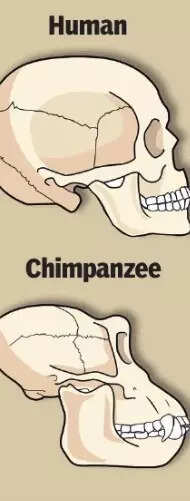
“The chin evolved largely by accident and not through direct selection, but as an evolutionary byproduct resulting from direct selection on other parts of the skull,” said lead author of the new study Noreen von CramonTaubadel, a professor of Anthropology at University at Buffalo, US.The “spandrel” theory of the chin is known, but it had pegged natural selection as the evolutionary driver of changes in the lower jaw. It’s here that Cramon-Taubadel and her team deviated. They tested the “null hypothesis” of neutrality by comparing skulls of apes with humans’ to see if evolution of the chin was random.Cramon-Taubadel said: “While we do find some evidence of direct selection on parts of the human skull, we find that traits specific to the chin region better fit the spandrel model. The changes since our last common ancestor with chimpanzee are not because of natural selection on the chin itself but on selection of other parts of the jaw and skull.”Essentially, the human chin is the space under the staircase, according to these scientists, which formed incidentally when nature was busy constructing our main features.

