


Last Updated:
US-Israel-Iran War And Strait Of Hormuz: How has the conflict impacted the traffic in the global oil shipping lane? What does it mean for India and the world? News18 explains




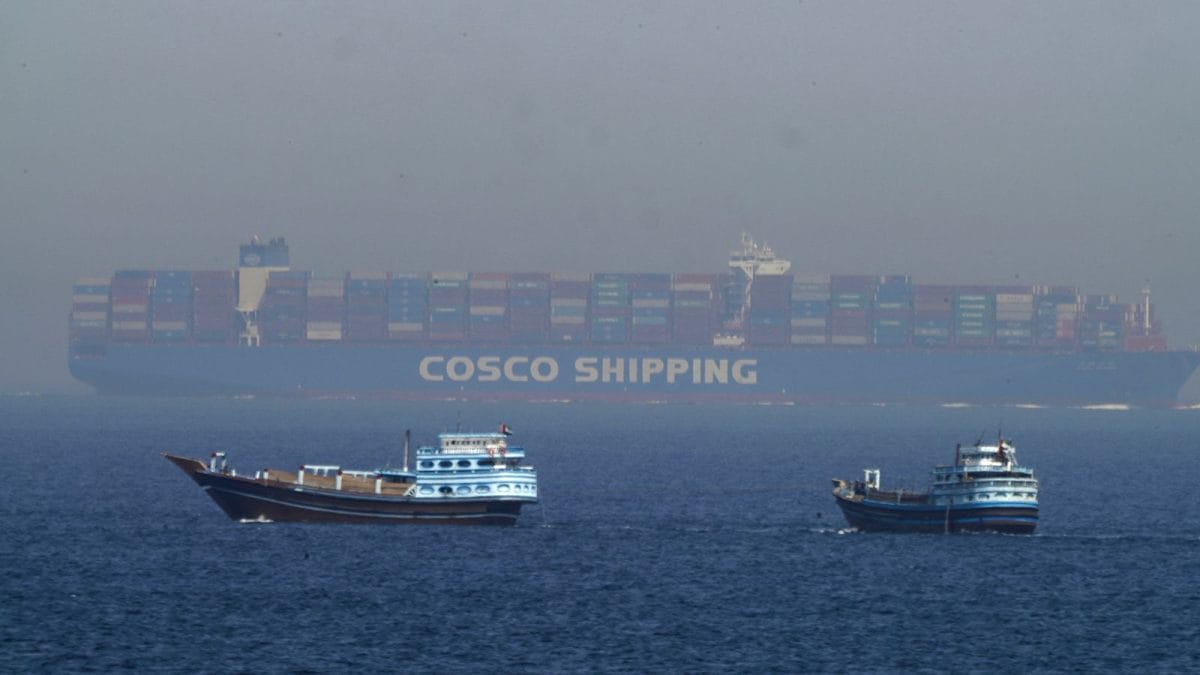
Two traditional dhows sail by a large container ship in the Strait of Hormuz. (AP)
The Strait of Hormuz is currently the focus of a severe global crisis. Following joint Israeli-United States strikes on Iran on February 28, the Islamic Revolutionary Guard Corps (IRGC) has reportedly closed the waterway to all maritime traffic.
Where is it? How was the conflict impacted the traffic? What does it mean for India and the world? News18 explains
Where is the Strait of Hormuz?
It is a narrow, strategically vital waterway in the Middle East that serves as the only sea passage from the Persian Gulf to the open ocean.
It links the Persian Gulf (to the west) with the Gulf of Oman and the Arabian Sea (to the southeast).
Bordering Countries
North Coast: Iran
South Coast: The Musandam Peninsula (an exclave of Oman) and the United Arab Emirates
It is about 21 to 33 miles (33–54 km) wide at its narrowest point. Due to the narrowness, ships must use two-mile-wide lanes (one inbound, one outbound) separated by a two-mile buffer zone to prevent collisions.
Major islands within or near the strait include Qeshm, Hormuz, Larak, and Hengam, most of which are controlled by Iran.
Key Oil Shipping Lane: Why the Strait of Hormuz matters
The Strait of Hormuz is the world’s most critical oil chokepoint. It connects the Persian Gulf with the Gulf of Oman and the Arabian Sea. It is approximately 21 miles (33 km) wide at its narrowest point.
It handles approximately 20% of global oil consumption (around 20 million barrels per day) and 20-25% of the world’s liquefied natural gas (LNG), primarily from Qatar. Over 80% of the oil passing through the strait is destined for Asia, with China, India, Japan, and South Korea being the primary importers.
Alternative routes are limited and cannot fully compensate for a total closure of the strait.
Saudi Arabia can divert up to 5 million barrels per day via its East-West Pipeline to the Red Sea. The UAE operates the Habshan-Fujairah pipeline, which can carry roughly 1.5 million barrels per day directly to the Gulf of Oman. Iraq has a pipeline through Turkey, but it primarily handles crude from northern fields.
How has the US-Israel-Iran conflict hit the Strait Of Hormuz?
While Iran has not issued a formal legal confirmation of a total blockade, vessels in the region are receiving VHF radio transmissions from the IRGC stating that “no ship is allowed to pass”.
The U.S. has surged naval assets to the region, including the USS Gerald R. Ford and the USS Abraham Lincoln, in what is described as the largest deployment since 2003.
The impact
Forecasts for Brent crude have already been hiked toward $100 per barrel due to supply chain risks.
At least three Pakistani ships operated by the Pakistan National Shipping Corporation were reportedly stopped by Iran on March 1.
Ship traffic has plummeted, with many tankers staying in port or turning back, though some continue to transit at their own risk.
BREAKING:Iran has attacked the Palau-flagged oil tanker Skylight as it was passinf through the Strait of Hormuz right off the coast of Oman.
4 sailors wounded in the attack. The entire crew has been evacuated. pic.twitter.com/wDX5X2czq6
— Visegrád 24 (@visegrad24) March 1, 2026
Attack reported
A Palau-flagged oil tanker, Skylight, was reportedly attacked while transiting through the Strait of Hormuz near the coast of Oman, amid escalating tensions in the region. According to reports circulating on social media, the vessel was struck while passing through the strategic waterway, triggering a fire onboard. Visuals shared online show thick plumes of black smoke rising from the tanker, with flames visible near the deck. Initial reports claim that four sailors were injured in the attack. The entire crew has since been evacuated from the vessel. The extent of the damage to the tanker remains unclear
What does it mean for India?
India is facing a high-stakes energy and economic crisis due to the reported closure of the Strait of Hormuz by Iran. India is the world’s third-largest oil consumer and is uniquely vulnerable because its dependence on this specific route has actually increased in early 2026, say experts.
Approximately 50% of India’s total crude oil imports (around 2.6 million barrels per day) pass through the Strait. This volume primarily comes from Iraq, Saudi Arabia, the UAE, and Kuwait.
India is even more vulnerable in terms of LPG (Cooking Gas), as it imports almost 100% of its LPG through this chokepoint. A sustained closure would immediately threaten the Pradhan Mantri Ujjwala Yojana and domestic household energy.
About 60% of India’s Liquefied Natural Gas imports, mainly from Qatar and the UAE, transit the Strait. Every $1 increase in the price of oil adds roughly $2 billion to India’s annual import bill.
Rising fuel costs are expected to spike domestic inflation, potentially forcing the Reserve Bank of India (RBI) to keep interest rates high. The increased demand for dollars to pay for costlier oil is also putting downward pressure on the Indian Rupee (INR), according to analysts.
Beyond energy, over 13% of India’s non-oil exports (worth $47.6 billion) to Gulf nations are at risk due to shipping disruptions.
India has enough crude oil in its Strategic Petroleum Reserves (SPR) and commercial stocks to last about 10–15 days, plus another 7–10 days of finished fuel inventories. While India had recently reduced its intake of Russian oil, officials have indicated they may pivot back to Moscow if Middle Eastern supplies remain blocked, though transit from Russia takes nearly 30 days compared to 5 days from the Gulf, according to reports.
The Ministry of External Affairs has activated contingency plans for the possible evacuation of the 9–10 million Indians living in the Gulf region through Operation Sindhu-II.
External Affairs Minister S. Jaishankar is currently engaging in “shuttle diplomacy,” calling for restraint from both Iran and Israel while emphasizing the respect of sovereignty and territorial integrity.
With Agency Inputs
March 01, 2026, 18:10 IST
Read More

