


Last Updated:
The Pax Silica initiative is a US-led alliance designed to strengthen supply chains for critical minerals and AI. Here’s what joining it means for India.




By joining the US-led Pax Silica initiative, India is moving away from being just a ‘buyer’ or technology to a ‘trusted architect’. (File Photo)
In a major development, India on Friday joined the ‘Pax Silica‘, a US-led strategic alliance aimed at building a resilient supply chain for critical minerals and artificial intelligence. Union Minister Ashwini Vaishnaw and US Ambassador to India Sergio Gor attended the signing ceremony. Gor said Pax Silica is a coalition of capabilities.
What Is Pax Silica?
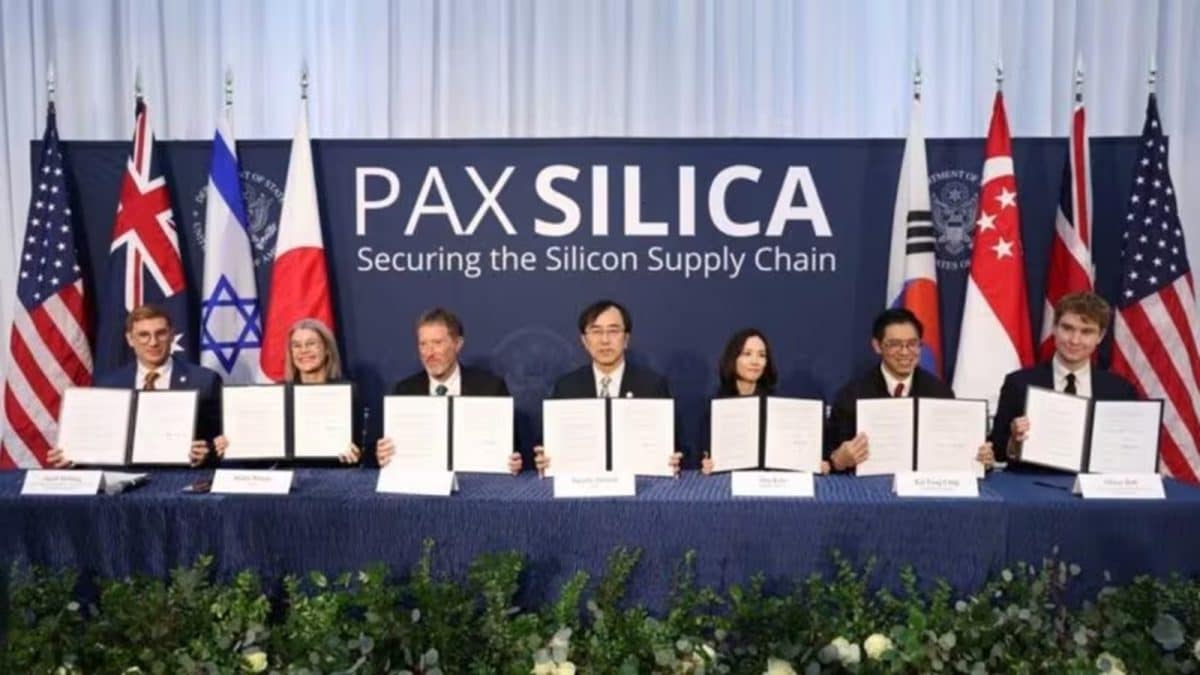
The Pax Silica initiative, launched by the US on December 12, 2025, is a strategic alliance to secure the global critical mineral supply chain and enhance manufacturing capabilities for semiconductors and AI. Critical minerals include lithium, cobalt, graphite, and rare-earth elements needed for high-end electronics.
Its member nations included Australia, Greece, Israel, Japan, Qatar, Republic of Korea, Singapore, the United Arab Emirates and the United Kingdom.
“Pax Silica is a declaration that future belongs to those who build and when free people join forces,” US Under Secretary of State for Economic Affairs Jacob Helberg said.
How Does It Help India?
By joining the US-led alliance, India is moving away from being just a ‘buyer’ or technology to a ‘trusted architect’.
India’s inclusion under the alliance makes it the primary destination for Western companies looking to diversify their AI and semiconductor operations. Currently, 90% of the world’s most advanced chips are made in just one place (Taiwan) and designed by a handful of companies; any geopolitical tension or natural disaster can break the entire chain.
After Pax Silica, India also gets priority access to high-end intellectual property (IP). This will help India move from service-based IT to product-based innovations. Recently, Union Minister Ashwini Vaishnaw said Indian engineers are already working on 2-nanometer chips, the bleeding edge of computing.
India is now also expected to see strategic co-investment from Pax Silica’s $200-billion AI fund.
The initiative will help India secure critical minerals like lithium, cobalt, graphite and rare-earth minerals.
The global semiconductor industry is projected to need one million additional skilled workers by 2030. Pax Silica recognises that only India has the scale to provide this.
In August 2025, Minister of Electronics and IT Ashwini Vaishnaw said India has the opportunity to bridge a significant part of this gap. He also highlighted the importance of developing a strong talent base and said that one of the major objectives of the India Semiconductor Mission (ISM) is to create a global pipeline of skilled professionals.
Pax Silica Declaration
According to the Pax Silica declaration, “We recognise that a reliable supply chain is indispensable to our mutual economic security… We also recognise that artificial intelligence (AI) represents a transformative force for our long-term prosperity and that trustworthy systems are essential to safeguarding our mutual security and prosperity.”
“We believe that economic value and growth will flow through and across all levels of the global AI supply chain, driving historic opportunity and demand for energy, critical minerals, manufacturing, technological hardware, infrastructure, and new markets not yet invented,” it said.
 Click here to add News18 as your preferred news source on Google.
February 20, 2026, 11:55 IST
Read More

