


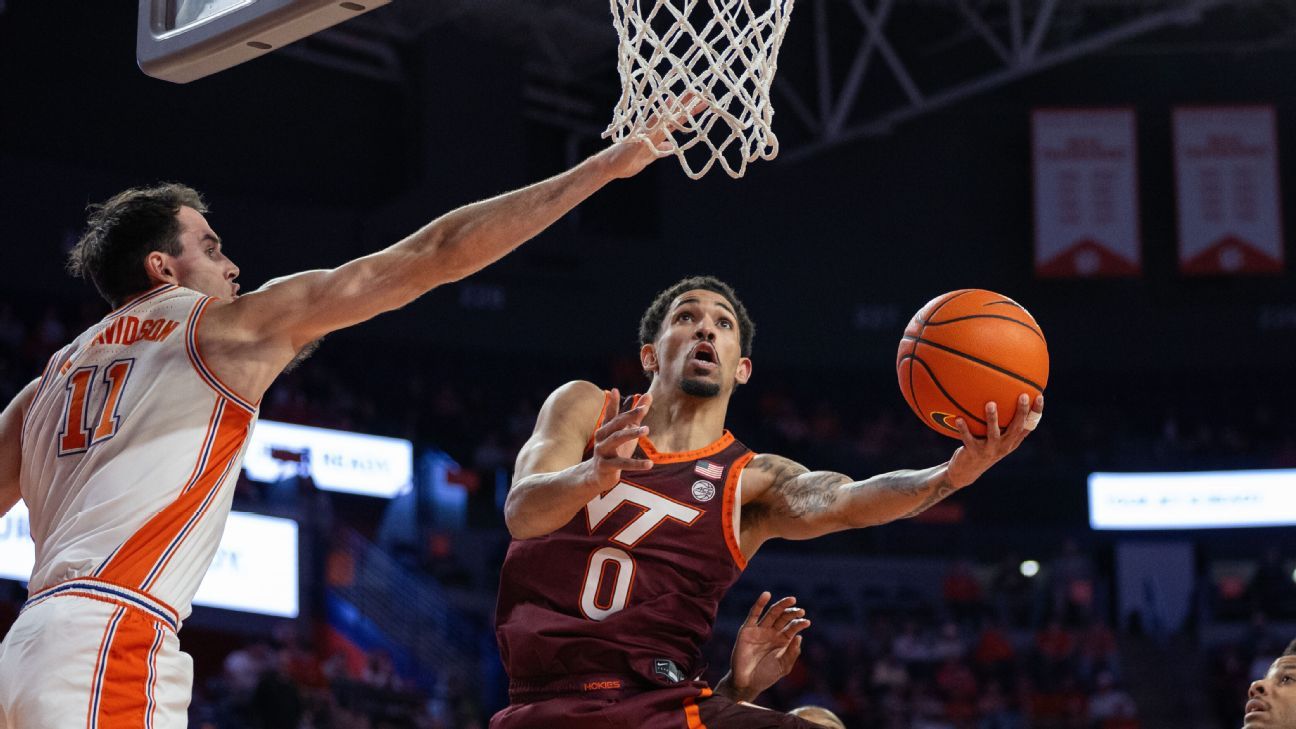
The 2026 men’s NCAA tournament is rapidly approaching, which means the question top of mind for many fans is: Will your team be in or out? They have roughly five weeks until Selection Sunday to strengthen their case. Until then, we’re here to track how each team on the “bubble” of the bracket is trending.
We’ll use a variety of metrics as guides, classifying teams based on how likely they are to make the field of 68 as one of the 37 at-large selections — conditional on not winning their respective conference tournaments for one of the 31 automatic qualifying bids (AQs). To that end, we’ll use Joe Lunardi’s Bracketology projections and a combination of data sources — including my forecast-model consensus and NCAA résumé metrics such as NET rankings that the selection committee will evaluate — to judge a team’s underlying potential. (For a full glossary of terms and sources, click here or scroll to the bottom of this story.)
We’ll sort teams in at-large contention into the following categories:
-
Locks: Teams that would need a significant change in momentum to miss the cut (which some inevitably still will). 29 current teams
-
Should be in: Teams tracking safely above the cutline, if not immune to trouble. Most likely, these teams should hear their names called March 15, though their fates are not yet assured. 12 current teams
-
Work to do: Teams whose upcoming results will meaningfully change their fate (for good or bad). These are the truest “on the bubble” teams, because their chances are closest to a coin flip. 16 current teams
-
Long shots: Teams that would need to outperform expectations or benefit from chaos. There is little — though not zero — chance these ones will make the Big Dance without winning their conference tournament.
Let’s go conference by conference — in order of which project to have the most NCAA tournament bids — to rank the teams in each category based on their chances to secure an at-large bid.
Note: All times Eastern. Only expected at-large bids are listed; each conference will receive one additional berth with an AQ.
Jump to a conference:
Big Ten | SEC | ACC
Big 12 | Big East
Mid-majors


BIG TEN
9.9 expected bids; 8.9 at-large

Locks (5)
Michigan Wolverines
Illinois Fighting Illini
Purdue Boilermakers
Nebraska Cornhuskers
Michigan State Spartans
Should be in (4)

Updated: Feb. 11, 8:24 p.m.
With a chance to run its win streak to seven games, Iowa instead fell short against Maryland on Wednesday. The Hawkeyes still own a conditional at-large probability in the 90% range, and a résumé around the top 30 nationally, so the road loss only stalls their momentum for now. Helping coach Ben McCollum’s team is the fact that it’s borderline top 20 in our average of predictive ratings, which in turn raises its potential going forward. Iowa’s schedule does get more difficult, though, jumping from 70th so far to 14th from here on nationally (fourth hardest in the Big Ten), according to the BPI.
Next game: vs. Purdue (Saturday)

Updated: Feb. 10, 10:24 p.m.
After trailing by double digits with seven minutes left in regulation, Wisconsin rallied to force overtime at Illinois on Tuesday, eventually scoring an impressive win behind 49 combined points from John Blackwell and Nick Boyd. The victory was the Badgers’ second Quadrant 1A win of the season, which improves a résumé that otherwise sits around 40th in the national consensus ranking (ninth in a Big Ten currently tracking for 10 bids). Their schedule doesn’t let up after the trip to Champaign, with three more Quadrant 1 contests still coming up. More wins over that stretch could further solidify their at-large case.
Next game: vs. Michigan State (Friday)

Updated: Feb. 10, 7:20 a.m.
Darling of the forecast models — which now average out to a conditional at-large probability in the mid-80% range despite the team’s borderline top-40 résumé ranking — Indiana bolstered its chances with a thrilling overtime win over Wisconsin on Saturday, then rolled all over Oregon on Monday. The latter was the Hoosiers’ fifth victory in six games, a stretch that includes three wins over opponents in Quadrants 1 and 2. With only the eighth-hardest remaining schedule in the Big Ten and a top-30 ranking in the predictive metrics, the Hoosiers have a good path to the tourney in front of them.
Next game: at Illinois (Sunday)

Updated: Feb. 8, 8:02 a.m.
The Bruins recently saw their 14-game home win streak snapped in double overtime against Indiana, but they’ve gotten right back to winning with consecutive victories over Rutgers and, on Saturday, Washington. In the big picture, their résumé ranks in the mid-40s nationally and 10th in the Big Ten, though that might be underselling their chances. The forecast model composite thinks they’re more likely to get a bid than not (76%) on the basis of two Quadrant 1 wins — a better predictive rating than their résumé gives them credit for — and a future projection that calls for them to end up above 20 wins on the season. That said, many high-leverage games remain for UCLA, and it faces the Big Ten’s third-toughest remaining schedule.
Next game: at Michigan (Saturday)
Work to do (3)

Updated: Feb. 11, 8:54 p.m.
Bouncing back from Sunday’s lopsided home loss to Michigan, the Buckeyes won Wednesday’s clash with USC to help raise their at-large chances. They still sit right on the bubble, ranking mid-40s in the national résumé rankings, and 11th in what is looking like a 10-bid Big Ten. They are also 0-7 against Quadrant 1 opponents, making them less sure of a tournament-bound team than they seemed to be earlier in the season. But the victory over USC is a step in a better direction, and now they’ll try to compile what has been too rare of a sight this season: a winning streak.
Next game: vs. Virginia (Saturday)

Updated: Feb. 11, 8:54 p.m.
Behind the play of freshman star Alijah Arenas, USC’s recent win streak helped pad its bubble case. But in a crucial visit to Ohio State on Wednesday, the Trojans were unable to hang on to a second-half lead, which ate into their at-large chances. Of course, their main problem remains future results: If the season ended today, they would likely secure one of the Big Ten’s last entries with the eighth-best résumé ranking in what’s tracking to be a 10-bid conference. The models, however, are less bullish. They are a high-40s team in the predictive ratings, with the nation’s 17th most difficult remaining schedule. The next three weeks will be a wild ride for Eric Musselman’s team.
Next game: vs. Illinois (Wednesday)

Updated: Feb. 8, 8:02 a.m.
The Huskies are tumbling further toward the “long shots” category, as a pair of losses to Iowa and UCLA dropped them to an 11% chance in the forecast model consensus. They are just 4-9 in Big Ten play and rank 12th in the conference on résumé (63rd nationally). But they also have a pair of wins over teams in the BPI top 50 — most recently adding what might have been their most impressive of the season, a 14-point road victory over Northwestern on Jan. 31. One other glimmer of hope for UW: It has the easiest remaining Big Ten schedule, though that also cuts against its ability to add signature wins.
Next game: vs. Penn State (Wednesday)
Long shots
None

SEC
9.5 expected bids (8.5 at-large)
Locks (6)
Florida Gators
Vanderbilt Commodores
Alabama Crimson Tide
Arkansas Razorbacks
Tennessee Volunteers
Kentucky Wildcats
Should be in (3)

Updated: Feb. 10, 9:17 p.m.
A couple of weeks ago, Auburn was multiple games above .500 in the SEC and was nearing “lock” territory in the model consensus. But three straight losses — albeit to a trio of tough opponents in Tennessee, Alabama and Vanderbilt — have complicated the pace of that trajectory. If we zoom out, the Tigers do have four Quadrant 1 wins (including one 1A) against the nation’s fourth-most-difficult schedule per the BPI, and they remain mid-30s in the national résumé ranking average. That means there’s still cushion to work with, though the BPI is projecting them to barely clear 18 wins. They will be a fascinating litmus test for how much the committee values schedule strength.
Next game: at Arkansas (Saturday)

Updated: Feb. 11, 9:15 p.m.
Georgia picked up a much-needed win in Saturday’s visit to LSU, but Florida made quick work of the Dawgs on Wednesday to hand them their fourth loss in five games. Still in the mid-to-high 30s of the overall résumé rankings — with a quartet of wins against the BPI top 50 — they are still eighth in résumé average amid what is looking like a nine- or 10-bid SEC, so their at-large chances remain solid despite the recent losses. But a jump from 73rd-hardest strength of schedule nationally to 18th moving forward could portend even more losses from here.
Next game: at Oklahoma (Saturday)

Updated: Feb. 7, 10:45 p.m.
Despite back-to-back losses to Alabama and Florida, most of the models in the forecast consensus still consider the Aggies to be in solid shape (80% or higher) for an at-large bid. They are projected by the BPI to finish the regular season with at least 21 wins, which should be enough to make the tournament. They’re still just eighth in the résumé ranking average out of what could be as few as nine tournament-bound teams from the SEC, though there’s a big gap between them and 10th-ranked Texas.
Next game: vs. Missouri (Wednesday)
Work to do (2)

Updated: Feb. 7, 5:34 p.m.
Despite ranking in the mid-30s of the predictive metrics nationally, Sean Miller’s team is in a tough numbers game after a handful of early defeats in SEC play. The Longhorns seem to be moving in the right direction, though, with three straight wins (and four in five). That includes Saturday’s victory over Ole Miss, courtesy of a game-ending 14-0 run that turned a three-point deficit into an 11-point win over the final 3½ minutes. They are still 10th in the conference in the résumé rankings (around 50th nationally), and their schedule strength jumps from 64th hardest looking back to 19th hardest going forward. Three Quadrant 1 wins, including two for Quadrant 1A, are helpful, but the Horns need to either keep the winning streak going against a tough set of opponents, or hope the SEC gets 10 bids.
Next game: at Missouri (Saturday)

Updated: Feb. 7, 3:15 p.m.
After a recent cold stretch, the Tigers won their second straight game (and third in four) with a dominant performance at South Carolina on Saturday. They still rank just 11th among SEC teams in the résumé average — a tough spot to be in with the conference projected for 10 tournament entries at most. Mizzou does have a pair of Quadrant 1A wins (Florida and Kentucky) and four against the BPI top 50. But even if its résumé is on par with that of Texas, Missouri is much lower in the predictive metrics, so outdueling the Longhorns with more wins remains a task easier said than done.
Next game: at Texas A&M (Wednesday)
Long shots
LSU Tigers
Ole Miss Rebels
Oklahoma Sooners

ACC
8.0 expected bids; 7.0 at-large
Locks (6)
Duke Blue Devils
Louisville Cardinals
Virginia Cavaliers
North Carolina Tar Heels
Clemson Tigers
NC State Wolfpack
Should be in (2)

Updated: Feb. 10, 9:09 p.m.
The Mustangs bounced back from consecutive losses, including an especially tough one hosting NC State, with a pair of wins over Pittsburgh and Notre Dame to help stabilize their trajectory. Even after the recent losses, SMU still ranked seventh best in what should be an eight-bid ACC on résumé. And although they are seventh in the ACC (34th nationally) in the predictive ranking, they have the nation’s 74th-hardest remaining schedule. That’s good for managing a status quo that likely resides above the bubble if the bracket was set today — especially if they can add another résumé win or two, which they’ll have a handful more chances to do before the regular season ends.
Next game: at Syracuse (Saturday)

Updated: Feb. 11, 7:58 a.m.
The Hurricanes’ chances had dipped with recent losses at Clemson (excusable) and to FSU and Cal at home (less so), but a return to the win column against Boston College followed by a huge, résumé-boosting victory over North Carolina has their tournament chances back on the rise. Miami is hardly a lock — it has a low-40s résumé quality nationally (eighth in the ACC) — but its consensus model at-large odds are now into the 70s. Which makes it more of a “should be in” team than a “work to do” team, for now. The BPI has the Canes facing the 59th-hardest remaining schedule in the nation, with four more chances to score Quadrant 1 wins.
Next game: at NC State (Saturday)
Work to do (2)

Updated: Feb. 11, 9:21 p.m.
Unlike on Saturday, when the Hokies could not overcome NC State on the road, they scored a huge road win over another Quadrant 1A foe with an upset at Clemson on Wednesday. It was their third Quadrant 1 win of the season — and first Quadrant 1A victory — helping to boost a résumé rating that threatened to drop out of the top 50. The at-large chances still suggest they are tracking to miss the field without additional résumé boosters, in part because they only rank borderline top 60 in the predictive metrics. But a win in the highest-leverage game of Wednesday’s slate, per BartTorvik, absolutely helped their case.
Next game: vs. Florida State (Saturday)

Updated: Feb. 11, 9:47 p.m.
Recent wins over North Carolina, Stanford, Miami and Georgia Tech vaulted Cal into bubble territory, but back-to-back losses to Clemson, then Syracuse in double overtime — the latter of which happened amid a city-wide power outage — splashed cold water on the Golden Bears’ hopes. They still sit in the borderline top 50 on the résumé ranking, have four Quadrant 1 wins (including one Quadrant 1A) and face the ACC’s second-easiest remaining schedule. But with a consensus at-large probability tumbling toward the single digits, the Bears truly do have “work to do” (and not much time to do it).
Next game: at Boston College (Saturday)
Long shots
Stanford Cardinal
Wake Forest Demon Deacons

BIG 12
7.4 expected bids (6.4 at-large)
Locks (6)
Arizona Wildcats
Houston Cougars
Kansas Jayhawks
Iowa State Cyclones
Texas Tech Red Raiders
BYU Cougars
Should be in (1)

Updated: Feb. 8, 4:15 p.m.
With so many of the conference’s expected bids being effective locks — the six teams listed above each have 100% conditional at-large odds in the model consensus — the Big 12 bubble picture really comes down to which team could be the seventh in. The Knights remain in the driver’s seat for that slot despite back-to-back losses at Houston and Cincinnati over the past week. They rank around 30th in the résumé average, while only one other non-lock Big 12 team (Oklahoma State) is even in the top 50. Despite the recent defeats, the Knights are still tracking for more than 20 wins and will get the chance to regroup and bolster their tournament chances against a more winnable sequence of upcoming games against West Virginia, TCU and Utah.
Next game: vs. West Virginia (Saturday)
Work to do (3)

Updated: Feb. 11, 7:58 a.m.
After a recent losing skid in Big 12 play, the Horned Frogs responded with a win over K-State and, on Tuesday, a big résumé-boosting upset win over Iowa State at home. Their case is now getting interesting: Although they sit with just 31% at-large odds after beating the Cyclones, they have four Quadrant 1 wins (including a pair of Quadrant 1A wins over Florida and Iowa State), and a couple more Quadrant 1 games coming up against Oklahoma State and UCF, in the Big 12’s third-easiest remaining schedule (51st hardest nationally). Winning those would add more to their portfolio.
Next game: at Oklahoma State (Saturday)

Updated: Feb. 11, 8:05 a.m.
The Cowboys followed Saturday’s lopsided loss at the nation’s No. 1 team, Arizona, with another loss Tuesday to Arizona State — where they fell behind early and never could close the gap. Their previous upset of BYU had them creeping toward the top 40 in the résumé ranking — still eighth best in the conference in that regard — and just on the edge of how many bids the Big 12 could have. That said, the models remain comparatively low on Oklahoma State because its predictive ranking (now outside the top 60) is so much worse than those of some of its bubble rivals. It also faces the conference’s third-toughest remaining schedule.
Next game: vs. TCU (Saturday)

Updated: Feb. 8, 3:15 p.m.
WVU certainly faces an uphill climb to get back to the tournament for the first time since 2023, and Sunday’s loss at home to Texas Tech gave back some of the gains from Thursday’s win at Cincinnati. The model consensus gives the Mountaineers just around a 10% at-large shot on average, and they reside outside the top 60 in the résumé rankings. West Virginia does have two wins against Quadrant 1 foes — including one against Quadrant 1A Kansas last month — but they sit below Baylor and TCU in the predictive ranking. WVU will get four more chances to add Quadrant 1 wins and will need to win some of them to get closer to a tourney-bound track.
Next game: at UCF (Saturday)
Long shots
Baylor Bears
Cincinnati Bearcats
Arizona State Sun Devils

BIG EAST
3.2 expected bids (2.2 at-large)
Locks (3)
UConn Huskies
St. John’s Red Storm
Villanova Wildcats
Should be in (0)
None
Work to do (1)

Updated: Feb. 11, 9:27 p.m.
Just when the season seemed to be slipping away from Shaheen Holloway and his team with six losses in eight games, the Pirates outlasted Providence on Wednesday in a game with exactly one lead change — midway through the second half. They still have a steep hill to climb, entering the day with only slightly above 10% at-large chances in the forecast composite, sitting outside the top 50 nationally in résumé average with only a single Quadrant 1 win (against NC State). An at-large bid will be hard to argue for if the Big East receives only three bids, which is the current Bracketology expectation, though the Pirates have a few more high-profile chances left to make their case.
Next game: at Butler (Sunday)
Long shots
Creighton Bluejays
Butler Bulldogs
OTHERS
Locks (3)
Gonzaga Bulldogs (West Coast Conference)
Saint Louis Billikens (Atlantic 10)
Utah State Aggies (Mountain West)
Should be in (2)

Saint Mary’s Gaels (WCC)
Updated: Feb. 8, 8:34 a.m.
Saint Mary’s hasn’t missed the NCAA tournament in five seasons, so it’s tough to imagine that streak coming to an end, with the Gaels sitting 33rd in the résumé rankings. Yet they’re here because they carry only a consensus 76% at-large probability, likely driven by the perennial question of how many WCC teams the NCAA can accommodate for the Dance after Gonzaga. One possible trouble spot: While their résumé is better than that of Santa Clara’s, the Gaels lost the first of the teams’ two head-to-head matchups. They also don’t have any Quadrant 1 wins — and likely won’t, unless they get revenge for last Saturday’s loss at Gonzaga when the teams meet again on Feb. 28 at Saint Mary’s. But back-to-back wins over San Diego and San Francisco have them back on the victory bus.
Next game: vs. Pepperdine (Wednesday)

Santa Clara Broncos (WCC)
Updated: Feb. 7, 8:13 p.m.
The Santa Clara and Saint Mary’s comparisons will be constant down the stretch, as we debate whether the WCC could get three bids — which has happened only once in the past 13 seasons, but could this year — and how much the committee should value head-to-head wins versus overall résumé quality. The Broncos’ chances continue to rise, however, with 71% consensus at-large odds and the 40th résumé ranking, which earns them “should be in” status for now. Their defense put the clamps on Washington State late Saturday to claim their eighth consecutive win (and 12th in 13 games). And they will get additional cracks at both Saint Mary’s and Gonzaga later this month.
Next game: vs. Seattle (Wednesday)
Work to do (5)

Miami (Ohio) RedHawks (MAC)
Updated: Feb. 10, 7:32 a.m.
The MAC hasn’t received multiple bids since 1998-99 — fittingly, the same season that Wally Szczerbiak led the RedHawks to the Sweet 16 after knocking off Washington and Utah in the first two rounds. Could history repeat itself? After Arizona’s loss, Miami is the sole remaining unbeaten in Division I and ranks inside the top 40 on résumé as a result. The forecast models don’t quite know how to handle the RedHawks, though the committee has never excluded an eligible team with fewer than four losses in a non-pandemic season. It is true that Miami is a borderline top-90 team in the predictive ratings (Akron ranks higher in the MAC) that has run up an undefeated record against the 347th-hardest schedule in the nation. But wins are wins, and Miami got another one Saturday against Marshall in a more comfortable fashion than its recent closer victory over Buffalo.
Next game: vs. Ohio (Friday)

Updated: Feb. 8, 8:34 a.m.
Saturday was a good day for SDSU: The Aztecs beat Air Force, and conference bubble rival New Mexico fell to Boise State. That said, the Aztecs are still one of the bubbliest of bubble teams. They sit 46th nationally in résumé ranking, third in the conference standings and their consensus at-large chances are almost exactly 50-50. The Mountain West could feasibly send at least three teams to the tournament this year (the conference has sent at least four teams in each of the past four seasons). With a fairly large gap in at-large odds over the next-best MW team (New Mexico at 27%), the Aztecs would figure to be in decent enough shape if they keep winning.
Next game: vs. Nevada (Saturday)

New Mexico Lobos (MW)
Updated: Feb. 8, 8:34 a.m.
Seeking a third straight NCAA tournament trip for the first time in more than a decade, the Lobos may no longer have the inside track to being the Mountain West’s second-most-likely entrant after Saturday’s heartbreaker against Boise State at The Pit dropped their consensus at-large odds to just 27%, a massive decline of 24 percentage points. New Mexico does have roughly the same résumé ranking as San Diego State, and the teams face fairly equivalent schedules from here on out. The primary blemish for the Lobos is their head-to-head loss at the Aztecs on Jan. 17, which they won’t have a chance to avenge until they play host on Feb. 28.
Next game: at Grand Canyon (Wednesday)

VCU Rams (A-10)
Updated: Feb. 11, 9:08 p.m.
VCU hasn’t made back-to-back NCAA tournaments since the Will Wade era nearly a decade ago, and the forecast models (around 20% consensus at-large) remain less than bullish on that streak ending this season, in part because the Rams are 0-4 against Quadrant 1 opponents with only one remaining shot at changing that (at Saint Louis on Feb. 20). However, they are right in the middle of bubble territory in overall résumé (46th nationally), and their remaining schedule is set up for plenty more wins, so they can certainly add to their case. After crushing Dayton at home to conclude last week, they were back at it Wednesday with a comfortable win at La Salle.
Next game: at Richmond (Saturday)

Boise State Broncos (MW)
Updated: Feb. 8, 8:47 a.m.
The Broncos have come on strong recently, elevating themselves into the “work to do” category with wins in six of seven games, including Saturday’s critical one-point victory at fellow bubble squad New Mexico. They’ve tripled their conditional at-large odds in the past week — but before we get too excited, that still leaves them at 15% odds, with a résumé ranking outside the top 60. They belong here for now, and will get further chances to build their case to the committee in the next month.
Next Game: vs. UNLV (Friday)
Long shots
Tulsa Golden Hurricane (American)
Nevada Wolf Pack (MW)
Belmont Bruins (MVC)
Grand Canyon Lopes (MW)
George Mason Patriots (A-10)
South Florida Bulls (American)
Liberty Flames (Conference USA)
McNeese Cowboys (Southland)
Dayton Flyers (A-10)
Yale Bulldogs (Ivy League)
Akron Zips (MAC)
Stephen F. Austin Lumberjacks (Southland)
Glossary of terms
-
Model consensus: A blend of the conditional at-large bid odds found via BartTorvik, TeamRankings, JThom Analytics and ESPN Analytics.
-
Résumé ranking: An average of rankings in strength of record (SOR), NET, KPI and wins above bubble (WAB).
-
Predictive ranking: An average of rankings in the Basketball Power Index (BPI), KenPom ratings (KP), Bart Torvik’s “Barthagorean” ratings, TeamRankings’ power ratings and Sports-Reference’s SRS ratings.
-
Strength of schedule and projected records are according to the BPI.

