


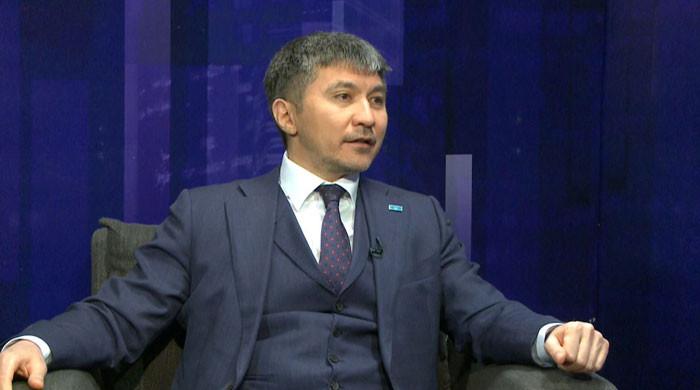
ISLAMABAD: When Yerzhan Kistafin arrived in Pakistan as Kazakhstan’s ambassador, the region was already unsettled. Trade routes were fragile, borders unpredictable, and Central Asia’s long struggle for access to warm waters remained unresolved.
While exclusively speaking to Geo News in Islamabad, the ambassador now describes a project he believes could quietly alter the economic geography of Eurasia.
“What we are doing today is not something new,” he said. “It is the continuation of a long-term regional strategy.”
At the centre of that strategy is an ambitious railway proposal linking Kazakhstan to Pakistan through Turkmenistan and Afghanistan, extending southward to Karachi and Gwadar ports. If completed, the corridor would connect landlocked Central Asia directly to the Arabian Sea for the first time in modern history.
The idea has circulated for years. What has changed, according to Kistafin, is political will.
He credits Prime Minister Shehbaz Sharif with sustaining Pakistan’s Central Asia policy despite internal political transitions.
“Prime Minister Shehbaz Sharif is a pragmatic and results-oriented leader,” the ambassador said. “His government focuses on delivery, not ceremonial diplomacy.”
Since taking office, the prime minister’s team has maintained regular engagement with Central Asian states, keeping connectivity at the centre of Pakistan’s regional agenda. Kistafin says discussions now revolve around implementation, financing, and timelines rather than declarations.
Trade between Pakistan and Kazakhstan currently stands at roughly 300 million dollars annually. Both governments regard the figure as misleading.
“The problem is not trade potential,” the ambassador said. “The problem is access.”
At present, goods travelling between Pakistan and Kazakhstan must cross at least two transit countries. Border closures, political disputes, and security disruptions can halt commerce overnight.
Rail connectivity, he argues, offers something diplomacy alone cannot guarantee: permanence.
“A train does not depend on political moods,” Kistafin said. “It depends on tracks.”
Under the proposed plan, rail cargo would move from Kazakhstan through Turkmenistan to Afghanistan’s western corridor, entering Pakistan at Chaman before linking with the country’s existing railway network and continuing south to its seaports.
The Afghan segment, long viewed as the project’s greatest obstacle, is also its strategic centrepiece.
“Afghanistan should not be seen as a barrier,” the ambassador said. “It should be part of the solution.”
Kazakhstan has held multiple rounds of dialogue with Afghan authorities while coordinating with Pakistan and Turkmenistan. While security risks persist, Kistafin argues that isolation has historically worsened instability.
“Connectivity creates responsibility,” he said. “Trade creates incentives for peace.”
The planned rail stretch from Turkmenistan’s border town of Turgundi through Afghanistan to Chaman would cover approximately 687 kilometres. Once final agreements are signed, construction is expected to take about three years.
Kazakhstan has committed to financing the project itself.
“We are not asking Pakistan for a single penny,” the ambassador said. “This is not aid. It is a mutually beneficial investment.”
If completed, the railway would integrate Pakistan into two major Eurasian trade systems: the North–South International Transport Corridor and the Trans-Caspian Middle Corridor. At present, Pakistan is not part of either.
For Central Asia, the corridor would provide the shortest route to warm waters. For Pakistan, it would position the country as a transit hub linking South Asia with Central Asia, the Caucasus, Türkiye, Russia, and Europe.
Economic projections are substantial.
During a visit to Karachi in December 2024, Kistafin met with the leadership of the Pakistan Business Council, which later conducted an independent assessment of bilateral trade potential.
According to the study, trade between Pakistan and Kazakhstan alone could reach 14 billion dollars once transportation bottlenecks are removed. The figure excludes commerce with the rest of Central Asia.
“That number is only for two countries,” the ambassador noted. “It does not include Uzbekistan, Turkmenistan, or others.”
Momentum behind the initiative increased following the official visit of Pakistan’s Army Chief, Field Marshal Asim Munir, to Kazakhstan last year, the first such visit in bilateral history.
The field marshal held extensive discussions with President Kassym-Jomart Tokayev, senior defence officials, and economic planners.
“Field Marshal Asim Munir is a visionary leader,” Kistafin said. “He understands that economic security and national security are inseparable.”
According to the ambassador, talks extended beyond military cooperation to infrastructure protection, regional trade corridors, and investment security. The visit strengthened institutional confidence and accelerated coordination on connectivity projects.
Kazakhstan’s broader strategic goal is to transform Central Asia from landlocked to land-linked.
Through China’s Belt and Road Initiative, freight already crosses Kazakh territory from western China to Europe in less than three weeks, compared with more than forty days by sea.
The Pakistan corridor would extend that network southward. Through Gwadar and Karachi, Central Asian exports could reach the Gulf, Africa, and Southeast Asia, while Pakistan would gain direct land access to Eurasian markets.
Alongside infrastructure, Kazakhstan has also moved to ease mobility between people. Business visas for Pakistani nationals are now issued within two days. Tourism cooperation agreements have been finalised, and direct flights between the two countries are expected to resume later this year.
Concerns related to human trafficking and illegal migration have been addressed through direct coordination between Kazakhstan’s migration authorities and Pakistan’s Federal Investigation Agency. Additional security agreements are expected during upcoming high-level visits.
For decades, Central Asia’s trade routes pointed north toward Russia and east toward China, while Pakistan’s outlook faced the sea.
The railway proposal sketches a different future, one where mountains become corridors and geography becomes opportunity.
“This project is not only about trains,” Ambassador Kistafin said. “It is about changing the direction of history.”
Whether politics, security, and time ultimately align remains uncertain. But for the first time in generations, a firm line is being drawn across the map, steel laid through valleys and borders, pointing south.
If it holds, it may finally connect two regions long separated not by distance, but by missing tracks.

