


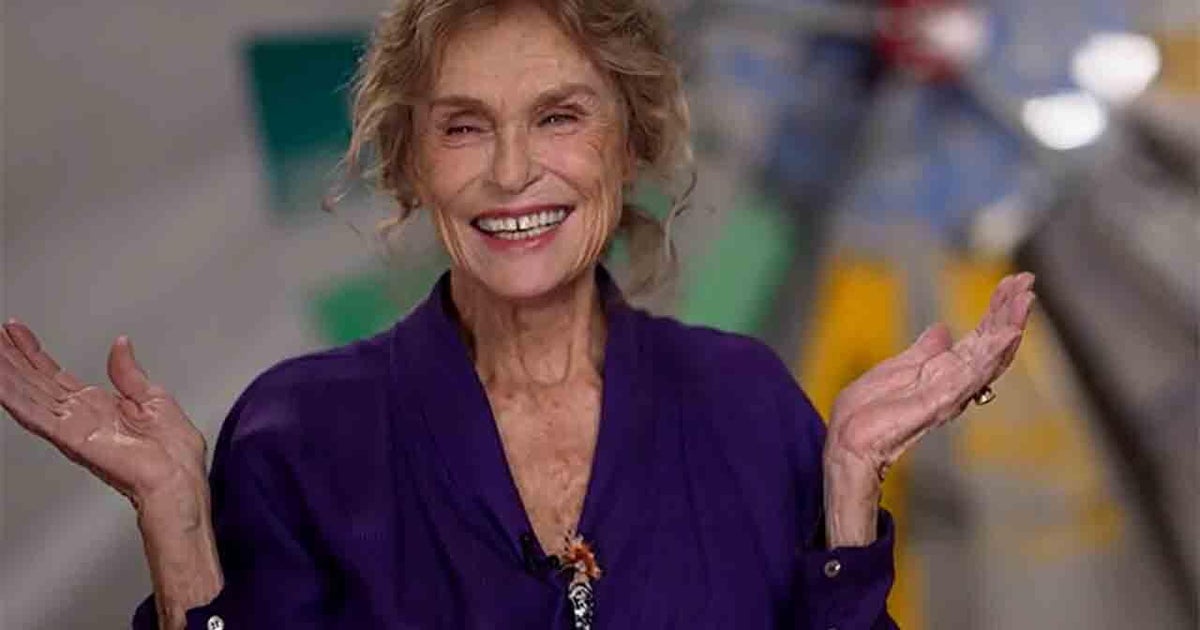
Lauren Hutton was told again and again in the 1960s that she wasn’t cut out to be a model. She recalled being told, “‘You’ve got that space between your teeth, your eyes are crossed a lotta the times. I had improper … everything.'”
While the gap in her teeth was sometimes visible, in the beginning she was discouraged from showing it. “I had to buy a little $300 plastic thing that went there, that I would sneeze out and lose,” she said.
She still owns the record for most cover appearances on American Vogue: 26. And at 82, she still has that smile.
Asked how she feels having been the first supermodel, Hutton said, “Yeah, certainly, if it was about money. And I changed the whole money system.”
In 1973, Revlon signed her to an exclusive deal for a quarter of a million dollars a year, then the biggest contract in modeling history.
Coming from college in New Orleans, she saw New York as a gateway to the world and to the wild places she wanted to visit. Ask her about modeling, and somehow you’ll almost always end up in Africa: “I lived with pygmies, and I lived with Karamojong, and I lived with Kalahari bushmen,” she said. “You’re constantly excited. You’re constantly thrilled. And everything’s beautiful. My life was none of this stuff. My life was traveling. That’s the only reason I came to New York.”
“You never really wanted to be a model?” I asked.
“Never heard of it!”
“In so many ways, it was all an accident.”
“Amen! Amen!” Hutton replied. “I’ve always been lucky. I was born lucky.”
A “believable” beauty
She was born Mary Laurence Hutton in Charleston, South Carolina, during World War II. Her dad was an Army pilot overseas: “He wrote me every single day from the war. And my mother, very kindly and beautifully, put it into books for me.”
Her parents split in 1945. Lauren grew up in Florida with an abusive stepfather. So, she treasured her father’s letters: “‘Cause I wanted my daddy bad,” she said.
But she never met him. “No. No. But he gave me a love, enough love in those letters that held me all this time, and made me love men!” she laughed.
Hutton made her screen debut in 1963 as a decoy contestant on the TV game show “To Tell the Truth,” while working as a “Bunny” at the Playboy Club in New York City. But at the beginning she was turned down by five modeling agencies.
Eileen Ford, who’d call Hutton a “believable” beauty, finally gave her a shot, later admitting, “I still don’t know what made me take her.”
Bert Stern/Conde Nast via Getty Images; CBS News 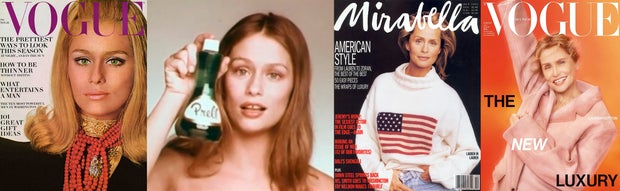
Hutton was sent to see the legendary editor of Vogue, Diana Vreeland, a meeting Hutton described as “heaven.” “And she said, ‘You!’ And I looked, and she had pointed this long, beautiful finger at me. And she said, ‘You have quite a presence.’ I had no idea what that was. What was a presence? But I took a chance, and I said, ‘Well, you sure do!'”
Vreeland quickly connected her with one of Vogue’s top photographers, Richard Avedon. “And he made wonderful – they’re still some of the best pictures I ever took,” Hutton said.
Avedon and Hutton became frequent collaborators. Soon she was the hottest model in the country, and a household name. Artist Robert Rauschenberg, a friend and neighbor, created a collage portrait of her. Hutton landed film roles, too, in “Paper Lion” with Alan Alda; “The Gambler” with James Caan; and “American Gigolo” with Richard Gere.
Photographs by Richard Avedon. © The Richard Avedon Foundation 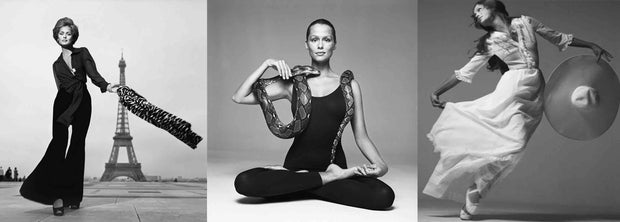
I asked, “For someone who didn’t want to be a model, or an actress, you turn out to be really good at it. And you seem to not only understand how to do it, but you seemed to figure out the economics of it?”
“Twice. I did that twice,” Hutton said. “‘Cause Bob lost all the first bunch.”
“Bob” was Bob Williamson, for nearly three decades her boyfriend, father figure, and financial manager. Hutton said, “You’d hear all those girls say, ‘Well, my sweetheart’s in high finance. What is yours in?’ I’d say, ‘Low finance.’ And I was right!”
They travelled the world together, until she discovered he’d lost nearly $13 million of her money. “Bob was very, very smart about all kinds of stuff,” she said.
“But he also lost all your money?”
“Yeah. But you know what? I’d do it again in a second,” Hutton said.
CBS News 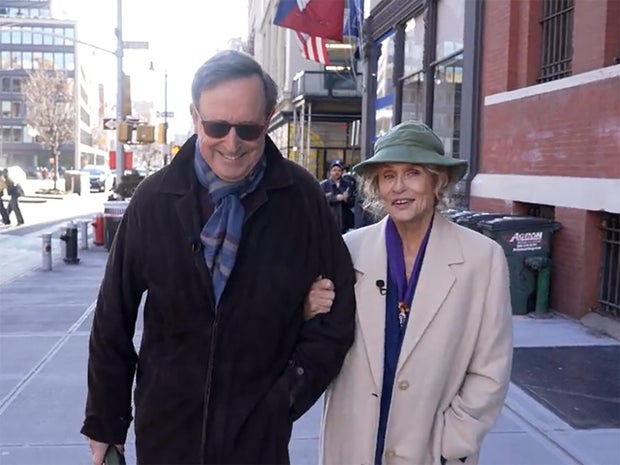
She went back to fashion and earned her fortune all over again. “I just kept on plugging at it,” she said.
Resilience is a recurring theme in Hutton’s life. In 2000, a motorcycle accident knocked her 20 feet into the air: “I can remember every second of it, and it was really sort of rapturous.”
She’d been riding to Las Vegas with a group of friends that included Jeremy Irons and Dennis Hopper, and was badly hurt: “Oh, I was dead, and I wasn’t breathing at all. Those boys saved me. My gang, my guys saved my life. My wingmen! Don’t make me start crying!”
But the cover girl came back from that, too.
Lauren Hutton has never regretted an adventure. “I was not there to see myself on the stands,” she said. “I was there to get the money to go see the world. I’ve had a great life. I’ve been very lucky.”
For more info:
- Thanks to the Rauschenberg Foundation, New York City
- Photographs by Richard Avedon © The Richard Avedon Foundation
Story produced by Gabriel Falcon. Editor: Carol Ross.

