


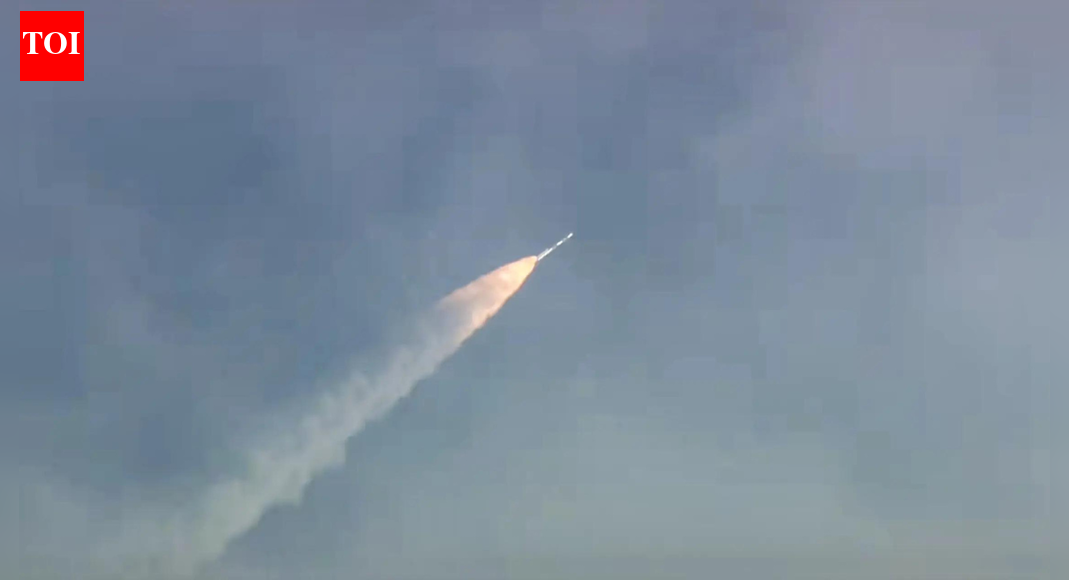
SRIHARIKOTA: The Indian Space Research Organisation (Isro) on Monday said that the PSLV-C62 mission encountered an anomaly during end of the PS3 stage and a detailed analysis has been initiated.“Today we have attempted the PSLV C62 / EOS – N1 Mission. The PSLV vehicle is a four stage vehicle with two solid stages and two liquid stages,” Isro chief V. Narayanan said.“The performance of the vehicle close to the end of third stage was as expected. Close to the end of third stage we are seeing more disturbance in the vehicle. Subsequently, there is a deviation in the vehicle observed in the flight path. We are analysing the data and will come shall come back at the earliest,” he added.Isro launched EOS-N1, along with 14 co-passenger satellites and a capsule into a re-entry trajectory in a marathon mission, marking the space agency’s first mission of 2026.The flight comes months after a rare setback, when PSLV-C61, launched on May 18, 2025, failed to place the EOS-09 earth observation satellite into orbit due to a third-stage anomaly. The 44.4-metre-tall Polar Satellite Launch Vehicle (PSLV-C62) lifted off from the First Launch Pad at the Satish Dhawan Space Centre, Sriharikota, in a commercial mission for NewSpace India Limited (NSIL). The launch marked the 64th flight of PSLV and the fifth mission of the PSLV-DL variant.The mission carried a diverse suite of technology demonstration satellites from India and overseas, covering applications such as AI processing in orbit, store-and-forward communication systems, IoT services, radiation measurement, and agricultural data collection.The primary payload, EOS-N1 (Anvesha), is a hyperspectral earth observation satellite designed for advanced surveillance and strategic monitoring.Among the notable secondary payloads was AayulSAT, developed by Bengaluru-based startup OrbitAID Aerospace, which serves as India’s first on-orbit satellite refuelling demonstrator. The mission aims to test technologies for propellant transfer and satellite servicing in low Earth orbit, a capability seen as critical for extending satellite lifetimes and enabling sustainable space operations.Another key payload, the KID re-entry capsule, a European technology demonstrator developed with a Spanish startup, was expected to be separated from the PSLV’s fourth stage and was designed to splash down in the South Pacific Ocean, validating controlled atmospheric re-entry technologies.The flight also included a mix of CubeSats and small satellites from universities and startups, including missions from Dhruva Space (CGUSAT), and international partners, supporting research and commercial applications in communication, IoT and Earth observation.The 2026 PSLV-C62 mission follows Isro’s detailed review of the PSLV-C61 failure, one of only a handful of setbacks in PSLV’s three-decade operational history. Isro had constituted a failure analysis committee after the May 2025 mission and implemented corrective measures before returning the launcher to flight.

