


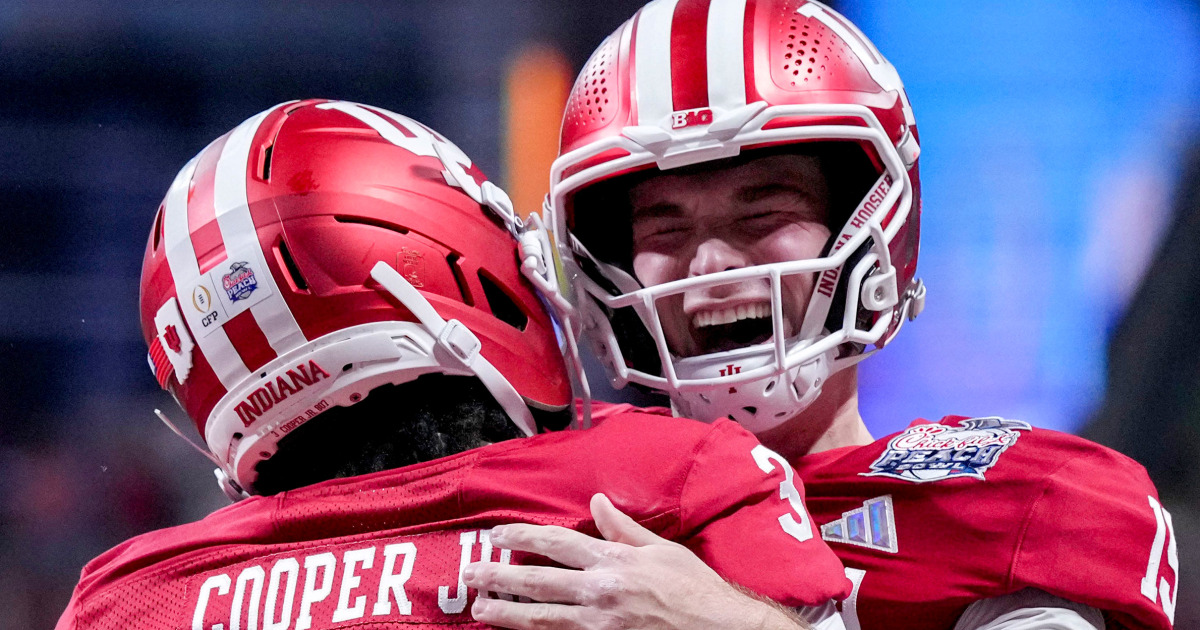
Riding a nearly perfect first half and aided by a torrent of self-inflicted mistakes by Oregon, the Indiana Hoosiers won their College Football Playoff semifinal Friday in a 56-22 rout to continue their stunning rise from doormat to dominance.
Indiana, the Big Ten champion and the playoff’s top seed, will play 10th-seeded Miami for the national championship on Jan. 19 on the Hurricanes’ home field, Hard Rock Stadium in Miami Gardens, Florida.
The Hoosiers (15-0) seized control of their runaway victory at Mercedes-Benz Stadium in Atlanta 11 seconds into the game when defensive back D’Angelo Ponds returned his interception of Oregon’s Dante Moore 25 yards for a touchdown on the first play from scrimmage.
By the first half’s end, Indiana quarterback Fernando Mendoza had thrown more touchdowns (three) than incompletions (one) in a surgical performance juxtaposed against Oregon’s litany of miscues. Moore fumbled in the shadow of his own end zone nine minutes before halftime when the ball slipped out of his hands as he dropped back to pass. Indiana scored just three plays later to lead 21-7.
Seven minutes later, Moore fumbled again when his blocking broke down, and the Hoosiers pounced on the mistake yet again, scoring another touchdown six plays later to extend to their lead to 35-7. That stood as the halftime margin when Oregon (13-2) missed a 56-yard field goal try as time expired on the first half.
In many statistical categories, the Ducks compared well to Indiana, but their turnovers were back-breaking, in that they put them at an immediate and steep deficit.
On its opening possession of the second half, Indiana ran off six minutes before scoring yet again to lead 42-7. When Oregon answered with a score, and Indiana punted, the Ducks quickly moved downfield while attempting to halve their deficit. Yet that sign of life came to an end when Indiana swarmed the Ducks’ fourth-down conversion attempt, giving the ball and the momentum back to the Hoosiers.
Another critical mistake by Oregon all but ended the game with 13 minutes still to play, when Indiana blocked a punt and recovered the ball just seven yards from the end zone. The Hoosiers scored just three plays later to ensure the only doubt concerned the margin of victory, not the outcome.
In a matchup of quarterbacks touted as potential No. 1 picks in April’s NFL draft, Mendoza completed 17 of his 20 passes for 177 yards and five touchdowns. He is only the fourth player to throw for five touchdowns in the 11-year history of the College Football Playoff. Moore threw for 285 yards with two touchdowns, plus his three turnovers.
Indiana converted 11 of its 14 third-down opportunities and never required a fourth-down attempt while averaging 8.9 yards per pass, and 4.8 yards per rush.
Indiana’s win sets the stage for a south Florida homecoming for Mendoza, who will attempt to win a national title in a stadium a 21-mile drive north of where he attended high school — the same high school where Mendoza’s father was once teammates with Miami coach Mario Cristobal. Under Cristobal, the Hurricanes defeated Texas A&M, Ohio State and, on Thursday, Ole Miss, to advance to the national championship for the first time since 2002.
Mendoza will attempt to become the first quarterback to win both the Heisman Trophy and a national title in the same season since LSU’s Joe Burrow in 2019.
Beyond sending the Hoosiers to their first national-title game, the victory kept alive perhaps the most unforeseen turnaround in the history of college football. When Curt Cignetti was hired to coach the school two years ago, the Hoosiers had won only 39 percent of their games in 125 seasons. His predecessor was fired after a record of 33-49.
Cignetti arrived on campus in Bloomington, Ind. at a fortuitous time to be a college football have-not, as seismic changes to college sports, such as increased freedom to transfer schools, and the ability for players to be paid, had leveled the playing field. In many cases, a school’s financial resources became more important to luring talent than its on-field tradition.
Those rules changes, and the exquisite, uber-serious coaching of Cignetti — the son of a longtime college coach who won national championships at Alabama while working for iconic coach Nick Saban before finding success as a head coach at smaller schools — have allowed the Hoosiers to become the ultimate party-crasher.
Cignetti led Indiana to the playoff last season, but proved it was no fluke this year as the Hoosiers topped established longtime power Ohio State to win their first Big Ten championship since 1967. In its playoff opener at the Rose Bowl on Jan. 1, Indiana then crushed another powerhouse, Alabama.
After Indiana’s latest rout Friday in Atlanta, the college football season is down to just two teams.

