


Last Updated:
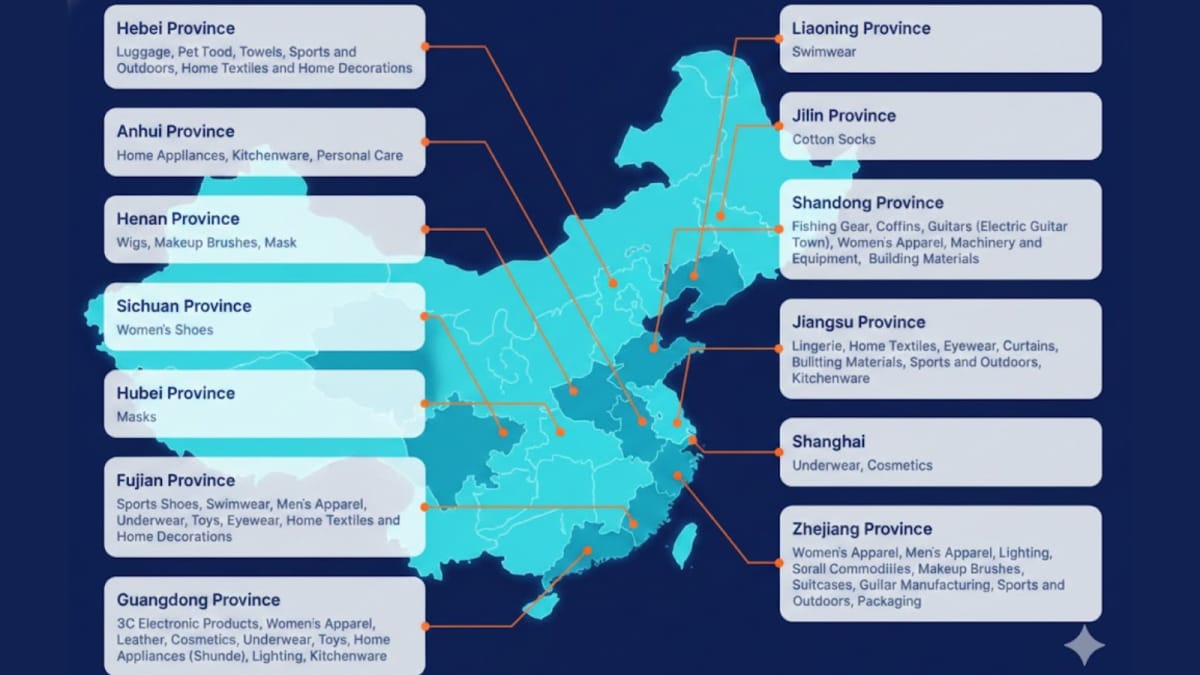
From coffins in Shandong to electronics in Shenzhen, each province in China has a distinct production focus with even highly specialised industries following the same pattern



In China, industries were encouraged, formally and informally, to cluster. (Image: SourceReady)
China is often described as the world’s factory, an explanation that points to reasons like low-cost labour, efficient supply chains and flexible regulations. Apart from these factors one of the most striking features of Chinese production is it’s industrial divide.
Why does a lighter almost always come from Wenzhou? Why do Christmas decorations trace back to Yiwu? Why are guitars linked to one town, wigs to another, socks to an entirely different province? For many foreign buyers, this pattern only becomes visible after costly mistakes.
Why China Manufactures Different Products In Different City?
In most Western economies, factories are distributed across regions based on land prices, tax incentives or historical accident. Supply chains stretch across states or countries. Components are shipped in, assembled, then shipped out again. The system works, but it is fragmented.
In China, industries were encouraged, formally and informally, to cluster. Once a cluster formed, it tended to harden rather than disperse. Suppliers moved closer to their biggest customers. Workers trained for one specific product. Machinery was customised for narrow production needs. Logistics routes shortened. Repair shops, mould makers, testing labs and packaging firms followed.
For example, Cixi, a district in Ningbo, Zhejiang province, is virtually unknown to most consumers outside China. Yet it is one of the world’s most important production centres for hairdryers and similar appliances.
Within a few kilometres, there are motor manufacturers, injection-moulding plants, heater element suppliers, plastic shell producers, button makers, packaging companies and dozens of final assembly lines. Workers are trained specifically for appliance assembly. Machines are calibrated for one product type. Even equipment repair shops specialise in appliance machinery.
This pattern repeats across China, industry after industry. Here is how China has divided it’s industries across the country.
Electronics
Consumer electronics are synonymous with Shenzhen. The city sits at the centre of China’s 3C electronics industry, supported by neighbouring Dongguan and Guangzhou. Huaqiangbei, Shenzhen’s vast electronics market, functions as a real-time supply chain where components, prototypes and finished products circulate at extraordinary speed.
For electronics sellers, this region offers unmatched convenience. Component sourcing, rapid prototyping, tooling, assembly and shipping can all be handled within a compact geographic area. The density of expertise is such that entire product categories can be developed and scaled in months rather than years.
Home Appliances
Hefei, in Anhui province, has become China’s home appliance capital. It leads the country in output of air conditioners, televisions, washing machines and refrigerators. Years of targeted investment have produced a deeply skilled workforce and a comprehensive supplier base.
For smaller appliances, Shunde in Guangdong stands out. Often described as the world’s largest small home appliance production base, Shunde hosts more than 3,000 manufacturers and supporting enterprises. Together, they account for roughly 15% of China’s entire home appliance industry.
Lighting
More than 80 per cent of China’s lighting products come from Zhongshan, Guangdong province. From basic fixtures to advanced LED systems, Zhongshan’s dominance is so complete that it is commonly referred to as China’s lighting production base.
Ningbo, known as the hometown of lamps, and the eastern Pearl River Delta belt including Dongguan, Huizhou and Shenzhen, add depth to the industry, particularly at the branded and high-end end of the market.
Apparel
China’s apparel industry is highly segmented. Women’s clothing clusters around Guangzhou, Hangzhou, Humen and Shenzhen. Men’s apparel is concentrated in Ningbo and Quanzhou. Shirts come largely from Puning and Yiwu.
Each region specialises not only by garment type, but by fabric, cut, production speed and target market. Over time, these distinctions become embedded in local training systems and supplier relationships.
Socks, Shoes and Industrial Scale
Zhuji in Zhejiang is China’s largest sock production base, while Liaoyuan in Jilin focuses on cotton socks. Foshan has built a reputation for higher-quality sock production.
Sports shoes belong to Jinjiang in Fujian province, one of the world’s largest footwear production centres. With more than 3,000 enterprises and annual output exceeding 700 million pairs, Jinjiang supplies over 80 countries and accounts for a significant share of global sports shoe production.
Women’s shoes centre on Chengdu, particularly Wuhou district, while Huizhou, Dongguan, Wenzhou and Chongqing provide additional capacity.
Leather, Luggage and Travel Goods
Leather production points decisively to Shiling, in Guangzhou’s Huadu district. Known as China’s leather capital, it hosts the most complete leather industry chain in the country, from raw material processing to finished goods and research.
For luggage, Baigou in Hebei province dominates the mass market, trading lower-priced products at enormous volume. Pinghu in Zhejiang specialises in suitcases and has been officially designated China’s suitcase capital.
Children’s Clothing, Underwear and Swimwear
Children’s clothing clusters in Huzhou, Zhejiang, which accounts for around 30 per cent of national production and supplies most of China’s online children’s wear market. Guangdong’s Guangzhou-Foshan-Dongguan belt focuses on denim, while Qingdao is known for high-quality baby garments influenced by Japanese and Korean standards.
Underwear production is spread across several specialised cities. Shantou hosts the most comprehensive industry. Zhongshan produces at massive scale. Shenzhen focuses on premium brand processing. Yiwu leads in seamless underwear. Shanghai anchors domestic brand development.
Swimwear production centres on Huludao in Liaoning, which controls a significant share of both the Chinese and global markets.
Textiles
Home textiles come from Nantong. Curtains from Shaoxing. Home decorations from Yiwu. Carpets from Tianjin. Towels from Gaoyang, which produces a third of China’s total output.
Eyewear
Eyewear leads to Danyang, the world’s largest lens production base. Wigs point to Xuchang in Henan. Toys cluster in Shantou, Jinjiang and Shanghai. Makeup brushes come from Luoyang county. Cosmetics are dominated by Guangzhou and a growing network of purpose-built beauty towns.
Yiwu deserves special mention. As the world’s largest small commodities distribution centre, it covers nearly every low-cost consumer product imaginable, functioning less like a city and more like a global trading platform.
January 07, 2026, 16:56 IST

Stay Ahead, Read Faster
Scan the QR code to download the News18 app and enjoy a seamless news experience anytime, anywhere.