


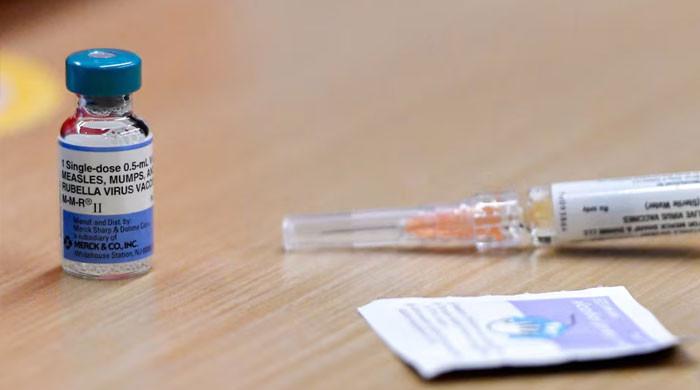
- Parents advised to decide with doctors under shared decision-making.
- Experts warn rollback could lead to preventable hospitalisation, deaths.
- Vaccine experts decry changes, say it puts American children at risk.
WASHINGTON: The United States ended on Monday its longstanding guidance that all children receive vaccines against flu and three other diseases, a sweeping change that advances one of Health Secretary Robert F Kennedy Jr’s long-term goals.
Public health experts warn the latest rollback could lead to preventable hospitalisations and deaths.
The action, which removes the recommendation for rotavirus, influenza, meningococcal disease, and hepatitis A, and states that parents should consult healthcare providers under what it calls shared clinical-decision-making, was approved by Centers for Disease Control and Prevention Acting Director Jim O’Neill without the agency’s usual outside expert review. It advances Kennedy’s campaign to pare back childhood vaccinations.
Last month, President Donald Trump urged the US to “align with other developed nations” by reducing the number of shots for children.
Trump said the new schedule was “rooted in the Gold Standard of Science” and aligns the United States with other developed nations. In a post on his Truth Social platform, the president congratulated Kennedy and other health officials on the change.
“Many Americans, especially the “MAHA Moms,” have been praying for these COMMON SENSE reforms for many years. Thank you for your attention to this matter!” he wrote, referring to Kennedy’s Make America Healthy Again movement.
Kennedy, a prominent vaccine critic, has previously led efforts to drop universal recommendations for Covid-19 and hepatitis B shots for children, citing links to autism that scientists have repeatedly debunked.
American children at risk
Vaccine experts decried the changes they said put American children at risk.
Dr Michael Osterholm, director of the University of Minnesota’s Center for Infectious Disease Research and Policy, said there should have been public discussion on the risks and benefits of the potential impact of dropping the recommendations.
Dr Sean O’Leary, chair of the American Academy of Pediatrics, said other developed countries face different disease risks and have different healthcare systems than the United States. Unlike the US, which depends on private healthcare, most countries provide basic universal healthcare that is paid for by the government.
“Any decision about the US childhood vaccination schedule should be grounded in evidence, transparency, and established scientific processes, not comparisons that overlook critical differences between countries or health systems,” he said.
Immunisation policy of 20 nations considered
For the change in policy, two leading officials of the Department of Health and Human Services, Martin Kulldorff and Tracy Beth Hoeg, reviewed vaccine protocols in 20 other developed countries — all of which have universal healthcare — and made the recommendations to change the US schedule, the agency said.
In a report, HHS wrote that the level of risk varies by disease and child.
The vaccine schedules of the 20 reviewed countries show that the flu shot is recommended universally in four countries, and a shot against hepatitis A is recommended only in Greece. The rotavirus shot is recommended for all children in 17 of the 20 countries, and shots against meningococcal disease are recommended in 16.
Each of the four vaccines prevents diseases that once caused unnecessary hospitalisations and death in children, said Dr Jesse Goodman, a Georgetown University professor and former FDA chief scientist.
Flu shots can help prevent pediatric deaths from flu, which killed 288 children in the 2024-25 season, according to the CDC. Hepatitis A, which infects the liver, usually resolves on its own but can lead to hospitalisation and lifelong liver damage.
Rotavirus, which causes severe diarrhea and dehydration, used to send tens of thousands of children to the hospital each year, but vaccines have made this extremely rare, Goodman said.
While meningitis, a bacterial infection of the brain, is rare in children, some 15% of those infected do not respond to antibiotics and die, he said. “If you can safely prevent it, it makes total sense.”
The updated recommendations maintain immunisations for 11 diseases, including measles, mumps, and varicella, while categorising others as either targeted for high-risk groups or subject to the shared-decision-making category, HHS said.
Insurance providers will continue covering immunisation costs regardless of the category, senior HHS officials told reporters on a call.
The new schedule also recommends US children receive a single dose of human papillomavirus (HPV) vaccine, rather than a two-dose course. Recent studies have concluded that a single dose is not inferior to the longer course and noted that the World Health Organisation also backs a single-dose schedule.
Merck, which makes Gardasil, the only US-approved HPV vaccine, was not immediately available for comment. The drugmaker has said that since there is not sufficient data for the US FDA to license the shot as a single-dose regimen, the CDC’s recommendations should be in line with the agency’s approval.
Merck recorded $2.4 billion in US Gardasil sales in 2024.

