


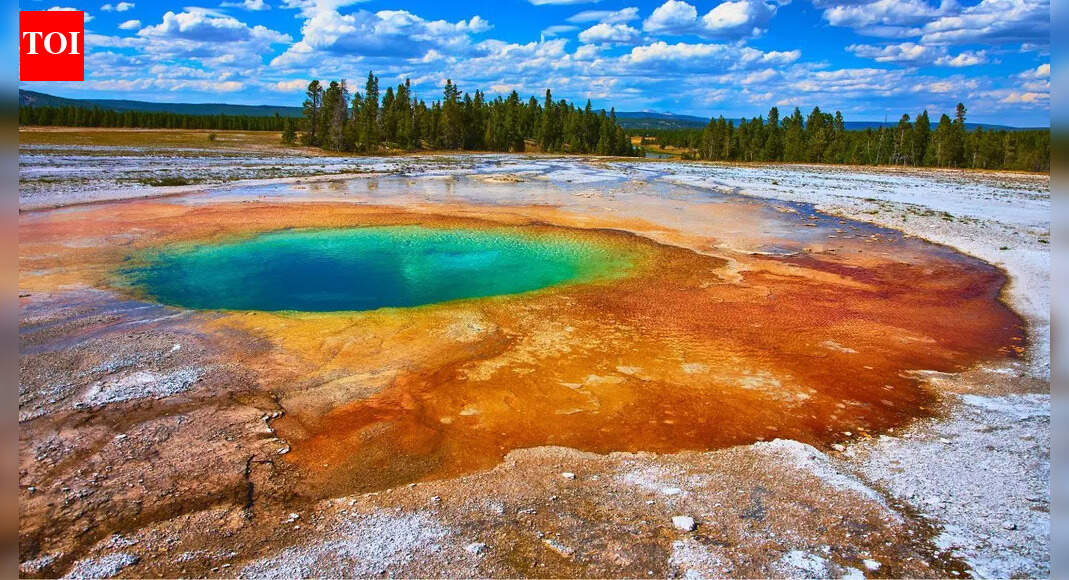
Yellowstone National Park sits above one of the most extensively studied volcanic systems on Earth. Beneath its forests, geyser basins and river valleys lies a vast accumulation of partially molten rock, heat and fluids that has shaped the region for more than two million years. Scientific attention has intensified as analytical techniques have improved, allowing past eruptive events to be dated with increasing precision and linked to broader changes in Earth systems. These findings matter beyond volcanology. They intersect with geomagnetic history, landscape evolution and long-term assessments of how large volcanic provinces behave through time. The unsettling quality of Yellowstone lies not in speculation about imminent catastrophe, but in the scale and persistence of processes continuing far below the surface.
How repeated eruptions shaped Yellowstone
The Yellowstone Volcanic Field is defined by a sequence of caldera-forming eruptions interspersed with smaller lava flows. The largest events expelled vast volumes of rhyolitic magma, collapsing the ground above and producing calderas tens of kilometres across. Three such eruptions are firmly established in the geological record, occurring at approximately 2.08 million, 1.30 million and 0.63 million years ago. Between these major events, the system produced numerous smaller eruptions that left domes and flows scattered across the region.Recent work has refined the duration of the earliest of these cycles. High precision dating of lava flows that preceded and followed the first caldera-forming eruption shows that the entire cycle unfolded over roughly 200,000 years rather than the much longer span previously assumed. The implication is that Yellowstone’s largest magma reservoirs assembled, erupted and were partially recharged on geologically brief timescales. The volcanic field did not remain steadily active. Instead, it alternated between eruptive pulses and quieter intervals measured in tens of thousands of years, leaving a fragmented but coherent stratigraphic record across Wyoming, Idaho and Montana.
How Yellowstone stores and renews magma
Geophysical imaging and geochemical studies indicate that Yellowstone’s magma is not stored in a single, fully molten chamber. Instead, it resides in zones of crystal-rich mush, with pockets of melt distributed at different depths. The upper portions of this system lie within the crust, while deeper sources extend into the upper mantle. Heat from below maintains these regions in a partially molten state, allowing magma to be mobilised when conditions permit.The timing of small-volume eruptions after caldera formation offers constraints on how long magma can reside beneath the surface before eruption. Dating of rhyolitic flows associated with the first volcanic cycle suggests that post-caldera magma reached the surface within about 100,000 years of the main eruption, with subsequent eruptions following after shorter intervals. These observations point to recharge and storage times of less than 40,000 years for some magma batches. Such durations are short in geological terms and indicate a system capable of reorganising rapidly after major disruption. The persistence of heat and melt beneath Yellowstone today reflects this long-lived capacity for renewal rather than a steady accumulation towards a single outcome.
How Yellowstone records Earth’s magnetic past
As lava cools, magnetic minerals align with Earth’s current field direction and then become locked in. This allows researchers to use the age of the lava flow along with palaeomagnetic measurements to pinpoint when changes were taking place from one type to another geomagnetic polarity. A study published in the journal Earth and Planetary Science Letters shows how flows from the first volcanic period at Yellowstone contain both normal (positive) and reversed (negative) magnetic polarities during an unstable time in the Matuyama time frame. These records were important for determining the timing of the onset of the Olduvai subchron and serve as a terrestrial marker for determining marine sediment records of magnetic excursions. But the importance of these records goes far beyond the geophysics field. The geomagnetic timescale is used to date sediments and fossils across the world, including sites important to understanding early human evolution. In this way, the volcanic history beneath Yellowstone connects directly to global chronological frameworks.
What Yellowstone’s past says about its future
Public discussion of Yellowstone often centres on the idea of a future super eruption. Scientifically, the more informative perspective comes from examining how the system has behaved over repeated cycles. The record shows variability rather than regularity. Later volcanic cycles appear to have lasted longer than the first, with activity extending over several hundred thousand years and including prolonged intervals of quiescence. The most recent caldera-forming eruption occurred more than 600,000 years ago, followed by rhyolitic eruptions that continued until about 75,000 years ago.Measurements of ground deformation, seismicity and gas emissions indicate that magma and fluids are still moving beneath the park. These observations confirm that Yellowstone is an active volcanic system, but they do not point to a singular trajectory. The unsettling aspect lies in recognising that enormous geological processes operate continuously beneath a landscape associated with stability and natural beauty. What science reveals is not an imminent threat, but a dynamic system whose past behaviour is preserved in rock, magnetism and time, offering a detailed but humbling view of Earth’s internal workings.Also Read | Think bats are blind? Science shows they can see more than humans

