


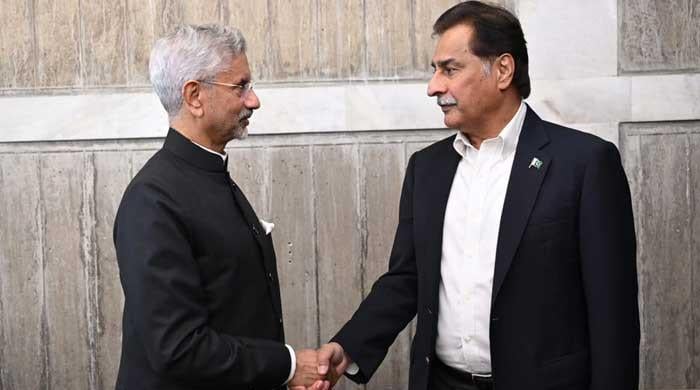
KARACHI: The recent, unexpected handshake between senior officials of the two archrivals has reopened debate over whether Pakistan–India ties could see even a limited thaw, after relations plunged to one of their lowest points following a four-day military confrontation in May last year.
On December 31, 2025, India’s External Affairs Minister S Jaishankar approached National Assembly Speaker Sardar Ayaz Sadiq in a public waiting room in Dhaka and shook hands with him ahead of the last rites of former Bangladeshi prime minister Khaleda Zia.
“During this interaction, Dr S Jaishankar introduced himself to the speaker [Sadiq] and told him that he had recognised him,” according to a statement issued by the National Assembly Secretariat.
Though customary, the interaction marked the first notable high-level contact from the Indian side since the May 2025 conflict, which India initiated after blaming Pakistan for the April 2025 attack that killed 26 tourists in Pahalgam, in Indian Illegally Occupied Jammu and Kashmir (IIOJK).
Delhi accused Islamabad of orchestrating the deadly IIOJK strike without offering any evidence, while Pakistan denied and demanded a neutral probe into the incident.
The attack triggered intense military clashes between the nuclear-armed neighbours, with Pakistan downing seven Indian aircraft, including French-made Rafales.
The 87-hour conflict between the two nuclear-armed nations ended on May 10, 2025, with a ceasefire agreement brokered by the US.
‘Impromptu, not planned’
Speaking to Geo.tv, former ambassador Maleeha Lodhi said the handshake held little significance, describing it as “impromptu, not planned or choreographed”.
“It is certainly not an ice breaker in the frozen India-Pakistan relationship. India has shown no interest in resuming dialogue with Pakistan and continues to direct hostile rhetoric at Islamabad,” she added.
Pakistan Peoples Party (PPP) Senator and ex-ambassador Sherry Rehman concurred with Lodhi, saying: “I doubt if it was a planned gesture, too much is being read into it.”
Speaking to Geo.tv, she referred to her post on X in which she welcomed the handshake between Sadiq and Jaishankar, saying it was always good to see the restoration of basic diplomatic courtesies, as seen at the funeral of Bangladeshi leader.
“The true test of statesmanship will be extending a hand to Pakistan to resume the minimum diplomatic protocols and agreements New Delhi suspended after May 10, 2025,” the senator said.
In the aftermath of the Pahalgam attack, India took several escalatory steps, including placing the 65-year-old Indus Waters Treaty (IWT) with Pakistan in abeyance.
The pact, mediated by the World Bank in 1960, regulates the division of water from the Indus River and its tributaries between the South Asian nations.
Since then, India has been taking measures, dubbed by Islamabad as “water terrorism”, to manipulate the flow of rivers into Pakistan.
“As a rational regional actor, I think Pakistan may reciprocate to any gesture of normalisation just as it will to an act of war. After all, New Delhi should have learnt by now that you cannot change your geography, nor can you change Pakistan’s borders,” Rehman noted.
‘Diplomatic no-no’
Michael Kugelman, Senior Fellow, South Asia at Washington-based Atlantic Council, told Geo.tv that the handshake between the senior officials of two archrivals was a simple case of protocol.
“The two men were at a funeral, and in such a solemn environment, it makes sense to share a brief handshake, instead of snubbing each other,” he noted, saying he doesn’t see it as an Indian effort to mend ties with Pakistan.
“New Delhi has taken a strong and consistent position that it’s not open to dialogue with Pakistan unless the focus is on Azad Jammu and Kashmir (AJK) —a no-go option for Islamabad,” Kugleman said.
“Additionally, India’s message post-Operation Sindoor has emphasised that hostilities have not necessarily ended, suggesting a level of tension that would preclude any Indian outreach to Pakistan,” the expert added.
Furthermore, he said if New Delhi truly wanted to signal a desire to improve ties, it would likely do so through back channels instead of via a handshake between two leaders of a different rank.
“To me, it comes across as a one-off spontaneous gesture with no policy intentions.”
Explaining the rationale behind Jaishankar’s move, Kugelman said refusing to share Sadiq’s hand might have caused a controversy for New Delhi “as it would have come across as a diplomatic no-no for India to drag its tensions with Pakistan into a state funeral in a third country”.
“Put simply, it would have looked bad in such circumstances. This wasn’t a regional summit or anything policy related; it was a state funeral,” he added.
‘Positive gesture’
However, former senator Mushahid Hussain Sayed termed the handshake a positive gesture from India: “Since Dr Jaishankar even had a faint smile on his face”.
Decoding Jaishankar’s move to visit Bangladesh, Sayed said it was a two-in-one message. “For Pakistan: that previous policy of no handshake was petty, hence, a mistake, so they reverted to diplomatic decency.”
“For Bangladesh, India is no longer committed solely to the Awami League, so positive gestures for both Pakistan and Bangladesh.”
According to Sayed, while a handshake does not signal India’s intent to mend ties, 2026 could be the beginning of Pakistan-India normalisation.
He also described the gesture as planned, “as the physical gesture was reinforced by positive body language, so it means it was planned!”
The Islamabad-Delhi conflict even spilt over into sports as Indian men’s, women’s and Under-19 cricket teams refused a handshake with archrivals.
“Finally, the Indians realised their mistake, and they are making amends now,” said Sayed when asked what caused the change of heart in the Indian approach.
“In 1954, at Geneva, John Foster Dulles, US secretary of state, refused to shake hands with Premier Zhou Enlai of China, and it took 17 years for the USA to reverse this wrong,” he added.

