


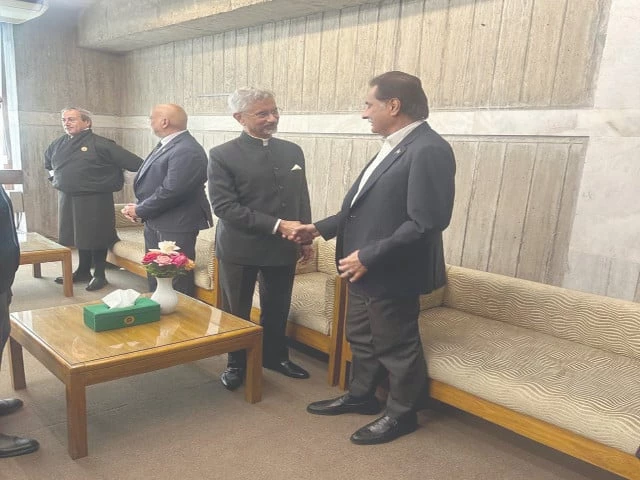
Jaishankar and Ayaz Sadiq hold brief conversation; Analysts caution against reading too much into episode
National Assembly Speaker Sardar Ayaz Sadiq and Indian External Affairs Minister S Jaishankar shake hands at the Bangladesh Parliament in Dhaka. Photo: ONLINE
ISLAMABAD:
National Assembly Speaker Ayaz Sadiq and Indian External Affairs Minister S Jaishankar briefly exchanged greetings in Dhaka on Wednesday, marking the first high-level face-to-face interaction between officials of the two neighbours since their four-day military confrontation in May last year.
The interaction took place on the sidelines of the funeral of former Bangladeshi prime minister and Bangladesh Nationalist Party (BNP) chairperson Khaleda Zia, who passed away on Tuesday after a prolonged illness.
Both Sadiq and Jaishankar were in Dhaka to represent their respective countries at the funeral rites. While the meeting itself was brief and informal, the image of the two leaders shaking hands immediately drew attention given the prevailing freeze in India-Pakistan relations.
The photograph was shared by the official X account of Bangladesh’s Chief Executive Dr Muhammad Yunus, head of the Bangladesh’s interim government.
“Sardar Ayaz Sadiq, Speaker of the National Assembly of Pakistan, exchanges greetings with Indian External Affairs Minister S Jaishankar in Dhaka on Wednesday ahead of the funeral programme of the former Bangladesh Prime Minister Khaleda Zia,” read the post from Yunus’s office.
The Indian government did not issue any statement on the interaction. However, Pakistan’s National Assembly Secretariat later confirmed the exchange in an official statement, providing further details.
According to the statement, Speaker Ayaz Sadiq visited the Bangladesh Parliament before the funeral to record his remarks in the condolence book, where foreign ministers and representatives of high-level delegations from several countries were present.
“On this occasion, the Indian Foreign Minister Dr S Jaishankar personally walked over to the Speaker of the National Assembly and introduced himself during a handshake,” the statement said. It added that Jaishankar remarked during the brief exchange that he was “familiar with Speaker Ayaz Sadiq’s personality.”
While diplomatic handshakes are routine at multilateral events, the symbolism of this particular interaction has generated interest because of the sharply adversarial state of India-Pakistan relations over the past year and the hard-line posture adopted by New Delhi under the Bharatiya Janata Party (BJP) government.
Following the April 2025 Pahalgam attack in the Indian Illegally Occupied Jammu and Kashmir (IIOJK) and the subsequent four-day military conflict with Pakistan in May, India announced a policy of “no public engagement” with Pakistan in any form. That approach was not limited to diplomatic channels but extended to sports and cultural interactions as well.
Soon after the conflict, when the Indian and Pakistani cricket teams faced each other during the Asia Cup in the UAE, Indian players, reportedly acting on government instructions, avoided the customary post-match handshake. The Indian women’s team and junior teams later followed the same template, reinforcing New Delhi’s policy of symbolic disengagement.
Against this backdrop, the Ayaz-Jaishankar handshake has triggered debate over whether India may be reconsidering aspects of its public disengagement strategy, or whether the interaction should be viewed strictly as a matter of diplomatic courtesy at a solemn international event.
Analysts caution against reading too much into the episode. They note that informal interactions at funerals and multilateral gatherings do not necessarily indicate a policy shift. However, they also acknowledge that symbolism matters in diplomacy, particularly when relations are otherwise frozen.
The year 2025 had been challenging for Indian foreign policy, with critics arguing that New Delhi’s assertive posture has contributed to growing regional and international unease. India’s decision to launch missile strikes following the Pahalgam attack, citing alleged Pakistani involvement, quickly escalated into a brief but intense military exchange.
Pakistan’s calibrated but forceful response surprised not only India but also several international observers, prompting urgent diplomatic intervention by major powers to prevent further escalation. While the conflict lasted only four days, its political and diplomatic fallout has been significant.
For India, the confrontation exposed limitations in its crisis management and drew criticism over the risks of escalation between two nuclear-armed states. For Pakistan, the episode proved to be a turning point. Prior to the Pahalgam attack, Islamabad was grappling with diplomatic challenges and economic pressure. However, the post-conflict period saw a noticeable shift in Pakistan’s geostrategic standing.
Pakistan’s handling of the crisis earned acknowledgement from key international actors, including US President Donald Trump, who publicly referred to Pakistan’s response as restrained yet effective. At the same time, Pakistan’s traditional partnerships in the Arab world witnessed renewed momentum.
Within this broader context, the brief handshake in Dhaka, though lacking any substantive diplomatic engagement, has acquired outsized significance. Social media platforms in both Pakistan and India were quick to amplify the image, with reactions ranging from cautious optimism to outright scepticism.
For now, officials on both sides appear keen to downplay the encounter. Yet, in a region where even small gestures are closely scrutinised, the image of a handshake between senior Pakistani and Indian leaders has once again underscored how symbolism can resonate far beyond the moment itself.

