


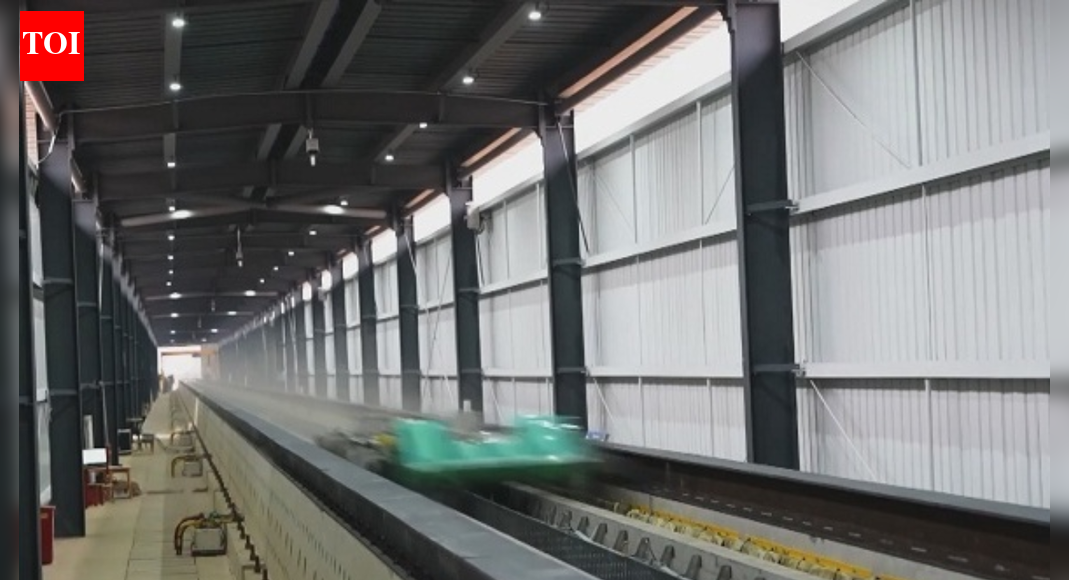
Chinese scientists have achieved a milestone in magnetic levitation technology. Researchers at China’s National University of Defence Technology successfully propelled a one-tonne vehicle to 700 kilometers per hour in just two seconds on a 400-meter test track, setting a new world record for superconducting electric maglev systems.The test, shown in footage making rounds on social media and Chinese news outlets, displayed a chassis-like vehicle zooming across the track leaving a misty trail. This demonstrates significant progress in both extreme acceleration capabilities and high-power control systems.“It resolves core technical challenges including ultra-high-speed electromagnetic propulsion, electric suspension guidance, transient high-power energy storage inversion, and high-field superconducting magnets,” CCTV stated, as reported by South China Morning Post (SCMP).
. This breakthrough could revolutionise various transportation methods, from hyperloop systems to aerospace launches.The same team had previously reached 648 km/h on the same track in January. Their decade-long research puts China at the forefront of global maglev technology, marking significant progress since developing their first manned maglev train thirty years ago.Professor Li Jie, who led Beijing’s first commercial maglev subway line, believes this success will speed up China’s ultra-high-speed maglev transport development.In 2020, CRRC Qingdao Sifang had tested a 600km/h prototype. In the meantime, Southwest Jiaotong University developed a high-temperature superconducting maglev system in Chengdu targeting speeds over 600km/h.The latest development includes a collaboration between the Third Research Academy of China Aerospace Science and Industry Corporation and North University of China. The built a 2-kilometer experimental line in Datong for testing maglev trains in low-vacuum pipelines, with an aim for eventual speeds of 1,000 km/h.This technology has the potential to transform city-to-city travel through vacuum-sealed tubes and potentially revolutionise rocket launches by reducing fuel consumption during takeoff. It also offers new possibilities for testing high-speed flight equipment through ground-based simulations.

