


New guidelines build on June rules easing STAR market listings for pre-profit innovative firms.
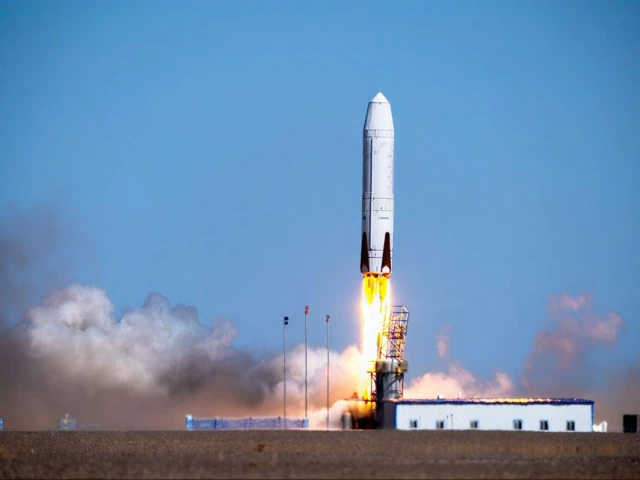
This photo shows the reusable rocket Nebula-1, developed by Chinese private rocket company Deep Blue Aerospace, blasting off during a high-altitude vertical recovery flight test in north China’s Inner Mongolia Autonomous Region, Sept. 22, 2024.PHOTO: XINHUA
Chinese companies developing reusable commercial rockets will have access to a fast lane for initial public offerings on the tech-heavy STAR market that exempts them from some financial requirements, the Shanghai Stock Exchange said on Friday.
Beijing is seeking to address a gap in its space capabilities compared to the United States, which is currently dominant in the ability to return, recover and reuse a rocket’s first stage, or booster, after it is launched.
The new guidelines build upon previous regulations published in June that made it easier for pre-profit innovative companies to get listed on the STAR market.
The fast lane exempts Chinese rocket firms from profitability and minimum revenue thresholds and instead requires them to have met key technological milestones, including one successful orbital launch using reusable rocket technology.
China aims to cut US SpaceX monopoly
US billionaire Elon Musk’s aerospace company SpaceX currently holds a near monopoly on this technology, and its signature Falcon 9 is the only reusable rocket model that is regularly launched and used to put satellites into orbit.
Read More: China says 700 generative AI models filed as tech breakthroughs accelerate
Earlier this month, China’s leading private rocket firm LandSpace became the first domestic entity to carry out a full reusable rocket test with the launch of its new Zhuque-3 model, signalling its ambition to catch up to SpaceX.
While the launch failed to complete the crucial step of recovering the rocket’s booster, a flurry of Chinese state-owned and private players are now rushing to test-launch their own reusable rockets.
LandSpace has said it wants to demonstrate a successful rocket recovery in mid-2026, when Zhuque-3 will be launched for a second time. It has said the capital-intensive nature of rocket development means it will need access to China’s capital markets if it hopes to compete with SpaceX.
The Shanghai exchange’s rules do not state that rocket firms must successfully recover a rocket, only that reusable rocket technology be used to put a satellite into orbit, something LandSpace already achieved with this month’s launch.

